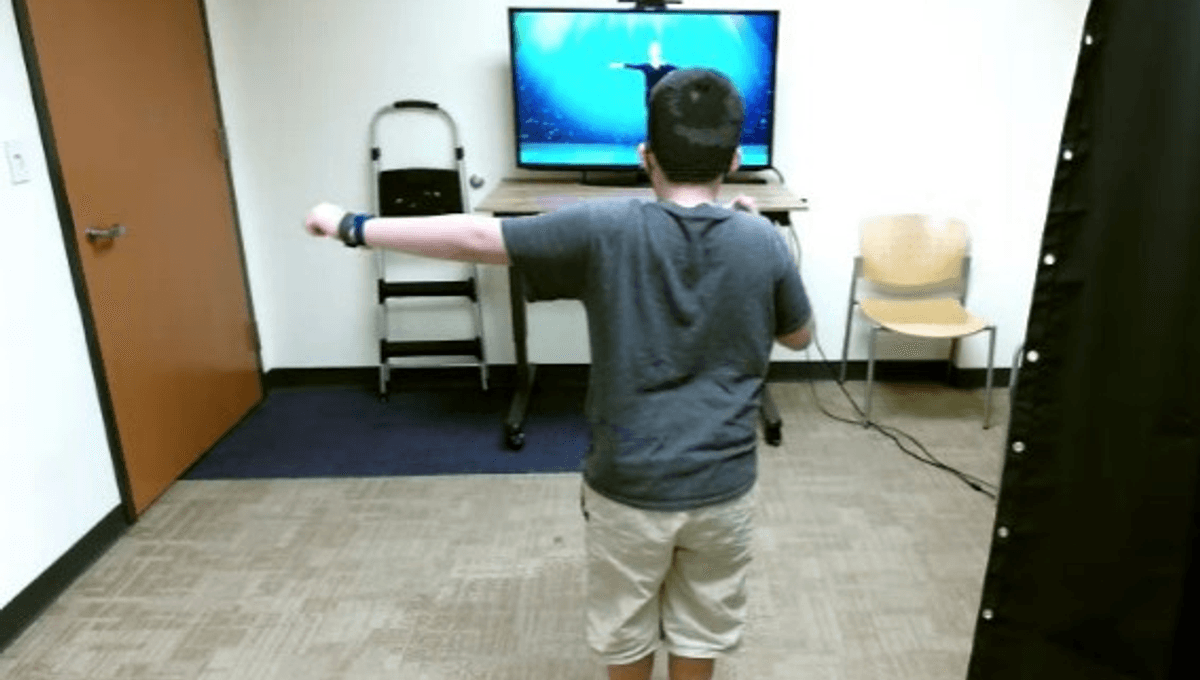
A team of scientists believe they’ve hit on a new quick and easy tool that could help diagnose children with autism. Using a 1-minute video game, their study found it was possible to correctly distinguish autistic 7-13-year-olds from neurotypical children with an 80 percent success rate.
ADVERTISEMENT GO AD FREE
“In my opinion, our current ways of diagnosing autism and ADHD are no longer fit for purpose,” senior author Dr Bahar Tunçgenç, from Nottingham Trent University, told IFLScience. “We have too many lengthy tests that rely either on self-report or on observations about your fit to the society, which are inherently subjective.”
“Our health systems desperately need objective, fast and cost-effective methods that have a solid evidence base behind them.”
Tunçgenç and the team, which also includes scientists from the Kennedy Krieger Institute in Maryland, Johns Hopkins University, and the University of Pennsylvania, hope that their new approach could help to bridge this gap. As well as correctly identifying autistic children from their nonautistic peers, they were also able to differentiate autism from ADHD with 70 percent accuracy. This is important as there can be a lot of crossover between these two diagnoses.
“Autism and ADHD co-occur at about 50-70 percent rate,” Tunçgenç explained. “Because both conditions are diagnosed mainly on the basis of behavioural observations, diagnosis not only takes a long time, but it is also prone to errors. And this is problematic because although autism and ADHD have similarities, the treatment routes can be very varied.”
It isn’t often that you do a study with children, and they want to ‘have another go’.
Dr Bahar Tunçgenç
The study involved 183 children who were asked to copy dance moves performed by a video game avatar. Think TikTok dances, and you’ll be in the right ballpark. They only had to mimic the movements for 1 minute, and their performance was recorded by cameras in front of and behind them. A previously developed algorithm called CAMI (Computerized Assessment of Motor Imitation) then assigned a score between 0 and 1, with 1 being a perfect imitation of the video avatar. Each child repeated the assessment twice, and some other standardized diagnostic tests were also employed.
ADVERTISEMENT GO AD FREE
The idea of using motor imitation in diagnostics is what sets this study apart, according to the researchers.
“Autism has been typically marked by either social-communicative difficulties, like difficulty with keeping eye contact or understanding social norms, or restricted and repetitive behaviours, like rocking or an intense interest in one topic,” Tunçgenç told IFLScience. “But research is increasingly showing that autistic people have sensory and motor difficulties, with some estimates pointing to 88 percent of autistic people experiencing a movement-related difficulty.”
But another of the big advantages to this approach is that the test is actually enjoyable. If you have any Gen Alpha kids in your life, you’ll know the magnetic power of an online dance trend.
ADVERTISEMENT GO AD FREE
“I personally was most excited about how much fun the children were having with the CAMI task. It isn’t often that you do a study with children, and they want to ‘have another go’,” said Tunçgenç. “It is really rewarding to see that we could develop something that is not only highly accurate and useful, but also puts a smile on the children’s faces!”
Whilst we need solutions to the overwhelming demand for autism assessments, you can’t cut corners when it comes to diagnosing autism.
Anoushka Pattenden
The team are enthusiastic about the future of CAMI and plan to conduct further studies in more diverse groups of people. However, this is a complex clinical landscape. IFLScience also spoke to UK-based charity the National Autistic Society, who raised some concerns about the approach used in the study.
“Whilst we need solutions to the overwhelming demand for autism assessments, you can’t cut corners when it comes to diagnosing autism,” said Anoushka Pattenden, Research Partnerships and Participation Manager. “An assessment should be a thorough process carried out by qualified professionals, carefully considering a person’s strengths, challenges and needs.”
ADVERTISEMENT GO AD FREE
“It’s concerning that this research suggests autistic children should imitate others as part of their development. We know that masking can, in fact, have a devastating impact on mental health, sense of self and access to diagnosis.”
Masking is a term that refers to neurodivergent people suppressing their natural behaviors such that they appear neurotypical; this can be either conscious or unconscious.
“We don’t believe this study carries enough weight to have any clinical implications,” Pattenden added.
While the study authors are planning more research, Tunçgenç told IFLScience they are already “looking forward to beginning conversations with clinics who see the utility of this approach in their practice.” The researchers also highlight that CAMI could be adapted to work for autistic people with a range of different access needs – it doesn’t require verbal communication, for example.
ADVERTISEMENT GO AD FREE
Tunçgenç explained, “Autism is a notoriously heterogeneous condition. This means that any two autistic people may have very different strengths and difficulty profiles from each other” – which is perhaps also a sign that we need a variety of different diagnostic tools in our arsenal.
One thing Tunçgenç was clear on is the importance of giving people the opportunity to receive an accurate diagnosis, and the impact this can have on a child’s life trajectory:
“Which diagnosis a child gets matters hugely, because if you’re a neurodiverse person, that diagnostic label is essentially your ticket to accessing provisions that will help you navigate life, be that in school, university, legal systems or workplaces.”
The study is published in The British Journal of Psychiatry.

Source Link: 1-Minute Dance Game Correctly Identified Autism 80 Percent Of The Time In Study Of 183 Kids
