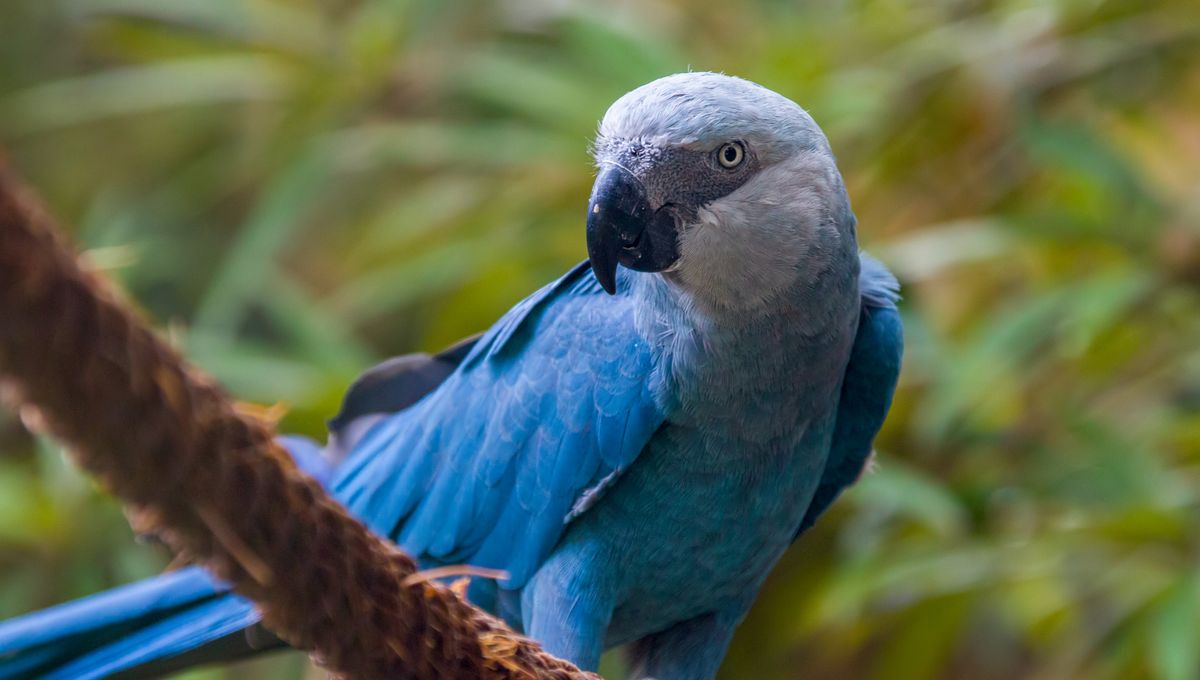
Yet another barrage of bad luck has struck the last remaining Spix’s macaw in the wild. A significant number of the super-rare, sky-blue parrots have tested positive for a highly contagious and fatal viral disease, marking a heartbreaking setback for the species’ rehabilitation.
The infected birds are part of the Spix’s Macaw Reintroduction Program, a bold initiative led by the Chico Mendes Institute for Biodiversity Conservation (ICMBio) that’s aiming to restore this spectacular species to its native Brazilian habitat in Curaçá after decades of absence.
The Spix’s macaws (Cyanopsitta spixii) are a brilliantly blue species of parrot once native to the dry tropical forests of northeastern Brazil. With its vivid cerulean plumage and paler gray-blue head, this charismatic bird is perhaps best known as the inspiration for the 2011 animated movie Rio.
Unfortunately, the species was officially declared extinct in the wild around 2018-2019, although the last wild bird was seen in 2000. The good news is that several zoos and private collections dotted around the world still house some Spix’s macaws, including individuals capable of breeding.
Since June 2022, dozens of captive-bred macaws have been flown, primarily from Europe, to the Brazilian wild as part of the Spix’s Macaw Reintroduction Program.
But hope has recently been shaken. In May 2025, ICMBio researchers working with the birds detected the presence of Psittacine circovirus, a viral disease that affects all Old World and New World parrots. Also known as Beak and Feather Disease Virus, the infection leads to feather loss, abnormal feather development, and deformities of the beak in parrots. There’s no known cure, and it kills the bird in most cases.
In early November, 11 Spix’s Macaws were recaptured and all tested positive, suggesting the circovirus has a tight grip on the wild population. A further 21 parrots of around 90 still in captivity at a breeding center in Bahia also tested positive for the infection, according to AFP.
ICMBio and Brazil’s Environment Ministry are not happy with the situation and appear to be pointing the finger at BlueSky, the company that manages a breeding facility with 103 Spix’s macaws in Curaçá. They recently announced the organization will receive a fine of R$1.8 million ($340,000) for not following necessary biosecurity protocols.
It’s claimed the breeding facility was “extremely dirty” and covered in dried bird poop. They added that employees frequently handled the birds without proper protective gear, often working in flip-flops, shorts, and T-shirts instead.
These conditions, they suggest, may have helped the deadly virus spread throughout the captive and semi-wild populations.
“If the biosecurity measures had been rigorously followed and implemented correctly, perhaps we wouldn’t have gone from just one positive animal to 11 positive individuals for circovirus,” Cláudia Sacramento, coordinator of the Climate and Epizootic Emergencies Coordination at ICMBio, who is leading the emergency response, said in a statement.
“What we hope is that the environment hasn’t been compromised, threatening the health of other psittacine species in our fauna.”

Source Link: 11 Of The Last Spix's Macaws In The Wild Struck Down With A Deadly, Highly Contagious Virus
