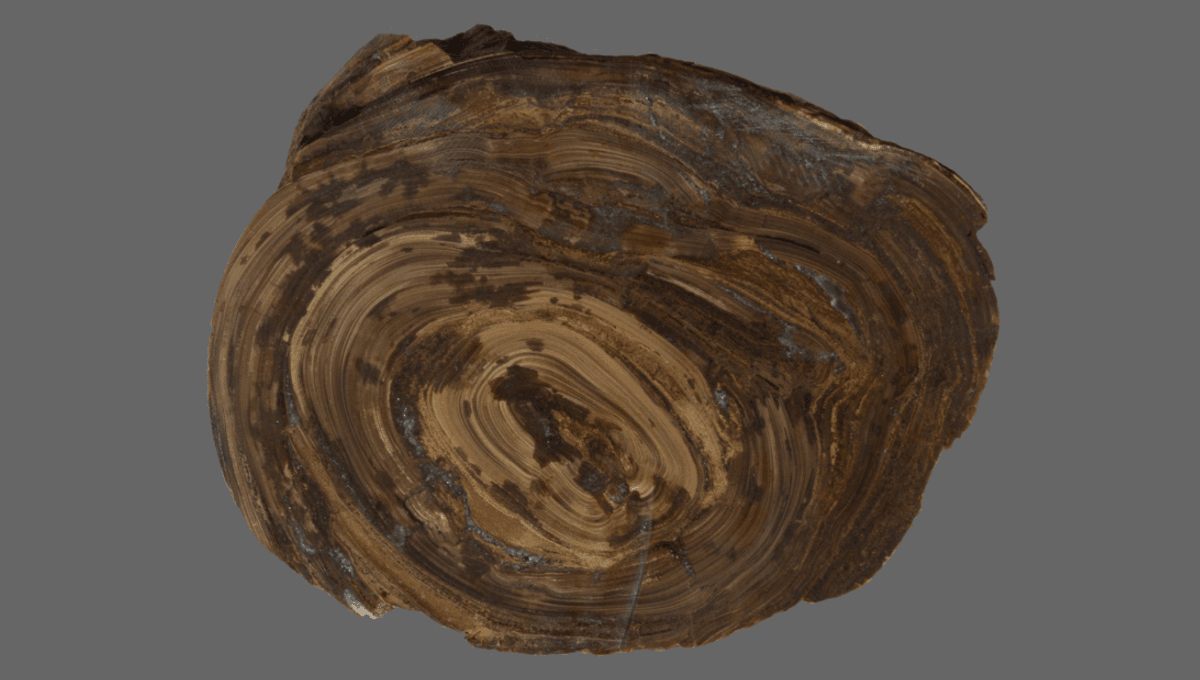
A 150-million-year-old stomach stone has become the oldest known fossil of its kind after being discovered on a beach in the UK. Shaped like a fist, it’s 59 million years older than the previous oldest-known stomach stone, having been rolling around in the gut of some animal back in the Jurassic era.
Stomach stones found out of context (that is, not inside a skeleton) are almost impossible to pin down to an exact animal. However, based on certain features, Nigel Larkin, palaeontologist and Visiting Research Fellow at the School of Biological Sciences at the University of Reading, has some ideas.
“The size of this stomach stone, and considering it was found in clay from the Upper Jurassic era, indicates it most likely formed inside a large marine reptile such as an ichthyosaur, plesiosaur, pliosaur or crocodilian,” he said in a statement. “The stomach stone did not come from a dinosaur – as dinosaurs lived on land – but this is still a very exciting and rare discovery.”
The rare rock was retrieved by renowned palaeontologist Dr Steve Etches MBE, in Kimmeridge, Dorset. When Larkin caught wind of the peculiar rock, he began to suspect its shape might be of biological origin rather than the result of geological processes, as other fossil experts had suggested. He’s since published a study on – to use Larkin’s own words – “this very curious mystery object”.
Stomach stones are a type of calculus, sitting alongside other pathological delights such as bladder stones and kidney stones. The link meant Larkin was able to lean on specimens at the Royal College of Surgeons, England, and the University College London Pathology Collections to confirm his diagnosis.
Unlike gastroliths, which are swallowed, stomach stones are mineral objects that form naturally inside a range of animals, from humans to ichthyosaurs. We’ve even found stomach stones in the guts of Egyptian mummies, but they remain rare in the fossil record.
One explanation for their sparseness in fossils is simply that they’ve been found but not properly identified. The identity of this particular calculus was pinned down with the help of Dr Ivan Sansom, Senior Lecturer in Palaeobiology at the University of Birmingham, who carried out microscopic analyses of the stone. Its structure and mineral composition indicated it formed in a gastrointestinal tract – making it a stomach stone.
Beyond being incredibly old, the stomach stone also confirms that these mineral growths aren’t exclusive to terrestrial animals and can be found in marine palaeoenvironments too. It also marks the first time such a specimen has been discovered in the UK.
A lot to digest from a fist-shaped lump.
The study is published in Proceedings of the Geologists’ Association.
[H/T: Heritage Daily]

Source Link: 150-Million-Year-Old Mineral Lump Becomes World's Oldest Stomach Stone
