• Email Us: [email protected]
  • Contact Us: +1 718 874 1545
  • Skip to main content
  • Skip to primary sidebar

Medical Market Report

  • Home
  • All Reports
  • About Us
  • Contact Us

2,000-Year-Old Child’s Shoe Recovered In Ancient Austrian Salt Mine

September 19, 2023 by Deborah Bloomfield

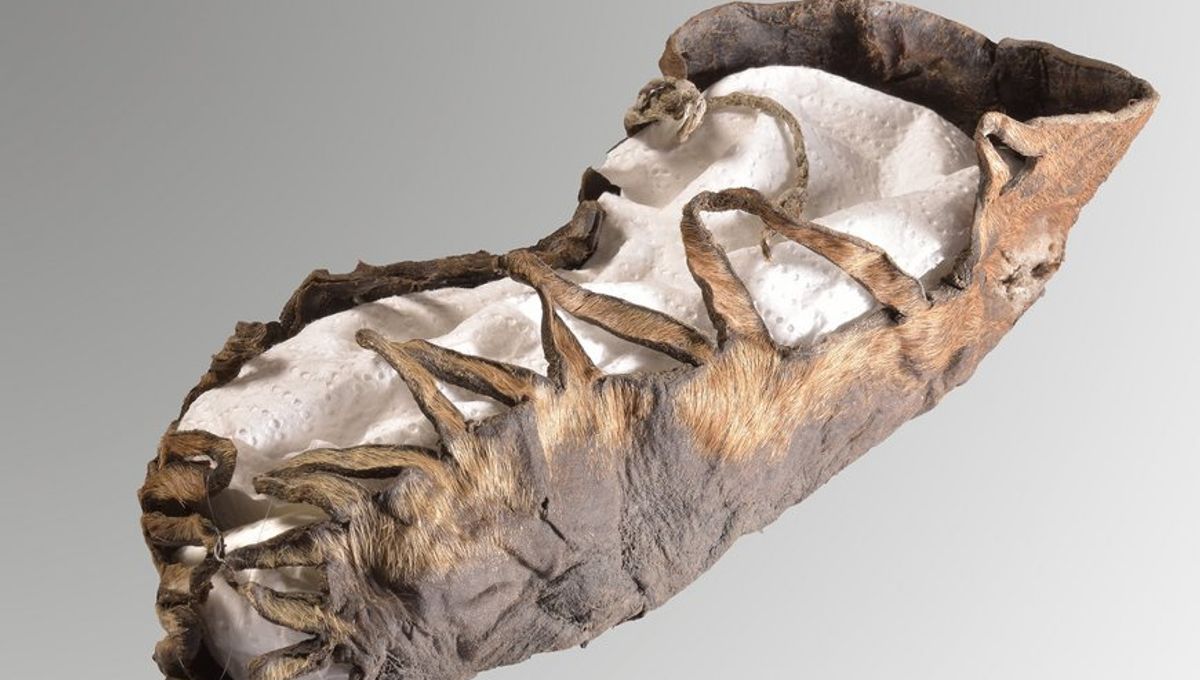
Archaeologists at an old mining site in Dürrnberg, near Salzburg, Austria, have recovered a perfectly preserved child’s shoe that is thought to be over 2,000 years old. The specimen is so well preserved that remnants of the fine materials used to lace it have also survived.

Since 2001, researchers with the German Mining Museum Bochum, Leibniz Research Museum for Georesources, have been investigating an ancient mine in Dürrnberg (otherwise known as Bad Dürrnberg). This site is known for containing rock salt (halite), and was mined as early as the Iron Age (between 1200 and 600 BCE).

Advertisement

The reason why the child’s shoe is so well preserved is because of the salt at the site. Salt helps prevent organic materials from decomposing as they would in other locations. 

According to the researchers, the shoe would be equivalent to an EU size 30 (13 US or child’s 11.5 UK) today.

“Our research activities at Dürrnberg have been providing us with valuable finds for decades in order to scientifically explore the earliest mining activities. The condition of the shoe found is outstanding,” Professor Dr Thomas Stöllner, of the German Mining Museum Bochum (Deutsches Bergbau-Museum Bochum), said in a translated statement.

This is not the only shoe recovered from the site, but it is significant because it proves children were present deep in the mine.

Advertisement

In addition, part of the material used to lace the shoe has also survived the centuries. This is extremely rare, especially as the lace appears to be made of flax or linen. This allows researchers to draw conclusions about how this early footwear was tied up. Judging by its overall design, Stöllner and his colleagues believe the shoe was made in the second century BCE.

Excavations have also recovered other organic remains in locations near to where the shoe was found. These include fragments of a wooden shovel, as well as the remains of what is thought to have been a fur hood with lacing.

“Organic materials generally decompose over time”, Stöllner added. “Finds like this child’s shoe, but also textile remains or excrement like those found on Dürrnberg, offer an extremely rare insight into the life of Iron Age miners. They provide valuable information for our scientific work.”

The excavation of the mining site is set to continue for several more years. In that time, the team hope to explore the whole area and to reconstruct a comprehensive image of what life was like in an Iron Age mine. The finds here are helping to address gaps in the historical record that cannot be filled through other sources.

Deborah Bloomfield
Deborah Bloomfield

Related posts:

  1. Soccer – Liverpool’s Klopp says Van Dijk fit, Keita fine after return to club
  2. France says Mali must stick to election timetable
  3. Blinken meets Lopez Obrador to soothe thorny U.S.-Mexico relations
  4. What Would Happen To Humanity If All Microbes Suddenly Disappeared?

Source Link: 2,000-Year-Old Child’s Shoe Recovered In Ancient Austrian Salt Mine

Filed Under: News

Primary Sidebar

  • This Brilliant Map Has 3D Models Of Nearly Every Single Building In The World – All 2.75 Billion Of Them
  • These Hognose Snakes Have The Most Dramatic Defense Technique You’ve Ever Seen
  • Titan, Saturn’s Biggest Moon, Might Not Have A Secret Ocean After All
  • The World’s Oldest Individual Animal Was Born In 1499 CE. In 2006, Humans Accidentally Killed It.
  • What Is Glaze Ice? The Strange (And Deadly) Frozen Phenomenon That Locks Plants Inside Icicles
  • Has Anyone Ever Actually Been Swallowed By A Whale?
  • First-Known Instance Of Bees Laying Eggs In Fossilized Tooth Sockets Discovered In 20,000-Year-Old Bones
  • Polar Bear Mom Adopts Cub – Only The 13th Known Case Of Adoption In 45 Years Of Study At Hudson Bay
  • The Longest-Running Evolution Experiment Has Been Going For 80,000 Generations
  • From Shrink Rays And Simulated Universes To Medical Mishaps And More: The Stories That Made The Vault In 2025
  • Fastest Cretaceous Theropod Yet Discovered In 120-Million-Year-Old Dinosaur Trackway
  • What’s The Moon Made Of?
  • First Hubble View Of The Crab Nebula In 24 Years Is A Thing Of Beauty… With Mysterious “Knots”
  • “Orbital House Of Cards”: One Solar Storm And 2.8 Days Could End In Disaster For Earth And Its Satellites
  • Astronomical Winter Vs. Meteorological Winter: What’s The Difference?
  • Do Any Animal Species Actively Hunt Humans As Prey?
  • “What The Heck Is This?”: JWST Reveals Bizarre Exoplanet With Inexplicable Composition
  • The Animal With The Strongest Bite Chomps Down With A Force Of Over 16,000 Newtons
  • The Eschatian Hypothesis: Why Our First Contact From Aliens May Be Particularly Bleak, And Nothing Like The Movies
  • The Great Mountain Meltdown Is Coming: We Could Reach “Peak Glacier Extinction” By 2041
  • Business
  • Health
  • News
  • Science
  • Technology
  • +1 718 874 1545
  • +91 78878 22626
  • [email protected]
Office Address
Prudour Pvt. Ltd. 420 Lexington Avenue Suite 300 New York City, NY 10170.

Powered by Prudour Network

Copyrights © 2025 · Medical Market Report. All Rights Reserved.

Go to mobile version