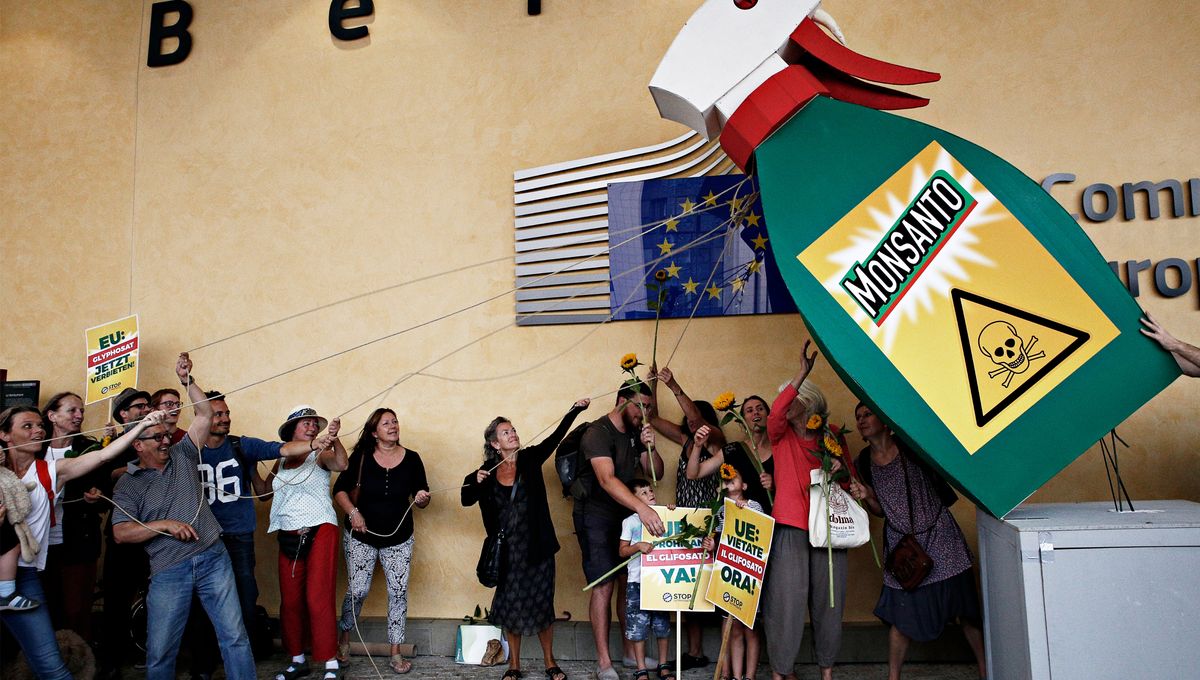
A study from 2000, which concluded the herbicide glyphosate was safe for humans, has just been retracted, after documents unearthed during a US court case revealed that Monsanto staff members were undisclosed “ghostwriters”.
The paper, Safety Evaluation and Risk Assessment of the Herbicide Roundup and Its Active Ingredient, Glyphosate, for Humans, was originally published in April 2000 in the journal Regulatory Toxicology and Pharmacology. Its three authors, Gary M. Williams, Robert Kroes, and Ian C. Munro, performed a review of safety data for Roundup, one of the most popular herbicide products ever created, and concluded that it “does not pose a health risk to humans.”
The study was influential. At time of writing, PlumX Metrics data shows it has been cited a total of 781 times, and it forms part of a much larger debate about Roundup that’s been raging pretty much since its invention.
Roundup controversy – a brief history
Roundup was first brought to market by Monsanto in 1974. Its active ingredient, glyphosate, had been rediscovered by chemists Phil Hamm and John Franz four years prior – it had first been synthesized in 1950, but it was Hamm and Franz who first noticed its herbicidal properties.
Roundup was an extremely effective product and soared in popularity. Hundreds of consumer products containing glyphosate are still available to buy.
It works by inhibiting an enzyme called EPSP synthase, ultimately preventing plants from producing all the amino acids they need to construct proteins essential for their growth. Some plants are naturally tolerant to glyphosate, but most are not. In the mid-90s, once genetically modified agricultural crops with glyphosate resistance started to be developed, its use in farming boomed even more.
But controversy was brewing. In 2014, a school groundskeeper called Dewayne Johnson was diagnosed with terminal non-Hodgkin’s lymphoma, which he attributed to work accidents in which he’d been soaked in Roundup weedkiller. Johnson filed suit against Monsanto in a landmark court case and, in 2018, the company was ordered by the Superior Court of California in San Francisco to pay a total of $289 million in damages.
The jury concluded that Monsanto knew, or should have known, that Roundup could pose a serious danger to users’ health and yet did not take adequate steps to warn them. To activists who’d long been convinced of the dangers of Roundup, despite a lack of hard data, it was a victory.
The debate over glyphosate’s safety continues to rage. It was declared “probably carcinogenic to humans” by the World Health Organization’s International Agency for Research on Cancer in 2015. Environmental charities have long been opposed to its use, citing a lack of long-term evidence of its safety for humans, animals, and the wider environment.
The US Environmental Protection Agency is in the process of “updating its evaluation of the carcinogenic potential of glyphosate” after its previous ruling that it posed no human health risk was successfully challenged in court.
The retraction
The 2000 study, being released right in the middle of this timeline, added weight to the arguments made by Monsanto and others that glyphosate was safe when used as indicated.
However, in a lengthy retraction notice, current journal co-editor-in-chief Martin van den Berg outlines serious ethical concerns, including a failure to disclose that Monsanto staff were involved in drafting the article.
This fact came to light when internal emails and documents from Monsanto were released during a class-action lawsuit in the US, where, just like Dewayne Johnson, plaintiffs were alleging that exposure to Roundup had led to them developing lymphoma.
As reported by AFP, one email even suggested that people who had worked on the 2000 paper and one other study might be given “Roundup polo shirts as a token of appreciation for a job well done.”
In the retraction notice, van den Berg writes, “The failure to disclose the involvement of Monsanto personnel in the writing process compromises the academic independence of the presented findings and conclusions drawn in the article regarding carcinogenicity.”
Other problems with the paper raised in the notice include the fact that the authors may have received undisclosed financial compensation from Monsanto, and that the conclusions almost entirely rely on unpublished studies conducted by Monsanto.
“In light of the aforementioned issues,” it reads, “the handling (co) Editor-in-Chief lost confidence in the results and conclusions of this article, and believes that the retraction of this article is necessary to maintain the integrity of the journal.”
The internal Monsanto emails first came to light in 2017, leading some to question why it’s taken so long to retract the paper. A 2025 paper by Alexander A. Kaurov and Naomi Oreskes, all about the situation, called this type of ghostwriting “a form of scientific fraud”.
After their extensive investigation, Kaurov and Oreskes wrote to the journal editors in July to request a retraction, which van den Berg told Retraction Watch was “the first time a complaint came to my desk directly.” By all accounts, things then moved quickly.
Two of the authors on the paper are now deceased, so van den Berg reached out to the only surviving author, Williams, but received no reply. Journals can and do retract papers without the express consent of the authors, but it’s not a decision that is taken lightly.
Monsanto was acquired by Bayer in 2018. In a statement, it said, “Monsanto’s involvement with the Williams et al paper did not rise to the level of authorship and was appropriately disclosed in the acknowledgments. The listed authors had full control over and approved the study’s manuscript.”
Where does that leave us?
The retraction notice concludes with an important disclaimer.
“As handling (co)Editor-in-Chief, I emphasize that this retraction does not imply a stance on the ongoing debate regarding the carcinogenicity of glyphosate or Roundup, but originates from directly following the COPE [Committee on Publication Ethics] guidelines.”
In other words, the study is being retracted according to best practice in the publishing industry because there are too many ethical question marks over it, and not because the journal or its editors are trying to make any kind of claim about whether glyphosate is safe.
That debate will continue. We also don’t know how widespread this practice of corporate ghostwriting truly is, or how many other published papers could potentially be affected.
“I am sure there (are a) lot (of) such ghost-written and undeclared conflict papers in the literature, but they are very difficult to unearth unless one goes really deep in litigation cases,” Stanford University professor John Ioannidis told AFP.
This is most likely not the last we’ll hear of this case.
The retraction notice is published in Regulatory Toxicology and Pharmacology.

Source Link: 25-Year-Old Paper On Controversial Glyphosate Weedkiller Retracted, After It Turns Out Monsanto Staff Helped Write It
