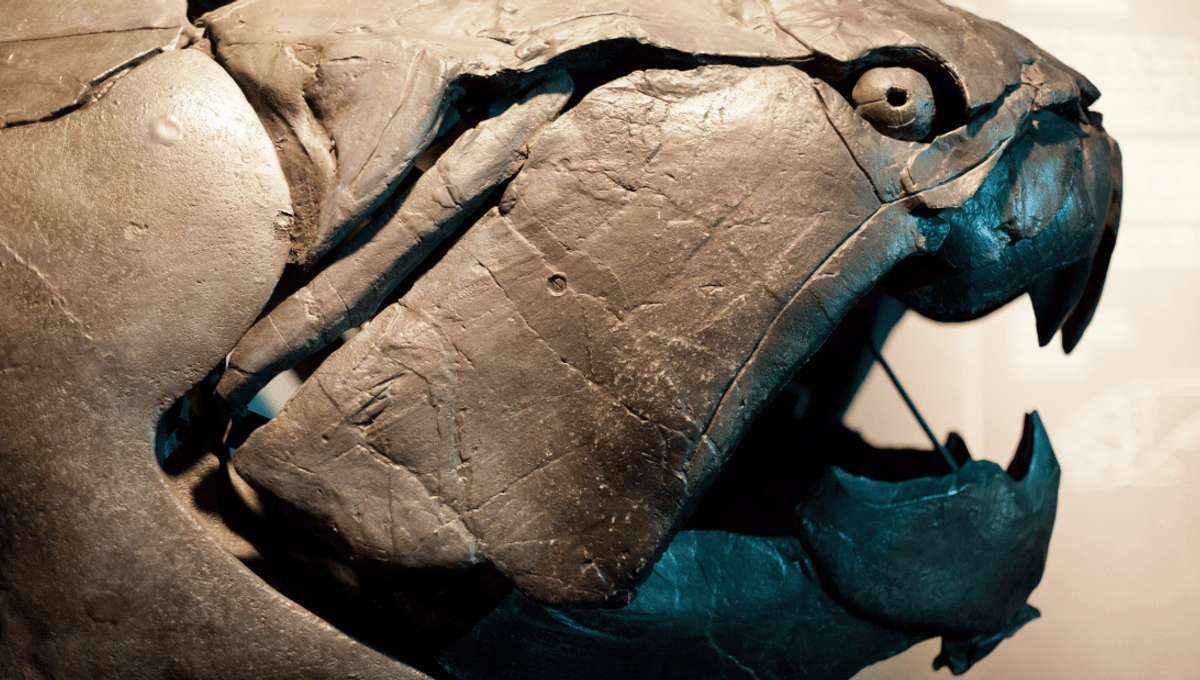
Had you been in Cleveland 360 million years ago, you’d be swimming for your life. Not only would you have found yourself bobbing in a shallow sea, but there’d be something monstrous in the water: Dunkleosteus terrelli, a 4.2-meter (14-foot) apex predator unlike any fish alive today.
The rest of this article is behind a paywall. Please sign in or subscribe to access the full content.
In fact, Dunkleosteus was unlike most fish alive in its time, too. That’s according to a new study that’s the first in nearly a century to take a proper look at the species. Discovered in the 1860s, it became the “poster child” for a group of fossils called the arthrodires, but Dunkleosteus stands out as something of a weirdo among the group.
“The last major work examining the jaw anatomy of Dunkleosteus in detail was published in 1932, when arthrodire anatomy was still poorly understood,” said Russell Engelman, a graduate student in biology at Case Western Reserve and lead author, in a statement. “Most of the work at that time focused on just figuring out how the bones fit back together.”
“Since the 1930s, there have been significant advances in our understanding of arthrodire anatomy, particularly from well-preserved fossils from Australia. More recent studies have tried biomechanical modeling of Dunkleosteus, but no one has really gone back and looked at what the bones themselves say about muscle attachments and function.”
Enough was enough, decided Engelman and colleagues, so they went to the Dunkleosteus repository – AKA, the Cleveland Museum of Natural History, home to the world’s largest collection of Dunkleosteus fossils. That ancient shallow sea I mentioned is to thank for the pristine condition of Cleveland’s collection, having locked the remains in a layer of black shale that gets exposed from time to time by construction projects.
The “osteus” in Dunkleosteus means “bone.” It’s a fitting reference to the heavily armored plates across its skull and front body, but like modern-day sharks, it also had a lot of cartilage.
This new research has revealed that cartilage actually made up nearly half of Dunkleosteus’s skull – far more than previously thought. It also uncovered another connection to sharks: a jaw muscle with its own bony channel, something for which we’ve found little evidence in ancient fish.
One of Dunkleosteus’s strangest features is the pair of bone blades it had in place of teeth. We see this trait in a few of its close relatives, too, but evolutionarily speaking, it’s otherwise unusual among arthrodires. So, not only are we getting closer to understanding what the oddball Dunkleosteus was really like, but we’re getting to know the arthrodires, too.
“These discoveries highlight that arthrodires cannot be thought of as primitive, homogenous animals,” said Engelman, “but instead a highly diverse group of fishes that flourished and occupied many different ecological roles during their history.”
So, Dunkleosteus – bit of a weirdo? Sure. But don’t you prefer it that way?
The study is published in The Anatomical Record.

Source Link: 360 Million Years Ago, Cleveland Was Home To A Giant Predatory Fish Unlike Anything Alive Today
