The Indiana Jones franchise isn’t well known for its accuracy in depicting the average professor-of-archaeology lifestyle. Jones tends to whip the gun out of the hands of a Nazi in the time a proper archaeologist might use for logging artifacts.
However, there’s one bit they got right, in his love for discovering obviously cursed items that should never be disturbed, and then disturbing the hell out of them.
The woman who refused to rot
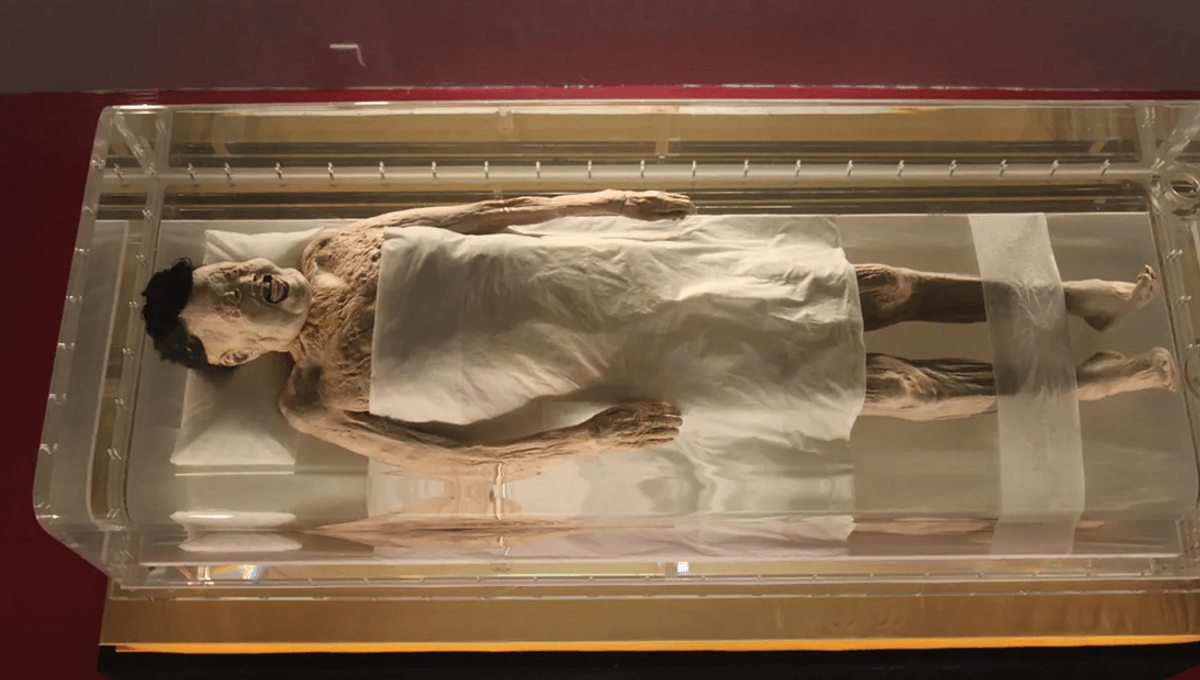
Construction workers first found the tomb of Lady Dai, also known as Xin Zhui, in the 1960s. Excavating the site in the 1970s, archaeologists found the surprisingly well-preserved mummy of Xin Zhui herself. Adding to the “don’t touch this” vibes was that she was found floating in a pool of clear liquid that turned brown after being exposed to the air. The liquid was either a herbal solution to help preservation, or her various bodily fluids from decomposition.
Remarkably, much of her soft tissue remains intact, while her veins are still filled with congealed blood.
The giant black sarcophagus
In 2018, archaeologists in Egypt discovered a 2.65-meter (8.7-foot) black sarcophagus buried 5 meters (16.4 feet) underground, dating back to the Ptolemaic period (323-30 BCE), prompting warnings from the public to not open the sarcophagus.
Archaeologists then opened the sarcophagus, revealing the contents inside. Upon opening, the team let it sit for over an hour to let the smell dissipate. Inside was a reddish brown sludge, containing several skeletons like croutons in the worst soup of your life.
The remains – there are images, though we’d advise against looking – likely belonged to officials or members of the military, with one found with an apparent arrow wound to the head.
A wall of Roman soldiers inside a collapsed tunnel
It’s not often you find a pile of Roman soldiers, assembled so as to block a passageway. When you do, a few thoughts probably pass your mind, such as “How pressed for materials were they that they used corpses instead of bricks?” and “Hold on now, what were they trying to keep out?”
These are questions you would probably ask yourself as you flee, but archaeologists attempted to answer them with further study. According to archaeologist Simon James, the scene was caused by an early example of chemical warfare. Soldiers attempting to dig under city walls into a military base were likely met with an attack by the defending Persians.
“As the Romans started to break through into the prop-filled void being created under the city wall, the Persians retreated into their approach tunnel behind their brazier and threw onto it some of the bitumen and sulphur crystals we know they had because they were using them, probably just minutes later, to set fire to the Roman tunnel,” James explained in his paper. “These materials would have produced dense clouds of hot fumes, a deadly cocktail of oily hydrocarbon smoke incorporating carbon dioxide, lethal carbon monoxide, and – even nastier – sulphur dioxide gas.”
Within a few seconds, James wrote, the Roman soldiers were choking to death and trying to stagger away from the “sulphurous clouds of Hell” as they followed them down the tunnel. Nineteen of the Romans died, and they were dragged, “some perhaps still alive”, to create a blocking wall.
The golden eye
In 2006, archaeologists discovered the skeleton outside Zabol, Iran dating back to around 4,800 years ago. As well as being unusually tall for the time at around 1.8 meters (6 feet), she had an unusual object inside her skull.
The golden prosthetic eye was found to be made by someone with a good grasp of ocular anatomy, with blood vessels recreated with golden wire. Though it’s not clear she was a priestess as claimed, please, for the love of god, still don’t remove the eye.

Source Link: 4 Times Scientists Disturbed The Obviously Cursed Items
