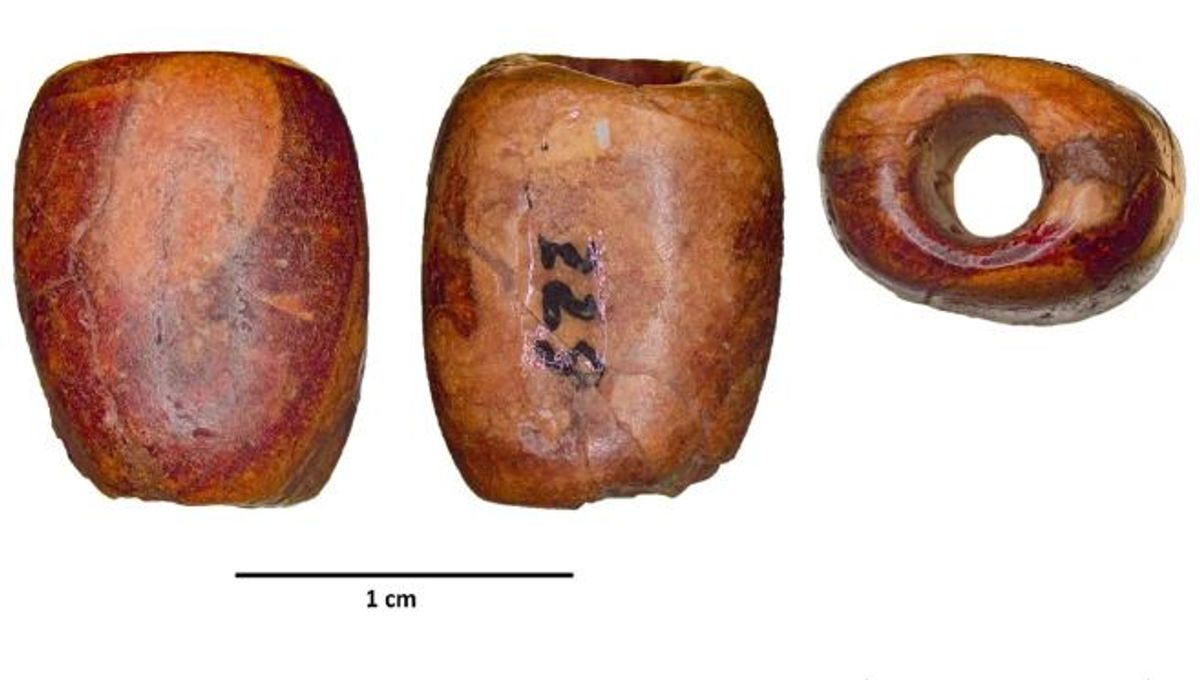
For thousands of years, Baltic amber – otherwise known as succinite – has been recognized as the finest in the world, and has been sought after for use in jewelry since Roman times. Despite other amber deposits existing across Europe, ancient people from far and wide were keen to get their hands on the Baltic bling, and new research reveals that the material was transported to the most westerly region of the continent more than 5,000 years ago.
In a new study, researchers describe the discovery of a single succinite bead in a grave in Catalonia, Spain. Dated between 3634 and 3363 BCE, the burial site in the Cova del Frare cave served as the final resting place for at least 12 prehistoric individuals and represents the earliest known appearance of Baltic amber in the Iberian peninsula.
Using a technique called Fourier transform infrared spectroscopy, the researchers were able to confirm that the bead’s reference spectra differed significantly from that of Iberian amber deposits, yet matched with Baltic amber.
In a statement, study author Mercedes Murillo-Barroso said the find “allows us to say with confidence that the arrival of Baltic amber on the Iberian Peninsula occurred at least in the fourth millennium BC, more than a millennium earlier than we thought, and that it was probably part of wider trade networks linked to the south of France”.
Originating in northern Europe, Baltic amber was utilized extensively by the so-called Funnel Beaker Culture that occupied present-day Denmark, the Netherlands, Germany, and Poland in the fourth millennium BCE. Typically used to make buttons, beads, and pendants, the material has been identified at sites across France dating back to around 5,000 years ago, with these constituting the earliest examples of succinite in Western Europe prior to this study.
Within Spain, researchers had previously discovered a Baltic amber bead within a grave of “exceptional opulence” in the Murcia region. Belonging to a male individual of 35 to 40 years of age, the burial dates back to between 1738 and 1534 BCE and until now had represented the earliest confirmed example of succinite in Iberia.
Based on this prior discovery, historians had come to believe that Baltic amber imports began with the so-called Bell Beaker culture, which emerged in Portugal in the third millennium BCE. Yet the Cova del Frare find shatters this narrative, proving that Baltic amber was present in the Iberian peninsula considerably earlier than previously assumed.
“Despite being a single bead, this finding provides the earliest evidence for the arrival of Baltic amber to the Mediterranean and Western Europe, before the Bell Beaker phenomenon and more than a millennium earlier than traditionally thought,” write the study authors.
Based on the age of the bead, the researchers speculate that it may have reached Spain via the ancient trade networks of the Sepulcros de Fosa culture, which arose in Catalonia during the Middle Neolithic period before disappearing between 4,000 and 5,000 years ago.
The study is published in the journal Scientific Reports.

Source Link: 5,000-Year-Old Baltic Amber Is Oldest Ever Found On Iberian Peninsula
