• Email Us: [email protected]
  • Contact Us: +1 718 874 1545
  • Skip to main content
  • Skip to primary sidebar

Medical Market Report

  • Home
  • All Reports
  • About Us
  • Contact Us

60,000 Beluga Whales Are On The Move – Watch Their Annual Migration Live

July 15, 2024 by Deborah Bloomfield

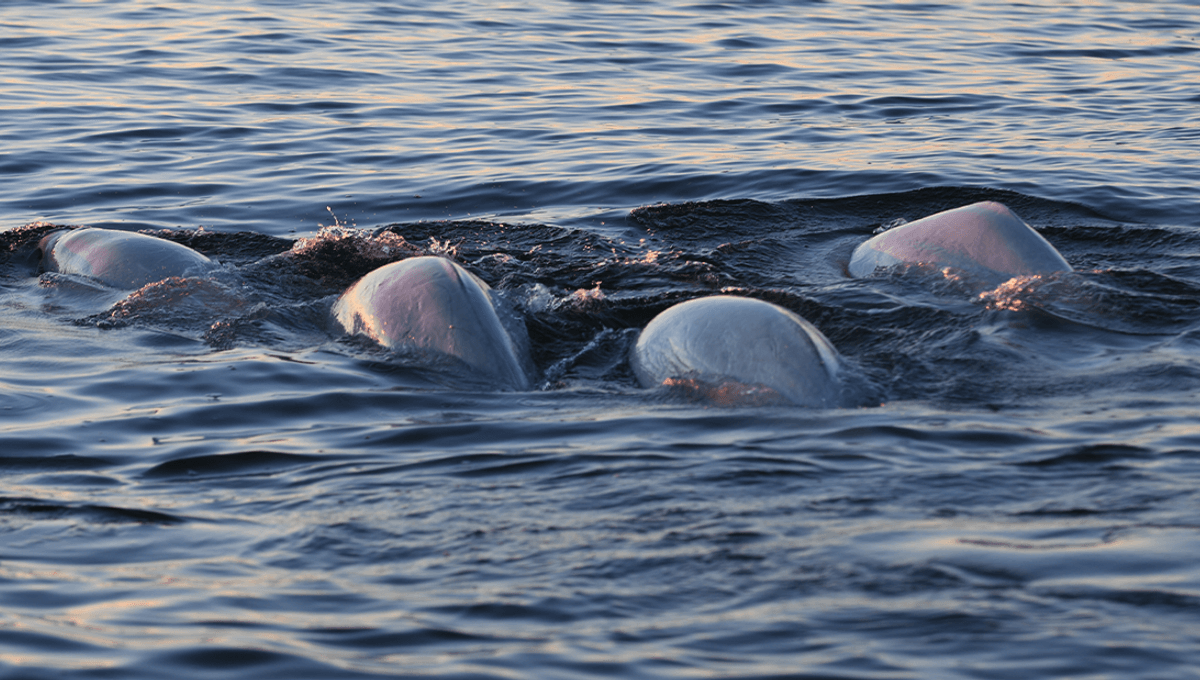
Whale species in Earth’s oceans are some of the most majestic and captivating animals the world has to offer. From the biggest blue whale to sperm whales and everything in between, few people get the chance to appreciate these marine mammals. However, almost 60,000 beluga whales are now on the move as part of their annual migration and Polar’s Bears International have set up a beluga whale live stream so we can join in on the action. 

Advertisement

Today, July 15, is Arctic Sea Ice Day, a day created by Polar Bears International to bring attention to the rapidly melting Arctic ecosystem. The beluga whales (Delphinapterus leucas) swim from the wider Arctic Ocean into the Churchill River in Hudson Bay, Canada, to feed and give birth to their young. More than 57,000 belugas will make this journey so the odds of spotting them frolicking in the water via the live cam are pretty good. 

“Beluga whales are so curious and many will swim right up to the underwater camera, as they play in the wake of the boat,” Alysa McCall, Polar Bears International Staff Scientist and Director of Conservation Outreach, told BBC Discover Wildlife. 


Two live cams are mounted on the research boat Delphi: one that films the water’s surface, while the other films under the water. A hydrophone is even used to pick up the voices of the belugas as they travel. These animals are known as the “canaries of the sea” because of their incredible range of vocalizations. As well as their vocalizations, studies have shown that the squishy melon on their heads can also change shape, aiding with visual communication. 

Hudson Bay has plenty of food for the whales but remains inaccessible to them in the winter months. In the summer, however, the ice melts, making it the perfect place for the whales to journey to as it is also home to relatively few killer whales, their natural predators. 

Advertisement

Part of the reason to return to these plentiful waters is that the adults must undergo the molt. According to the Alaska Department of Fish and Game, their skin grows about 100 times faster than normal during this time. According to research from the 1990s, the low salt and warmer temperatures of the waters in the Hudson Bay may help the skin grow faster, by stimulating blood flow to the skin. 

In the fall, the ice will once again reform and the belugas will travel back out. They feed on salmon and other fish as well as shrimp, crabs, and moullusks, explains the WWF. Not only do the belugas rely on the sea ice, but species like polar bears and seals use it as a platform to hunt, rest, and reproduce. 

Deborah Bloomfield
Deborah Bloomfield

Related posts:

  1. ARK Invest’s Wood expects market rotation back to growth stocks
  2. Most Plant-Based Milks Are Poorer In Key Micronutrients Than Dairy
  3. Great Pacific Garbage Patch Now A Floating Love Shack For Coastal Species
  4. Hard Working Urchins Don’t Deserve Their Bad Reputation

Source Link: 60,000 Beluga Whales Are On The Move – Watch Their Annual Migration Live

Filed Under: News

Primary Sidebar

  • Why You Need To Stop Chucking That “Liquid Gold” Down Your Kitchen Sink
  • Youngest Mammoth Fossils Ever Found Turn Out To Be Whales… 400 Kilometers From The Coast
  • The First Wheelchair User To Travel To Space Is About To Make History
  • “It Was Bigger Than A Killer Whale”: 66 Million-Year-Old Tooth Suggests Mosasaurs Were Hunting In Rivers, Not Just Seas
  • Killer Whales And Dolphins Team Up In First-Ever Footage Of Cooperative Hunting
  • Why Does Chocolate In Advent Calendars Taste Different From Normal Chocolate?
  • Why Do Sheep And Goats Have Rectangular Pupils?
  • What Kind Of Parents Were Dinosaurs?
  • First Images Of A Tatooine-Like Planet That Orbits Its Two Stars Closer Than We’ve Seen Before
  • JWST Finds Earliest Supernova Yet, From When The Universe Was Just 730 Million Years Old
  • How A Comet On Christmas Day Changed What We Knew About Space
  • What Color Was Diplodocus? First-Ever Sauropod Fossils With Melanosomes Bring Us A Step Closer To Finding Out
  • Why Do NASA’s Voyager Spacecraft Sometimes Get Closer To Earth, As They Head Out Of The Solar System?
  • What Is The Fastest Animal In The World?
  • Would The Burglars Have Survived “Home Alone”? We Asked An Intensive Care Doctor
  • World’s First-Ever Dictionary Of Ancient Celtic Languages Set To Be Created
  • Fresh From Capturing Image Of 3I/ATLAS, NASA’s MAVEN Suffers “Anomaly” And Is No Longer Communicating With Earth
  • Thought “Superflu” Was Bad? Strap In: It’s Norovirus Season In The US
  • Why Does Evolution Turn Everything Into Crabs?
  • Neil deGrasse Tyson And Professor Brian Cox Talk Interstellar Comet 3I/ATLAS And Alien Spacecraft: “It’s Older Than Us”
  • Business
  • Health
  • News
  • Science
  • Technology
  • +1 718 874 1545
  • +91 78878 22626
  • [email protected]
Office Address
Prudour Pvt. Ltd. 420 Lexington Avenue Suite 300 New York City, NY 10170.

Powered by Prudour Network

Copyrights © 2025 · Medical Market Report. All Rights Reserved.

Go to mobile version