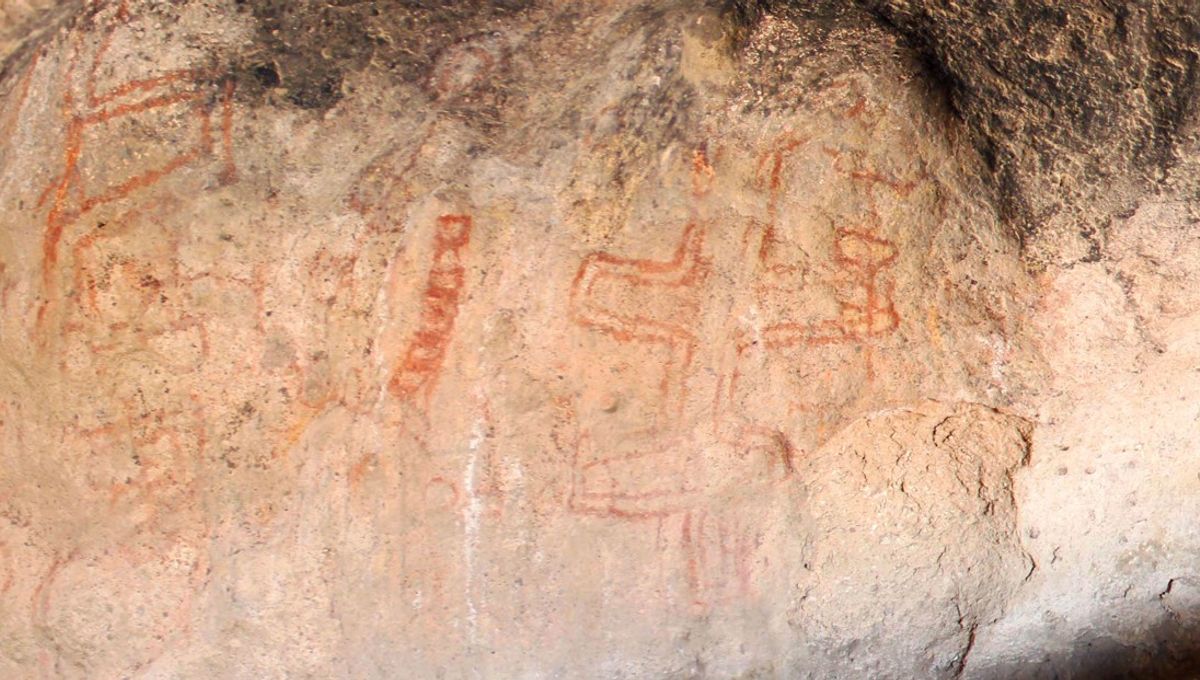
Ancient paintings on the walls of a Patagonian cave have been dated to 8,200 years ago, making them the oldest known rock art in the region by several millennia. Staggeringly, researchers also found that the markings were built up over a period of roughly 3,000 years, suggesting that the illustrations were used to transmit cultural knowledge for around 130 generations.
Located within the harsh, arid desert of northwest Patagonia, in what is now Argentina, the Cueva Huenel 1 (CH1) site is known among archaeologists for its enormous concentration of prehistoric artworks, consisting of geometric shapes and patterns including human forms and strange, comb-like figures. Previously, the paintings were believed to be just a few thousand years old, yet the authors of a new study have now revealed that the markings stretch all the way back to the Late Holocene.
Using direct radiocarbon dating of the plant-based pigments with which the drawings were produced, the researchers discovered that the CH1 artworks are several thousand years older than expected, and that they remained consistent in their design over three millennia. Oddly, the cave shows no signs of having been lived in during this period, with an absence of stone tools or butchered animal bones, although a pit filled with plant material that had been dyed with red ocher was present.
The study authors therefore suspect that the cave represented a “cultural keystone place”, where ancient hunter-gatherers stored local knowledge and met to maintain tribal connections and conduct rituals over many years. Such focal points, they suggest, enabled the sparsely populated communities that inhabited Patagonia to remain connected at a time when extreme heat and dryness made survival incredibly challenging.
“The emergence of rock art at CH1 is recorded since [8,200 years ago] against a challenging environmental background, where the ability to maintain connectivity and demographic viability would have been crucial,” write the researchers. “We suggest that the standardized painting events – and other pigment-related activities – practiced over generations sought to maintain large-scale safety nets by storing information rooted in collective memory and guaranteeing social preservation beyond oral tradition,” they continue.
In total, the study authors analyzed 895 separate paintings that encompassed 446 motifs, all of which were continually reproduced using the same pigments over thousands of years.
By providing a “place-based sense of identity”, the cave may have enabled dwindling numbers of people to stick together across a vast, unforgiving landscape. At a time when human populations in South American deserts were “experiencing repeated crashes”, the lifeline provided by CH1 and its communicative illustrations may have been the difference between survival and annihilation.
The study is published in the journal Science Advances.

Source Link: 8,200-Year-Old Paintings In Patagonia Helped Hunter-Gatherers Survive For 130 Generations
