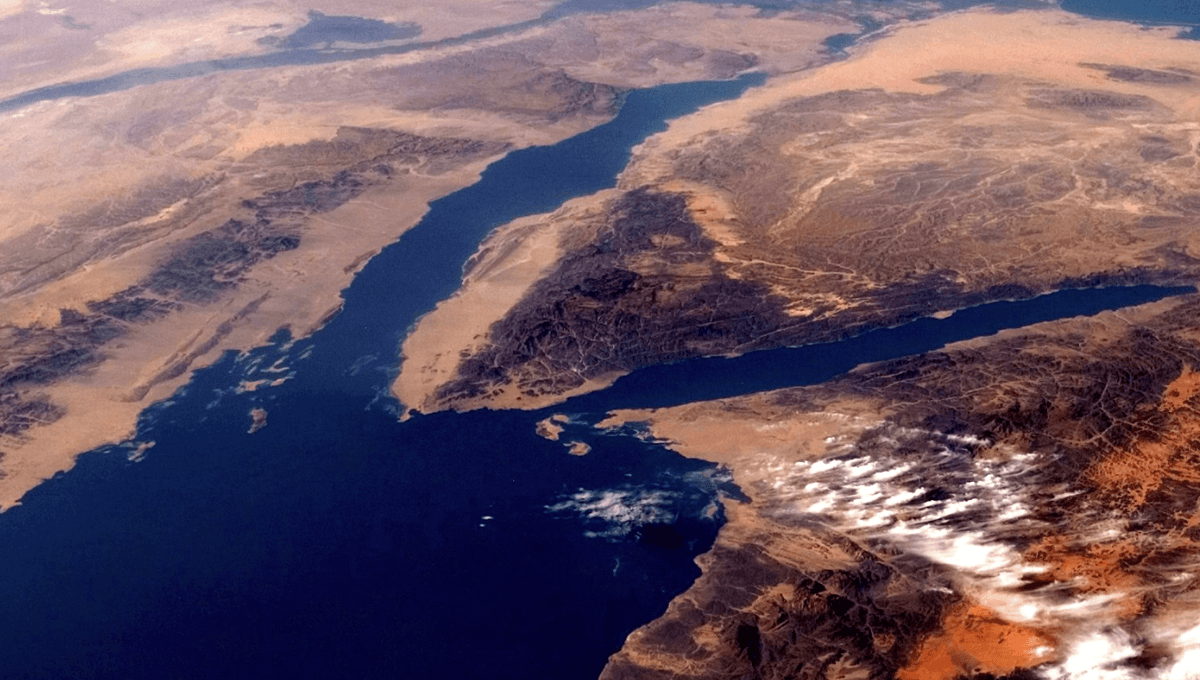
Parts of the tectonic boundary between Africa and Asia may be creeping away from each other, as fresh evidence shows that a rift near the border of the two continents is slowly pulling apart at the pace of a very, very slow snail.
The movement is occurring in the Gulf of Suez Rift, a deep fracture in the Earth’s crust that runs along the narrow strip of sea between mainland Egypt and the Sinai Peninsula, the land bridge where Africa and Asia meet. It forms the tail end of the larger Red Sea Rift, which split between the Arabian and African tectonic plates around 25 million years ago.
Once thought to be an inactive “failed” rift, new research is showing this crack in the crust is more lively than thought. By examining the Suez Rift’s shape and the positions of ancient coral reefs now above sea level, geologists found that the crust here is still rifting by up to 0.55 millimeters (0.02 inches) every year.
The researchers believe their findings could rewrite the textbook on geological rifts. Rather than being simply “on” or “off,” rifts may flicker along a spectrum of activity, occasionally stirring quietly when they are assumed to be done and dusted.
“By continuing to experience extension, the Suez Rift does not fit its failed rift classification, possibly due to its proximity to an active plate boundary. These findings highlight the need to reassess supposedly inactive rifts globally, testing whether deceleration without failure as a common evolutionary pathway in intracontinental rifts,” the trio adds.
The subtle movements of the Gulf of Suez Rift are not forecast to totally tear Asia and Africa apart any time soon; the movement of tectonic plates is complex and multi-faceted, involving a web of interacting faults and subtle shifts that unfold over millions of years. But elsewhere in the region, tectonic forces are quietly setting the stage for dramatic continental shifts.
Not far from the Suez Gulf, there is significant activity within the East African Rift System, one of the largest rifts in the world that stretches downward through Ethiopia, Kenya, the Democratic Republic of the Congo, Uganda, Rwanda, Burundi, Zambia, Tanzania, Malawi, and Mozambique.
Multiple strands of evidence suggest that this activity could cause the Somalian tectonic plate to gradually tear away from the larger Nubian plate, causing a new sea to flood into the gap. This would essentially result in East Africa being sliced off from the rest of the motherland.
The good news is that this won’t happen for millions of years to come. Nevertheless, the Suez and East African rifts illustrate that Earth is far from a static, unchanging ball of rock. Our planet’s surface may seem rigid and eternal from a human viewpoint, but it is continuously, subtly reshaping itself.
The study is published in the journal Geophysical Research Letters.

Source Link: A Gulf Between Asia And Africa Is Being Torn Apart By 0.5 Millimeters Each Year
