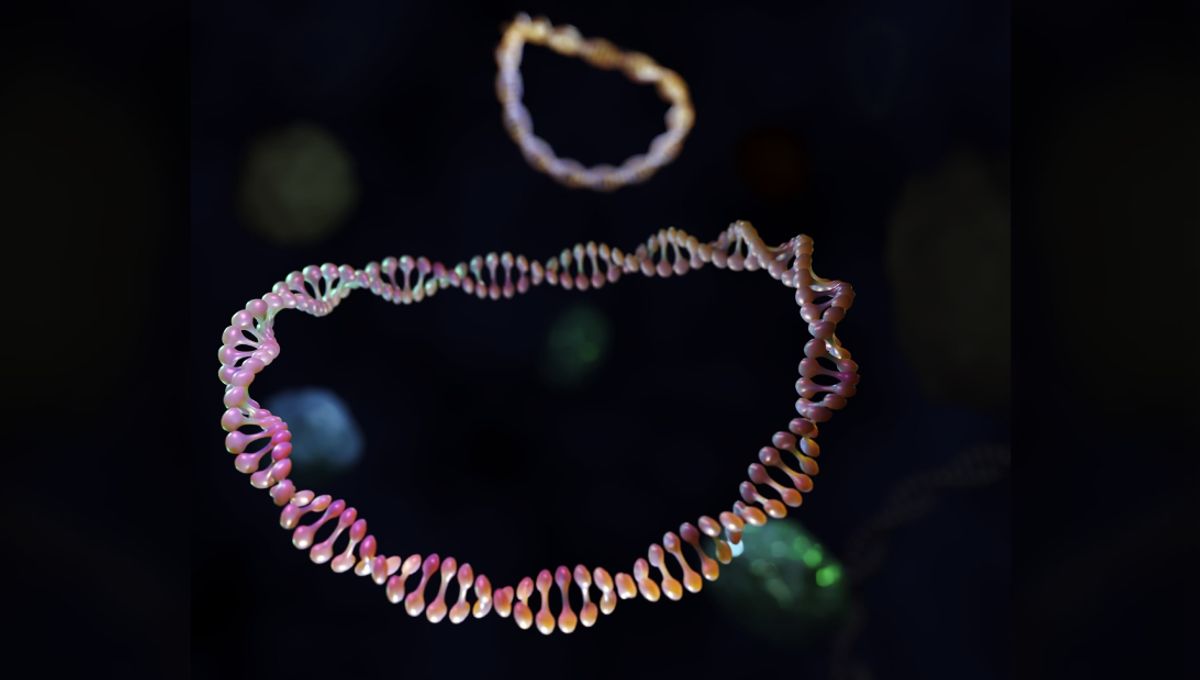
New research has revealed the existence of a brand new organelle within mammalian cells. The never-before-described “mini organ” is called the exclusome, and is made up of DNA rings called plasmids. The team responsible for its discovery believe it could be involved in autoimmune disease and may help further our understanding of how nuclei evolved.
Organelles are specialized subunits of a cell, sort of like a cell’s internal organs, each with their own important function. The exclusome, the newest of these subunits, is a compartment found in the cell plasma. This is unusual because in most cells with nuclei – which we call eukaryotic cells – DNA is found in the nucleus and is packaged into chromosomes.
Instead, in the exclusome, it is organized into plasmids – small, circular DNA strands that can replicate independently of chromosomes and are usually found in bacteria and other microscopic organisms. Some of the plasmids present in the new organelle originate from outside the cell, while others come from telomeres – the protective caps at the ends of chromosomes. Such telomeric rings often occur in cancer cells.
Their discovery in the exclusome, therefore, suggests that cells are able to identify DNA that is foreign or no longer required and eject it from the nucleus, depositing it in the cell plasma alongside plasmids coming from outside the cell. In this way, the exclusome may have a protective function, guarding the cell’s genetic integrity.
“It’s one of the key hygiene functions cells perform to protect the chromosomes,” Ruth Kroschewski, from the Institute of Biochemistry at ETH Zurich, said in a statement. “Plasmids that can’t be separated off could theoretically embed themselves in the chromosomes. More likely is that the nuclear plasmid genes of viruses or bacteria are translated into proteins, which disrupts the cell physiology.”
It seems the exclusome helps to prevent this from happening, but it’s not yet clear what other roles it performs, although it may be involved in cellular immunological memory, Kroschewski hypothesized.
A protein is known to bind DNA in cell plasma, possibly triggering the release of inflammatory messenger substances, which can kickstart an immune response. If this protein were to bind to plasmids in the exclusome, it could result in a pro-inflammatory signaling cascade, implicating the latest addition to the organelle family in autoimmune disease:
“This may well facilitate autoimmune responses such as systemic lupus erythematosus,” Kroschewski explained.
The exclusome shares some similarities to the cell nucleus in that both contain DNA enveloped in a membrane, and so could hint at the evolutionary origin of nuclei in eukaryotic cells. The exclusome is much simpler, Kroschewski said, and “features gaps that can be seen in the nuclear envelope only in the early stages of its formation.”
“Perhaps the exclusome is a first attempt at producing a cell nucleus,” she posits.
For now, these theories will remain theories, but the team hope that with more research, they might be able to get some answers about the mysterious new organelle and its biological and evolutionary roles.
The study is published in Molecular Biology of the Cell.

Source Link: A New "Mini Organ" Has Been Discovered In Mammalian Cells
