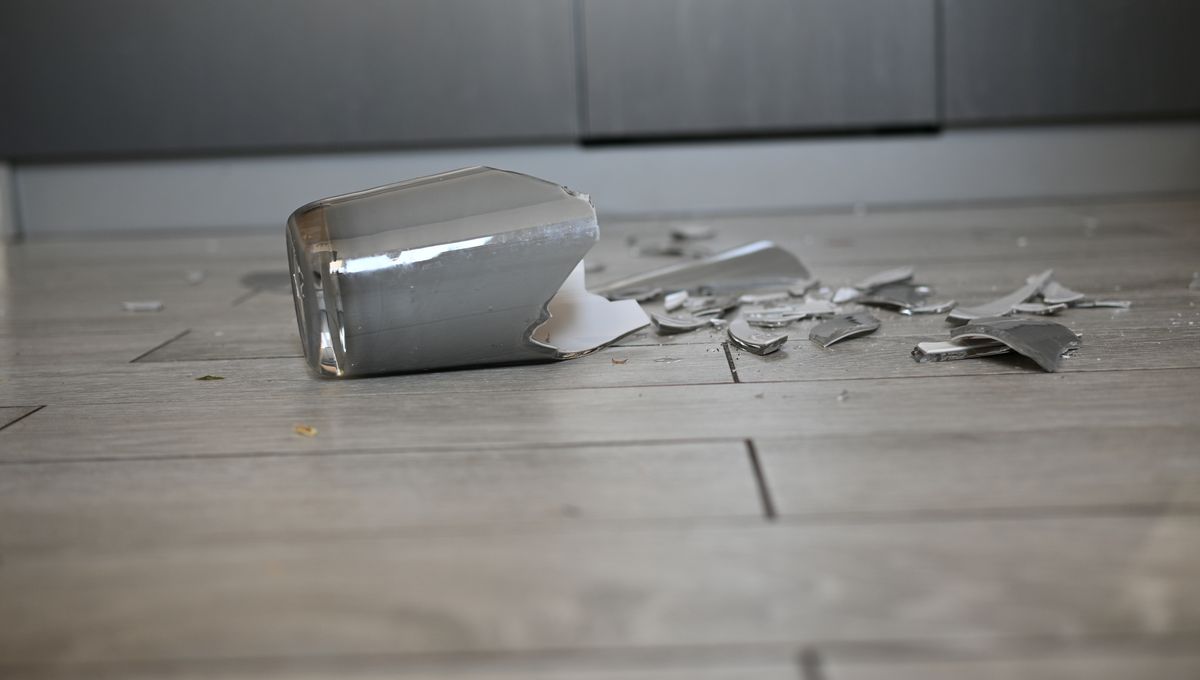
Imagine a beautiful vase filled with roses on a spring day, by an open window. A sudden gust of wind enters the room, the roses act as a sail, and the vase tumbles from its perch and onto the floor. The shards of that vase are, of course, a chaos of sizes and shapes. However, new research argues that behind the apparent chaos, there is a simple mathematical rule.
The rest of this article is behind a paywall. Please sign in or subscribe to access the full content.
Understanding the fragmentation of objects is crucial in material science. Sometimes objects just break due to defects, and others due to external impact. Some materials are designed to shatter in certain ways. The breaking of others informs how to make versions less likely to fall apart. The new research did not focus on the formation of the fragments, which requires knowledge of the specific material and physical processes involved, but on the statistical properties of an object, no matter the context, falling apart.
Emmanuel Villermaux at Aix-Marseille University in France and the University Institute of France has proposed that there is a principle behind the fragmentation process of an object. The idea is that of all the possible ways an object can break apart, the one that is most probable is the one that maximizes entropy. Entropy is a quantity that can be seen as the state of disorder of a system, and in the universe at large, it always increases.
Part of this statistical analysis is bound by the kinematics of the system; basically, what kind of event leads to the breakup. Part of it is the randomness of the debris formation. While chaos reigns supreme in our cosmos, this is not unconstrained. Randomness is bound to a specific conservation law discovered a decade ago.
The result is a power law that describes the distribution of sizes in the fragments created during a breakup. It is easy to assume that when an object shatters, more small pieces will be created than larger ones. What the research shows is that the distribution of these pieces follows a clear mathematical distribution. This finding matches a wide range of experimental results and models. It was even tested by crashing sugar cubes and seeing if the results agreed with the power law. They did.
This doesn’t mean that the law covers every possible material. There are cases, such as in certain liquids, where the breakup is a lot more orderly. There are also materials, such as certain plastics, for example, that are too soft. The principle does not work in those cases.
The study is published in the journal Physical Review Letters.

Source Link: A New Universal Principle Behind Fragmentation Predicts Size Of Any Breakup Debris
