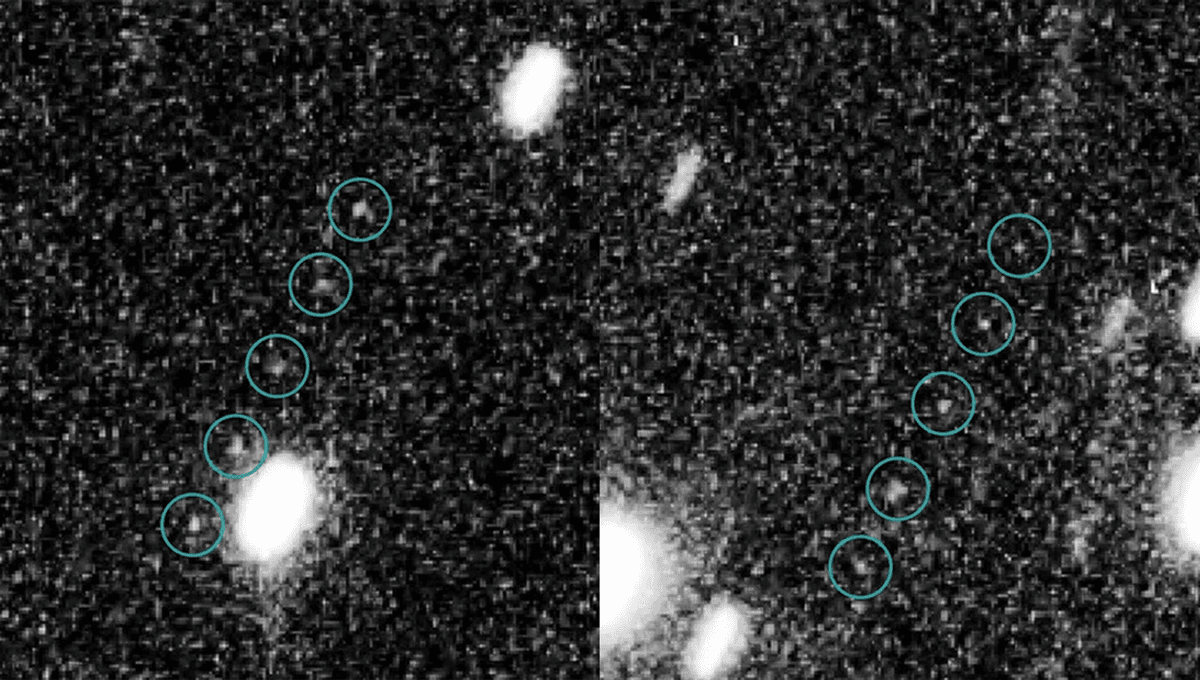
A team looking at the dynamics of objects in the Kuiper belt, the ring-shaped region of icy bodies well beyond the orbit of Neptune, believe they have found evidence for a “very old, undisturbed structure” in our Solar System.
While the Oort Cloud, thought to be between 5,000 and 100,000 astronomical units (AU) from the Sun, remains hypothetical, we have observed over 3,100 objects in the Kuiper belt, the home of Pluto, Makemake, Eris, and Arrokoth.
“The Kuiper Belt is located in the outer reaches of our solar system beyond the orbit of Neptune. It’s sometimes called the ‘third zone’ of the solar system. Astronomers think there are millions of small, icy objects in this region – including hundreds of thousands that are larger than 60 miles (100 kilometers) wide. Some of the objects, including Pluto, are over 600 miles (1,000 kilometers) wide,” NASA explains of the belt, located between 30 and 50 AU from the Sun, with one AU being the average Earth to Sun distance.
“Similar to the asteroid belt, the Kuiper Belt is a region of leftovers from the solar system’s early history. Like the asteroid belt, it has also been shaped by a giant planet, although it’s more of a thick disk (like a donut) than a thin belt.”
In 2011, a team of astronomers took a close look at the orbital distribution of 169 trans-Neptunian objects (TNOs), finding that they were not a single and simple population, but could be further split into three distinct groups.
“We find that the classical belt is a complex region with sub-structures that go beyond the usual splitting of inner (interior to 3:2 mean-motion resonance [MMR]), main (between 3:2 and 2:1 MMR), and outer (exterior to 2:1 MMR),” that team explained in their paper, published in The Astronomical Journal.
“The main classical belt (a = 40–47 AU) needs to be modeled with at least three components: the ‘hot’ component with a wide inclination distribution and two ‘cold; components (stirred and kernel) with much narrower inclination distributions.”
Of particular interest, and relevance to the latest preprint paper, is the component they dubbed the “kernel”.
“The cold population exhibits a particularly strong grouping in band of about 1 AU a thickness, centered at 44 AU (which we call the kernel). The linear number density (#/AU) of “cold” belt objects increases from the inner edge at 42.4 AU up to a maximum at ∼44.4 AU, all with rather low eccentricities,” that team continued.
“Past 44.4 AU, the linear number density drops noticeably, and classical TNOs tend to have higher eccentricities; the CFEPS-L7 model uses a ‘stirred’ population that covers the 42.4–47 AU range with a single parameterization. We favor the idea that this cold component is primordial (the objects formed at roughly their current heliocentric distances), although this is not required.”
Since that study, no further substructure has been found in the Kuiper belt. But in a new paper, which has not yet been peer reviewed, a team of scientists from Princeton University believe they may have found evidence of an “inner kernel”. The team looked at 1,650 Kuiper belt objects using a density-based clustering algorithm called DBSCAN, first seeing if it could identify the kernel, and then “if so, does it simultaneously identify any other clusters?”
Though we will have to wait for further observations for further evidence for or against this structure, dubbed the inner kernel, the team believes that they may have identified a new primordial cluster at around 43 AU.
“In addition to being located at a smaller semimajor axis (a ∼ 43 AU) as compared to the kernel (a ∼44 AU), the inner kernel also has a colder free eccentricity distribution than the kernel, both in terms of the Rayleigh distribution dispersion that best describes it (∼ 0.025) as well as the overall range (0.01−0.06),” the team explains in their paper. “As a result, the inner kernel may provide stricter constraints than the kernel with respect to the degree of dynamical heating that the Kuiper belt could have plausibly sustained during the formation and evolution of the solar system.”
What is particularly interesting about this is the low eccentricity of the proposed structure. In regular people words, the orbit is very circular.
“That kind of orbital calmness is a signal of a very old, undisturbed structure,” lead author Amir Siraj, astrophysicist at Princeton University, and lead author on the paper explained to New Scientist, “the kind of structure that can provide clues to the evolution of the solar system, how the giant planets have moved in their orbits, what kind of interstellar environments the solar system has been through, all sorts of things about the early days of the solar system.”
“It is not obvious how the inner kernel was formed,” the team adds. “Jumpy migration of Neptune is a possible explanation for the kernel that may also apply to the inner kernel.”
While it is an interesting study, we will have to wait for further observations to know more.
“It is yet unclear whether the inner kernel is an extension of the kernel or a distinct structure,” the team notes. “Forthcoming observations, including those by the Vera C. Rubin Observatory’s Legacy Survey of Space and Time (LSST) may provide further evidence for the existence of this structure, and perhaps resolve the question of whether there are two distinct structures.”
The study is posted to the preprint server arXiv.
[H/T: New Scientist]

Source Link: A "Very Old, Undisturbed Structure" May Have Been Discovered Beyond The Orbit Of Neptune, 43 AU From The Sun
