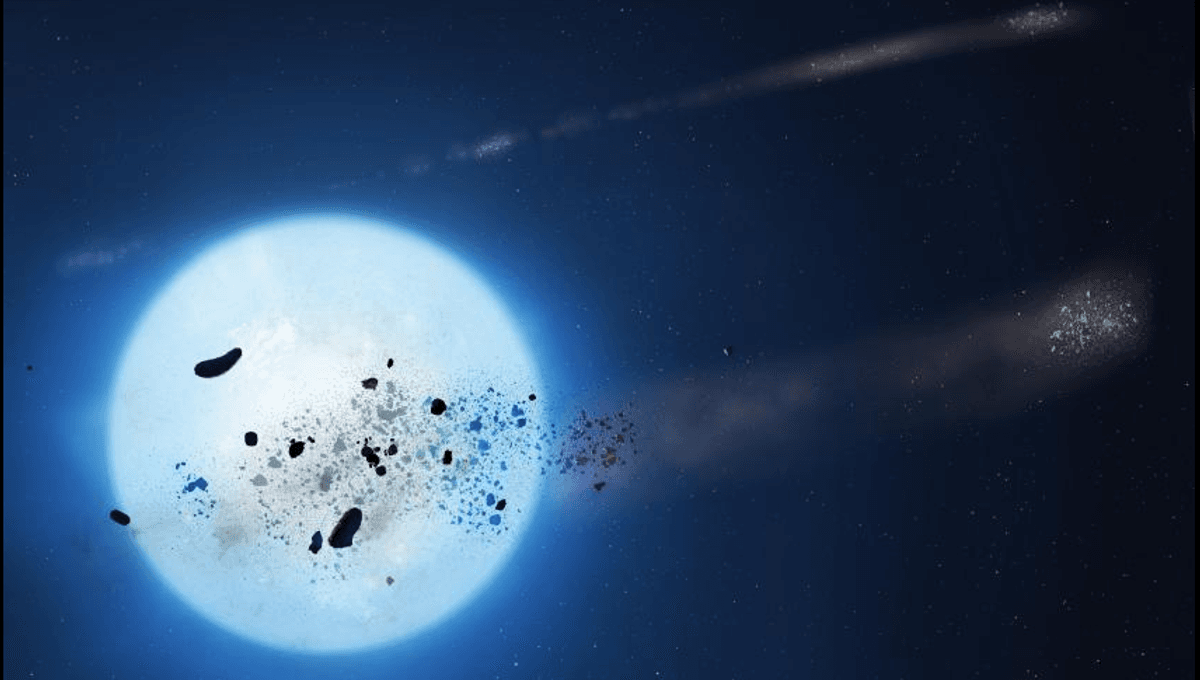
A study of white dwarf stars has some sorry news for the Earth’s future, suggesting that even if it is not consumed when the Sun is at its largest, it may one day be torn apart by the solar corpse.
Despite the occasional megaflare, the Sun is a very stable star. It has to be, or we wouldn’t be here – but it won’t be forever. Like all stars of its size, it will become a red giant, and then collapse to a white dwarf. Red giants put out so much more heat than their predecessor stars that even the beginnings of this phase will be enough to cook the Earth beyond habitability. Humanity had better have found another home by then, in the staggeringly unlikely chance we’re still around.
While the Earth will not be able to support life when that occurs, there is still debate as to whether the planet itself will survive, perhaps being a memorial for exiles to look back upon. That’s a matter of some debate, but Mercury and Venus will definitely be swallowed. Now, however, new research suggests that even if the Earth makes it through, this will not be the end of the threats it faces. Instead, the white dwarf stage, sometimes called a dead star, comes with its own risks.
Professor Boris Gaensicke of the University of Warwick, England, and Dr Amornrat Aungwerijwit of Naresuan University, Thailand, lead a team that has assembled observations of three white dwarfs over many years. They found changes in each star’s brightness which they attribute to objects being devoured, releasing bursts of dust in the process.
Although white dwarfs have less mass than their predecessor stars, having thrown some off, they are so much denser that the gravitational field in their vicinity is far more intense.
“Previous research had shown that when asteroids, moons and planets get close to white dwarfs, the huge gravity of these stars rips these small planetary bodies into smaller and smaller pieces,” said Aungwerijwit of in a statement.
The process produces dust that obscures the stars temporarily. It also leads to a change in the composition of the white dwarfs’ outer layers, allowing us to determine the make-up of the objects consumed.
“The simple fact that we can detect the debris of asteroids, maybe moons or even planets whizzing around a white dwarf every couple of hours is quite mind-blowing, but our study shows that the behavior of these systems can evolve rapidly, in a matter of a few years,” Gaensicke said. “While we think we are on the right path in our studies, the fate of these systems is far more complex than we could have ever imagined.”
In the case of the three target stars, one was steady, but apparently recovering from something catastrophic more than a decade ago. A second star was slowly brightening, but previous observations in 2015 revealed chaotic fluctuations. A third is the most mysterious, dimming every few months with changes by the minute during these periods. “These long-term changes may be the result of the ongoing disruption of a planetesimal, or the collision between multiple fragments, both leading to a temporarily increased dust production,” the authors write.
These stars would have cleared out the areas around them during their red giant phase. Consequently, the objects currently being pulverized must have had more distant orbits, like those of Mars or the asteroid belt. Once the white dwarf stage had begun, something must have disrupted the unfortunate objects’ orbits, causing them to travel close enough to the dead star to suffer the effects of its gravity.
Exactly what causes such disruptions is not clear, but the fact that each of these stars is either consuming something substantial right now, or has done so in recent years, suggests it is a common process. The white dwarfs in this study were far from a random sample. The authors propose a few percent of white dwarfs are disintegrating debris at any time, which presumably most do over longer timespans.
If the Earth survives the red giant phase, it will make a much larger target than some measly asteroid, and therefore be harder to disrupt. On the other hand, at this point it would be the survivor with the innermost orbit, making its chances of evading the dusty fate dicey.
The study is published in Monthly Notices of the Royal Astronomical Society.

Source Link: A Zombie Sun May One Day Tear The Earth Apart
