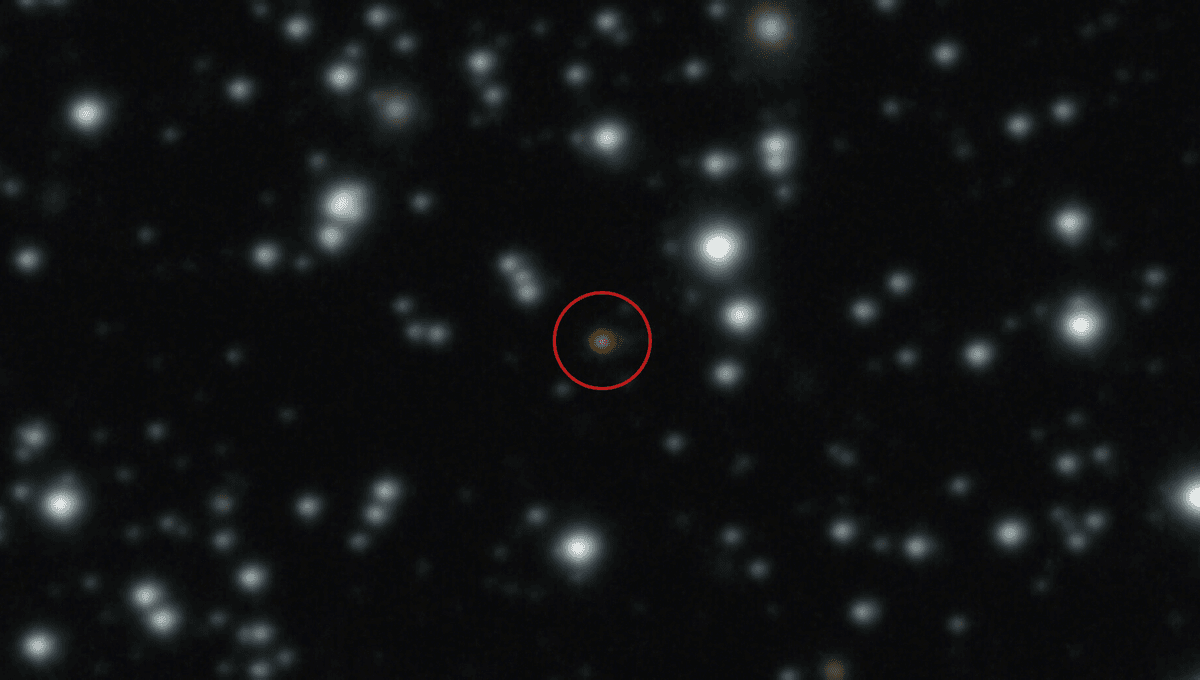
A gamma ray burst (GRB) unlike anything we detected before has released some of the most powerful photons in the universe four times in the course of 24 hours. The event was not the most powerful GRB ever detected, but was easily the longest.
It’s only a few decades since astronomers thought supernovae were the most powerful events in the universe, but in recent times, we’ve learned they can be overshadowed by neutron star mergers and GRBs. Some GRBs accompany supernovae, revealing they release even more energy in their first seconds than we realized, others are thought to result from black holes consuming stars. Other categories may also exist.
Both these events destroy the source, making the discovery of repeating GRBs, which appear to come from the same place months or years apart, a further puzzle. This latest signal, GRB 250702B, tops anything we have seen before for strangeness. Either it can be viewed as at least four events happening in ridiculously short succession, or one lasting a day compared to the usual milliseconds, or a few hours for the previous record.
“This is 100-1,000 times longer than most GRBs,” said Professor Andrew Levan of Radboud University, Netherlands, in a statement. Repeating GRBs have been seen before, but these have been among the shortest bursts, and release far less energy than GRB 250702B. They’re thought to come from magnetars.
The Fermi Gamma-ray Space telescope alerted astronomers to GRB 250702B on July 2, only to witness two more bursts 47 minutes and three hours later. Impressive as that would be on its own, further investigation revealed the Einstein X-ray space telescope had picked up fading signs of a burst from the same location 10 hours earlier, which probably took place the previous day.
Neither instrument could locate the source precisely, but the Swift X-Ray telescope gave enough direction for the Very Large Telescope (VLT) to seek the afterglow in the infrared, further deepening the mystery.
Timelapse of observations for the burst.
Powerful GRBs come from outside the galaxy, while the smaller ones from magnetars can be closer at hand. With GRB 250702B located close to the galactic plane, where the most interesting Milky Way events usually occur, it initially seemed likely we were looking at something in our cosmic neighborhood. “Before these observations, the general feeling in the community was that this GRB must have originated from within our galaxy. The VLT fundamentally changed that paradigm,” Levan said.
The Hubble Space Telescope has since confirmed the VLT’s evidence that this is an extra-galactic event, requiring a far more powerful source than a magnetar to be seen at such a distance. Indeed, current estimates are that the source is billions of light years away, although these are still quite uncertain. The galaxy suspected of being the source has an unusually complex shape. Natural as it is to suspect this complexity is connected to the event, it’s not obvious how.
Another fact, which may or may not be significant, is that the gap between the last and second last burst is exactly three times as long as the space before it. Unusually, the last burst was the brightest, releasing more energy than the first two combined.
“If this is a massive star, it is a collapse unlike anything we have ever witnessed before,” Levan said. On the surface, a star being ripped apart by a black hole makes more sense, presumably with some predigestive process where it got broken up and consumed in stages.
However, the authors conclude that to match the specifics of what was observed, this scenario would require the star to have some unusual features, and the black hole would need to be even more distinctive. Their best bet is a white dwarf being shredded by an intermediate mass black hole. However, since black holes in this mass range are so rare that astronomers still weren’t convinced they existed a few years ago, it’s clear it would take a remarkable combination of circumstances for something like this to occur.
The event is so remarkable that telescopes across the electromagnetic spectrum, JWST included, have been diverted from their planned tasks to try to make sense of what is going on.
The observations are open access in the Astrophysical Journal Letters.

Source Link: Abnormally Long Gamma Ray Burst Unlike Anything We've Seen Before Baffles Astronomers
