Scientists respond to handwringing about our failure to find evidence for life beyond the Solar System by pointing out how limited our searches so far have been. Even if our instruments have picked up a signal, however, we may have overlooked it using decades-old algorithms to comb the data.
That idea has become more plausible with the application of a machine learning-based selection method to data from a major radio telescope. The system identified 100 times as many patterns in the noise deserving investigation as had been noticed previously.
Although none of these have yet led to strong indications of alien life – you’d have heard about it if they had – a paper in Nature Astronomy reports that eight are sufficiently interesting as to prompt follow-up observations. All this from a tiny sliver of humanity’s radio telescope recordings.
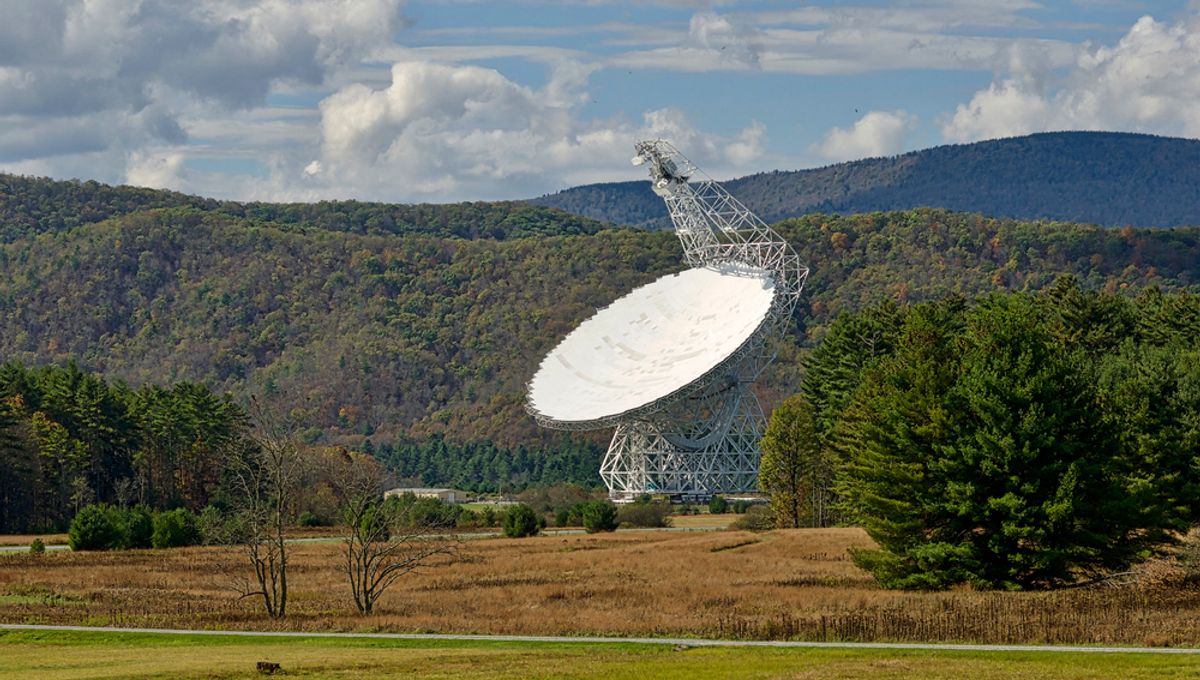
The data analyzed came from 480 hours of observations of 820 stars made by the Robert C. Byrd Green Bank radio telescope, booked by SETI Breakthrough to search for radio waves that may indicate the presence of alien civilizations.
No one is anticipating a deliberate signal directed straight at Earth like the one in Contact. Instead, astronomers are hoping for stray leakage. Identifying this is a challenge, however, since it has to be distinguished not only from natural radio emissions but from the hubbub of Earth-based and satellite sources. The apparent signal known as BCL1, initially thought to come from the direction of Proxima Centauri, shows how hard these can be to tell apart.
Breakthrough Listen’s system initially identified 2.9 million “signals of interest”, narrowed to 20,515 worthy of human attention. This compares with approximately 200 found in the same data using previous methods.
The authors followed up eight (labeled MLc1-8) from seven stars, hoping for a repeat. The re-examination struck out, but the team are encouraged by the system’s sensitivity.
“We’re scaling this search effort to 1 million stars today with the MeerKAT telescope and beyond. We believe that work like this will help accelerate the rate we’re able to make discoveries in our grand effort to answer the question ‘are we alone in the universe?’” said lead author Peter Ma, an undergraduate at the University of Toronto, in an emailed statement.
The data Ma examined was collected years earlier, reducing the prospects of finding anything on a second look. The team are excited about being able to investigate data more quickly, shortening the time to follow up studies.
“It is a pity that, despite attempts reported by the team, these signals could not be confirmed by other instruments,” said Dr Franck Marchis of SETI, who was not an author on the study, in a statement emailed to IFLScience. “The MLc1 and MLc7 signals are very interesting because they were recorded on two different dates, suggesting that they are not known interference if they are terrestrial in nature. Such a discovery requires confirmation by other instruments before we can be sure that we have detected extraterrestrial life. Nevertheless, this scientific result shows that it is now possible to announce this kind of detection quickly enough to do the necessary follow-up.”
“The arrival of large networks such as MeerKAT and the SKA, which will produce terabytes of data per week, make it imperative that SETI research adopt powerful algorithms such as deep learning,” Marchis added. “We hope that this algorithm will be able to detect a signal more quickly than conventional methods because this will allow us to follow up with other antennas and therefore confirm whether a signal is extraterrestrial.
The paper is published in Nature Astronomy.

Source Link: AI Finds Possible Overlooked Alien Signals In Radio Telescope Data
