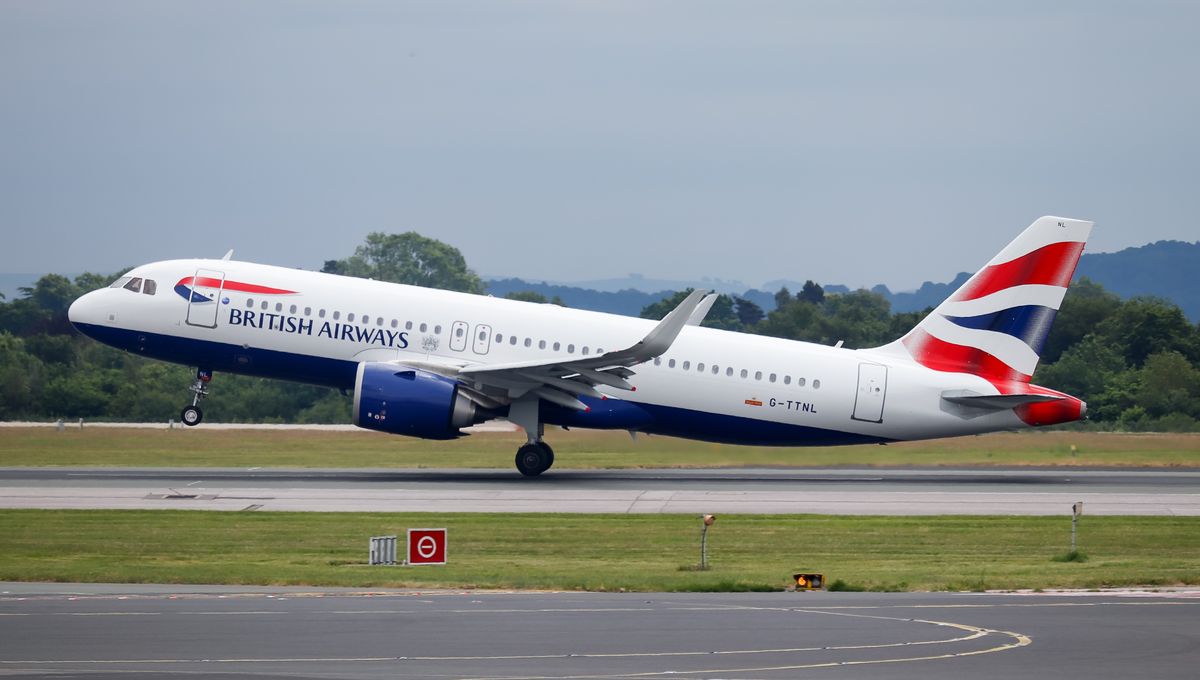
On Friday, several thousand Airbus planes had to be grounded to make sure that their onboard computers would not suffer from unusual but potentially very serious interference. The source of the interference was not even of this Earth – the French company was concerned about the effect of an increase in solar radiation on the onboard software.
The rest of this article is behind a paywall. Please sign in or subscribe to access the full content.
The Sun is constantly spewing charged particles: the solar wind. There are also particles coming from beyond the Solar System known as cosmic rays. These particles are raining on us every moment of every day. The Sun occasionally launches more energetic plasma into space, and those powerful solar storms can play havoc with electronics as well as creating beautiful aurorae at lower latitudes, like on May 14, 2024.
About 6,000 planes were affected, with over 5,000 of them requiring a straightforward software update. For 900 older models, a replacement computer was needed. Air traffic in general was not severely affected.
“Analysis of a recent event involving an A320 Family aircraft has revealed that intense solar radiation may corrupt data critical to the functioning of flight controls,” Airbus said in a statement.
“Airbus has consequently identified a significant number of A320 Family aircraft currently in-service which may be impacted.”
The problem was with software that calculates the elevation of a plane. Solar particles from the Sun can mess with the onboard hardware, leading to software issues. It has been suggested that a JetBlue plane that had to perform an emergency landing in October was affected by this issue.
“Particles from space, mostly from the Sun, can occasionally strike an airplane’s electronics. Because aircraft fly where the atmosphere is thinner, more of these high-energy particles are able to reach them. When one passes through a microchip, it can flip a tiny “bit,” the smallest unit of digital information in the microchip, stored as a 0 or a 1. This creates a glitch known as a single-event upset, which can make an electronic system behave in unexpected ways,” Professor Mathew Owens, Professor of Space Physics at the University of Reading, stated in an expert comment on the situation.
“However, we still do not know whether this had anything to do with the situation Airbus is looking into, or what sequence of events they are investigating. As more information emerges, we will get a clearer picture of what actually happened.”
The monitoring of the Sun is fundamental to protecting our technology and ourselves. Some satellites specifically study space weather, the interaction between solar phenomena and our planet, while others study the Sun itself to better understand our star. We are moving towards the solar minimum, so powerful events will be fewer and farther between, but the Sun never really sleeps.

Source Link: Airbus Just Had To Ground 6,000 Of Its Airplanes – Was A Celestial Threat To Blame?
