• Email Us: [email protected]
  • Contact Us: +1 718 874 1545
  • Skip to main content
  • Skip to primary sidebar

Medical Market Report

  • Home
  • All Reports
  • About Us
  • Contact Us

Alien Life On Enceladus Could Be Found By Studying Saturn’s Rings

February 24, 2023 by Deborah Bloomfield

The E-ring is quite unlike all the other rings of Saturn. It is much wider, roughly the Earth-Moon distance, and much thicker than the other rings. It is also rich in microscopic particles of ice and silica and the Cassini mission identified the icy moon Enceladus as its creator.

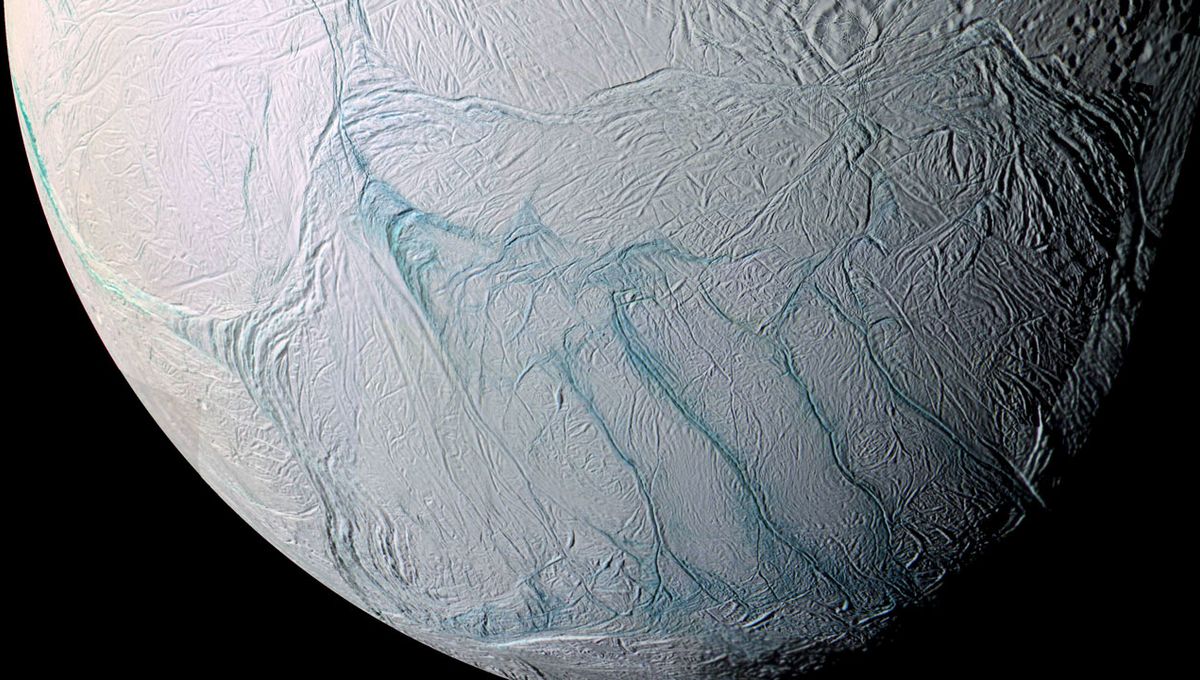
Underneath its icy shell, Enceladus harbors a deep water-ocean with hydrothermal activity at its bottom. And on the southern pole of the moon, a region called the tiger stripes is known to have geysers. And these geysers launch material into space and ended up forming the E-ring.

Advertisement

It is unclear how the nano-silica particles seen by Cassini formed but one suggestion sees them as coming from the seafloor of Enceladus, and new models agree with the idea. Materials can be lifted from the moon’s seafloor and taken to the icy shell in a matter of months.

“Our model shows that these grains may be transported through the ocean interior on timescales faster than previously thought,” Assistant Professor Emily Hawkins, from Loyola Marymount University, said in a statement. “The nano-silica material is thought to be important in the generation of life on the icy moon. Ultimately, our research aids in the understanding of the habitability of Enceladus, and will guide future missions to the outer solar system moon.”

What keeps the interior of Enceladus going is the tidal forces it experiences as it goes around Saturn in a strongly elliptical orbit. The forces squish the rocky core and the ice shell and the bottom of the ocean gets heated by hydrothermal vents that form there.  

“It’s like boiling a pot on a stove. Tidal friction adds heat to the ocean and causes upwelling currents of warm water,” explained planetary scientist Ashley Schoenfeld, the article’s lead author and a graduate student at the University of California, Los Angeles. “What our study shows is that these flows are strong enough to pick up materials from the seafloor and bring them to the ice shell that separates the ocean from the vacuum of space.”

Advertisement

While it takes only a few months for particles to rise from the seafloor, it is unclear how long its takes for them to be sprayed into space. The process might be quick or it could involve more complex processes related to the ice shell. 

The team is now looking further into this distant ocean evolution and investigating what might end up in space. But it is clear that understanding the composition of the E-rings might provide fantastic insights into what lies beneath the ice shelf. Maybe even life.

The work was published in Communications Earth & Environment.

Deborah Bloomfield
Deborah Bloomfield

Related posts:

  1. Asian shares fall on growth and tapering fears, dollar holds firm
  2. Osano, a risk and compliance startup, raises $11M
  3. Vlad Novakovski and Nicole Quinn to elucidate Series A fundraising
  4. A new US bill would force companies to disclose ransomware payments

Source Link: Alien Life On Enceladus Could Be Found By Studying Saturn’s Rings

Filed Under: News

Primary Sidebar

  • US Just Killed NASA’s Mars Sample Return Mission – So What Happens Now?
  • Art Sleuths May Have Recovered Traces Of Da Vinci’s DNA From One Of His Drawings
  • Countries With The Most Narcissists Identified By 45,000-Person Study, And The Results Might Surprise You
  • World’s Oldest Poison Arrows Were Used By Hunters 60,000 Years Ago
  • The Real Reason You Shouldn’t Eat (Most) Raw Cookie Dough
  • Antarctic Scientists Have Just Moved The South Pole – Literally
  • “What We Have Is A Very Good Candidate”: Has The Ancestor Of Homo Sapiens Finally Been Found In Africa?
  • Europe’s Missing Ceratopsian Dinosaurs Have Been Found And They’re Quite Diverse
  • Why Don’t Snorers Wake Themselves Up?
  • Endangered “Northern Native Cat” Captured On Camera For The First Time In 80 Years At Australian Sanctuary
  • Watch 25 Years Of A Supernova Expanding Into Space Squeezed Into This 40-Second NASA Video
  • “Diet Stacking” Trend Could Be Seriously Bad For Your Health
  • Meet The Psychedelic Earth Tiger, A Funky Addition To “10 Species To Watch” In 2026
  • The Weird Mystery Of The “Einstein Desert” In The Hunt For Rogue Planets
  • NASA Astronaut Charles Duke Left A Touching Photograph And Message On The Moon In 1972
  • How Multilingual Are You? This New Language Calculator Lets You Find Out In A Minute
  • Europa’s Seabed Might Be Too Quiet For Life: “The Energy Just Doesn’t Seem To Be There”
  • Amoebae: The Microscopic Health Threat Lurking In Our Water Supplies. Are We Taking Them Seriously?
  • The Last Dogs In Antarctica Were Kicked Out In April 1994 By An International Treaty
  • Interstellar Comet 3I/ATLAS Snapped By NASA’s Europa Mission: “We’re Still Scratching Our Heads About Some Of The Things We’re Seeing”
  • Business
  • Health
  • News
  • Science
  • Technology
  • +1 718 874 1545
  • +91 78878 22626
  • [email protected]
Office Address
Prudour Pvt. Ltd. 420 Lexington Avenue Suite 300 New York City, NY 10170.

Powered by Prudour Network

Copyrights © 2026 · Medical Market Report. All Rights Reserved.

Go to mobile version