• Email Us: [email protected]
  • Contact Us: +1 718 874 1545
  • Skip to main content
  • Skip to primary sidebar

Medical Market Report

  • Home
  • All Reports
  • About Us
  • Contact Us

Amateur Astronomer Captures Large Flash As Something Slams Into Jupiter

November 28, 2023 by Deborah Bloomfield

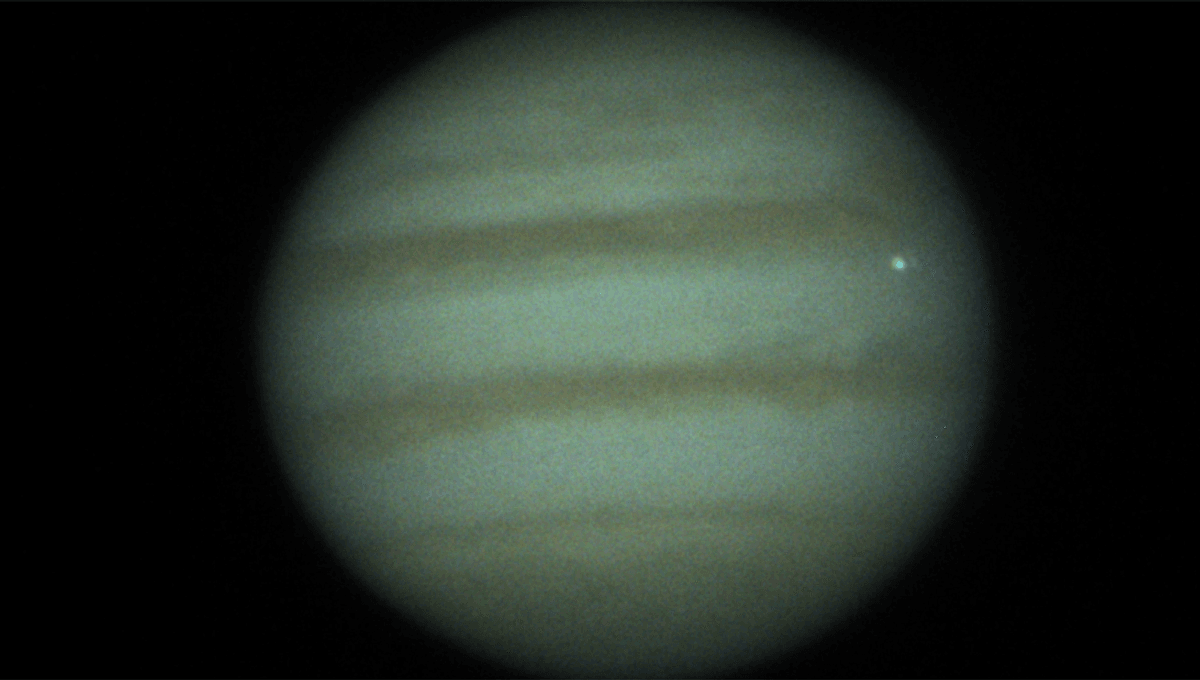
An amateur astronomer has captured an object slamming into Jupiter, producing a bright flash of light as it disintegrated in the gas giant’s atmosphere.

Jupiter is so massive that it technically doesn’t orbit the Sun. With such a gravitational pull, you’d expect it to be regularly impacted by asteroids that make their way to its part of the Solar System, and you’d be right. One model simulation study in 2013 estimated that the planet experiences 12−60 impacts of 5 to 20 meter (16.5 to 65 foot) diameter objects every year. Another study estimated that larger objects of around 1.6 kilometers (1 mile) in diameter impact the planet once every 6,000 years. 

Advertisement

However, actually capturing these impacts as they happen is something of a rarity. At the time of that study, three flashes had been captured by amateur astronomers on the planet, which the team determined to be asteroids.

The latest impact, captured by amateur astronomer Kunihiko Suzuki on November 15, is one of only a small handful of such events recorded on the planet.

ⓘ IFLScience is not responsible for content shared from external sites.

Studying the light curves from such impacts can tell us about the amount of energy released by the object (be it an asteroid or comet) as well as what the object was.

Advertisement

The more we learn about such impacts the better. Many suspect Jupiter plays a role in protecting the inner planets from asteroid impacts, drawing comets and asteroids away from us. 

#asteroids and the Hilda group orbiting the Sun. The second part shows three Hilda group orbits and in the last part, the asteroids are shown orbiting in #Jupiter ‘s co-orbiting frame.
For a smoother version see: https://t.co/1uFriYiRrN pic.twitter.com/iKnmcyt1in— Petr Scheirich (@PScheirich)

ⓘ IFLScience is not responsible for content shared from external sites.

Searching for systems with gas giants may help us find planets that have been similarly shielded from extinction-causing impact events that could wipe out life before it progressed beyond single-celled organisms. However, there have also been suggestions that the planet acts as a slingshot, pulling in objects from further out in the Solar System that would otherwise not have made it closer to the Sun.

Deborah Bloomfield
Deborah Bloomfield

Related posts:

  1. Facebook questions British watchdog’s authority to order Giphy sale
  2. S.Africa’s Zuma seeks to replace prosecutor in arms trial
  3. Burro raises $10.9M for autonomous produce field transport
  4. How Much Heat Can A Human Take? Scientists Crack The Critical Limit

Source Link: Amateur Astronomer Captures Large Flash As Something Slams Into Jupiter

Filed Under: News

Primary Sidebar

  • In 1940, A Dog Investigated A Hole In A Tree And Discovered A Vast Cave Filled With Ancient Human Artwork
  • “Time Is Not Broken”: US Officials Work To Correct Time, After Discovering It Is 4.8 Microseconds Out
  • The Evolutionary Reason Why Rage Bait Affects Us – And How To Deal With It This Holiday Season
  • Whales Living To 200 May Actually Be The Norm – There’s A Sad Reason Why We Don’t Know Yet
  • IFLScience The Big Questions: Can Magic Be Used As A Tool In Science?
  • Sheep And… Rhinos? There’s A Very Cute Reason You See Them Hanging Out Together
  • Why Does The Latest Sunrise Of The Year Not Fall On The Winter Solstice?
  • Real Or Fake Christmas Trees: Which Is Better For The Environment?
  • “Cosmic Dipole Anomaly” Suggests That Our Universe May Be “Lopsided”, Seriously Challenging Our Understanding Of The Cosmos
  • Which Animals Mate For Life?
  • Why Is Rainbow Mountain So Vibrantly Colorful?
  • “It’s An Incredible Feeling”: Salty Air Bubbles In 1.4-Billion-Year-Old Crystals Reveal Secrets Of Earth’s Early Atmosphere
  • These Were Some Of The Most Significant Scientific Experiments Of 2025
  • Want To Know What 2026 Has In Store? The Mesopotamians Have A Tip, But You’re Not Going To Like It
  • Can Woolly Bear Caterpillars Predict Winter Weather? No – But They Do Have A Clever Way To Survive The Freeze
  • Is Showering More Hygienic Than Bathing – What Does The Science Say?
  • Why Is Christmas Called Xmas?
  • Stardust Didn’t Reach The Solar System The Way We Thought, So How Did It Get Here?
  • This Might Be The First Time We’ve Ever Seen A Gravitational Wave Event Gravitationally Lensed
  • Carnivorous, Enormous, And Corpse-Scented: What Are The Rarest Plants On Earth?
  • Business
  • Health
  • News
  • Science
  • Technology
  • +1 718 874 1545
  • +91 78878 22626
  • [email protected]
Office Address
Prudour Pvt. Ltd. 420 Lexington Avenue Suite 300 New York City, NY 10170.

Powered by Prudour Network

Copyrights © 2025 · Medical Market Report. All Rights Reserved.

Go to mobile version