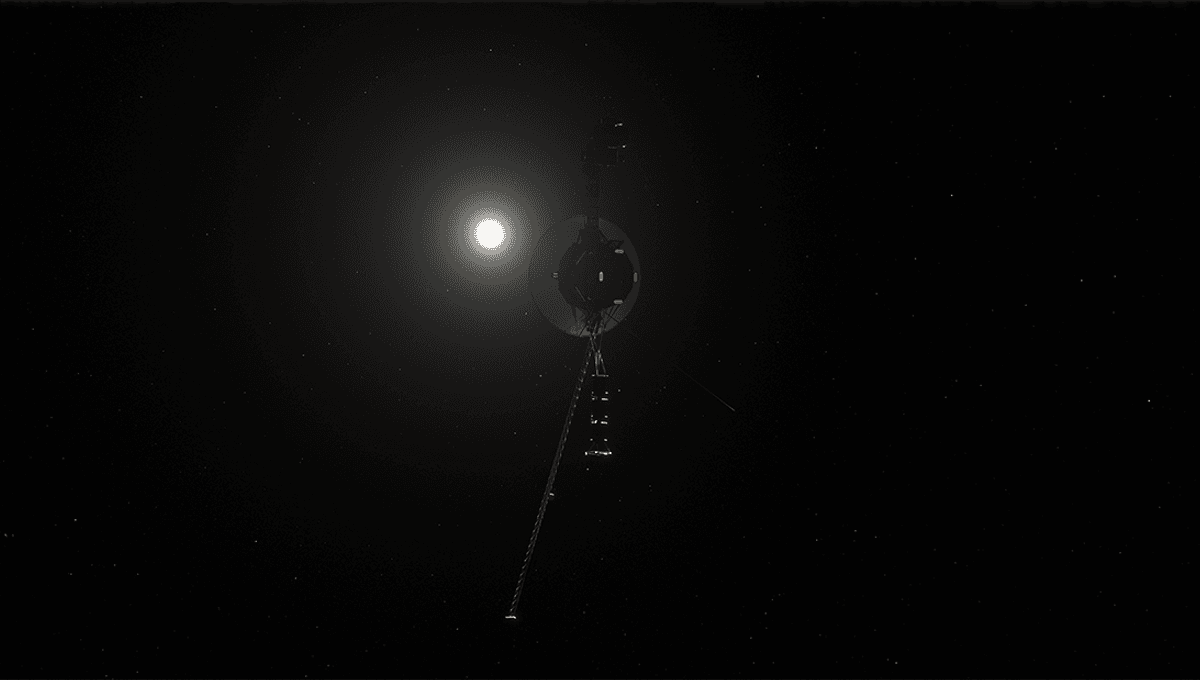
Amateur astronomers in Dwingeloo in the northeastern Netherlands have picked up a signal from NASA’s ailing Voyager 1 spacecraft, around 24.9 billion kilometers (15.5 billion miles) away.
The Voyager probes, launched in 1977, have performed spectacularly well over nearly half a century, flying past various planetary bodies and studying them on their way to the outer reaches of the Solar System. But time, and a diminishing supply of fuel, have taken their toll on the spacecraft in recent years, forcing NASA to shut down scientific instruments in order to keep them running.
Several glitches have taken place over the last year too, with Voyager 1 sending back nonsense for six months before NASA was able to sort the issue. In the latest error to hit the probe, on October 19 it stopped sending signals back to Earth at all.
However, the impressive spacecraft’s onboard computer was able to solve the situation by switching to using a transmitter that had not been used since 1981.
“The flight team suspected that Voyager 1’s fault protection system was triggered twice more and that it turned off the X-band transmitter and switched to a second radio transmitter called the S-band,” NASA’s Tony Greicius explained in the Voyager Blog soon after the transmitter was confirmed to be working.
“While the S-band uses less power, Voyager 1 had not used it to communicate with Earth since 1981. It uses a different frequency than the X-band transmitters signal is significantly fainter. The flight team was not certain the S-band could be detected at Earth due to the spacecraft’s distance, but engineers with the Deep Space Network were able to find it.”
Though the transmitter was working, Voyager was still not fully operational. But in an update, NASA has confirmed that they were able to reactivate the X-band transmitter, and the spacecraft resumed collecting data with its four remaining powered-up science instruments in the week of November 18.
Thankfully, the signals received from Voyager 1 still appear to be coherent and strong enough to detect on Earth. Amateur astronomers in the Netherlands were able to detect the signal, using the Dwingeloo radio telescope, now a national monument available for public projects.
“Since the Dwingeloo telescope was designed for observing at lower frequencies than the 8.4GHz telemetry transmitted by Voyager 1, a new antenna had to be mounted. At these higher frequencies, the mesh of the dish is less reflective, making it extra challenging to receive faint signals,” C.A. Muller Radio Astronomy Station (CAMRAS) explained in a blog post.
“To find the very weak carrier signal in the noise, we used orbital predictions of Voyager 1 to correct for the Doppler shift in frequency caused by motion of Earth and Voyager 1. By doing so, the signal could be seen live in the telescope observation room. Later analysis confirmed that the Doppler shift corresponds to that of Voyager 1.”
Despite the telescope being far smaller than those that make up NASA’s Deep Space Network, the team was able to receive the signal, making it one of the few telescopes on Earth to have received communication from Voyager 1. At four times the distance of Pluto, the signal took over 23 hours to make it to Earth.
Meanwhile at NASA, scientists are now attempting to return the spacecraft to the condition it was in before the communication errors arose, including doing a reset of the system that synchronizes Voyager 1’s onboard computers. With a little luck, there’s a few more years of life in the old dog yet, before it powers down completely.

Source Link: Amateur Astronomers Detect Signal Coming From Voyager 1 Spacecraft, 24.9 Billion Kilometers Away
