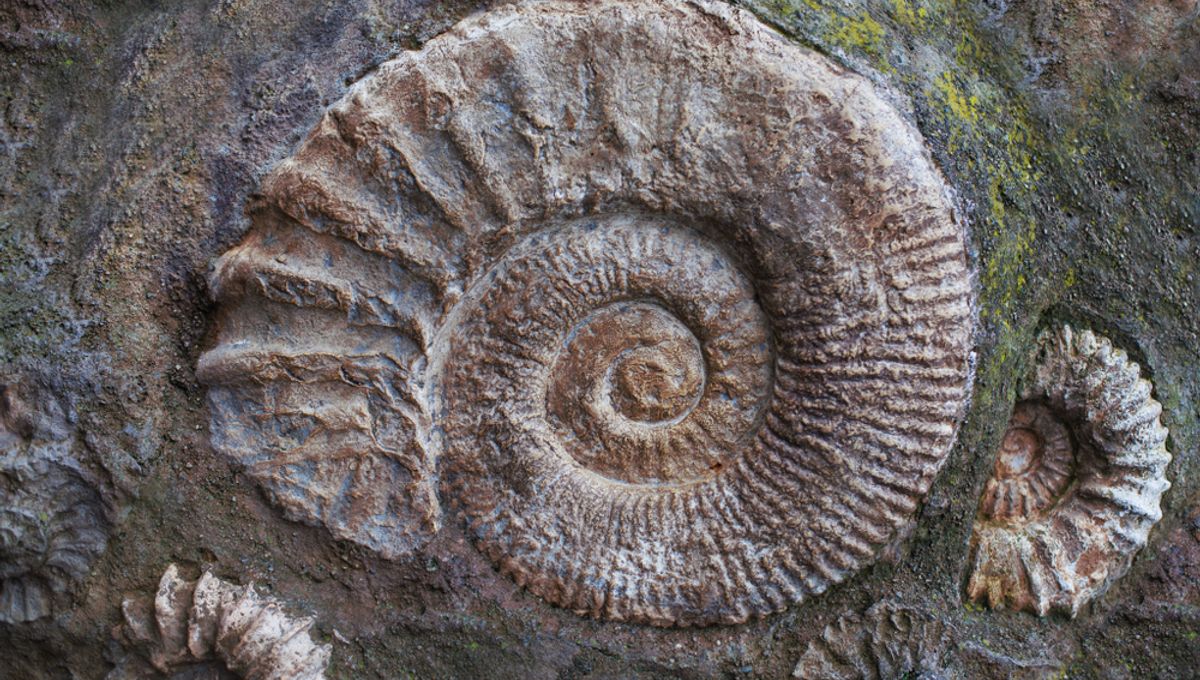
Evidence for ammonite survival into the Paleogene era is solid, a new study confirms, indicating that these ancient mollusks were well positioned to inherit oceans now cleared of competitors. Yet for some reason, the fossils stop within 200,000 years, leaving the mystery of ammonite extinction even more puzzling than before.
There’s a reason the film about the fossil-hunter Mary Anning was called Ammonite. On Dorset’s Jurassic Coast, where Anning transformed paleontology, ammonites represent the most common form of ancient life turned to stone. The same is true in many other parts of the world, reflecting not only how abundant these armored cephalopods were, but how enduring. For 340 million years, they were a major presence in the oceans, and then they were gone.
Ammonites disappear from the fossil record close enough to the time the non-avian dinosaurs make their own exit, 66 million years ago, that it was assumed their extinctions were related, even before we knew a space rock was to blame. Discussion hinged on how, rather than whether, an asteroid or comet caused the ammonite demise, and why the nautilids, relatives that lived a similar lifestyle, were more enduring.
The discovery of ammonite fossils in rocks laid down on both sides of the North Atlantic after the mass extinction led some to rethink this, but most information about ammonites continues to claim they died with the dinosaurs. If these fossil anachronisms are considered at all, they are treated as displaced older fossils that had somehow been buried in the wrong strata. Indeed, there were even suggestions that the ammonites were on their way out before the impact, although more recent research has challenged this.
However, Professor Marcin Machalski of the Polish Academy of Sciences and colleagues conducted a detailed study of limestone at Stevns Klint, Denmark. Many of these limestones were deposited during the lower Danian, the first million or so years after the Cretaceous-Paleogene (K-Pg) extinction event.
Machalski and coauthors found 10 ammonites they identified as coming from three genera: Hoploscaphites, Baculites, and Fresvillia. Only one of them shows any of the common signatures of a reburied fossil. The other specimens were accompanied by signs, such as a void within the limestone indicating burial of an intact shell, that make the authors confident this was their original burial place.
Notably, Fresvillia ammonites have not been found in Denmark from the last period of the Cretaceous, suggesting that not only did this genus make it through the extinction event, but it was initially expanding its range thereafter.
The site where the ammonites were found has been declared a UNESCO World Heritage site because it preserves so many fossils from shortly before and after the extinction, as well as a clear geochemical signal to mark the boundary. Although this makes identifying the age of fossils easier than at many other locations, the site does have older mounds that stick up between basins filled with Danian deposits. That made it initially plausible that fossils deposited in these mounds could have eroded out and been reburied in Paleogene stone in neighboring basins. However, the authors argue the specimens themselves are inconsistent with this idea.
Machalski himself was one of the first critics of the idea that ammonites survived the mass extinction, only to subsequently change his mind.
How long the ammonites survived after the asteroid impact remains a big question. The Stevns Klint deposit provides indications of ammonites from at least 68,000 years ago, and potentially as much as 200,000 years. This is a much longer timescale than indicated by deposits in the Netherlands and the United States, which were previously considered the best evidence for Paleogene ammonite survival.
Impressive as the ammonites’ survival was, the bigger question remains unanswered – what could have eventually wiped out a clade that made it through three mass extinctions? The authors refer to what they call the “Dead Clade Walking” phenomenon, where a branch of the tree of life survives some major threat, yet is somehow weakened enough to succumb thereafter. In this case, it would be a dead clade swimming, but why?
It had previously been thought that ocean acidification, a likely short-term consequence of the impact, had destroyed ammonites’ capacity to build their shells, but tens of thousands of years later, ocean chemistry was back to normal.
The study is published open access in Scientific Reports.

Source Link: Ammonites Survived The Asteroid That Killed The Dinosaurs, So What Killed Them Not Long After?
