• Email Us: [email protected]
  • Contact Us: +1 718 874 1545
  • Skip to main content
  • Skip to primary sidebar

Medical Market Report

  • Home
  • All Reports
  • About Us
  • Contact Us

An Ancient Planet May Be Trapped Near The Center Of The Earth

February 17, 2024 by Deborah Bloomfield

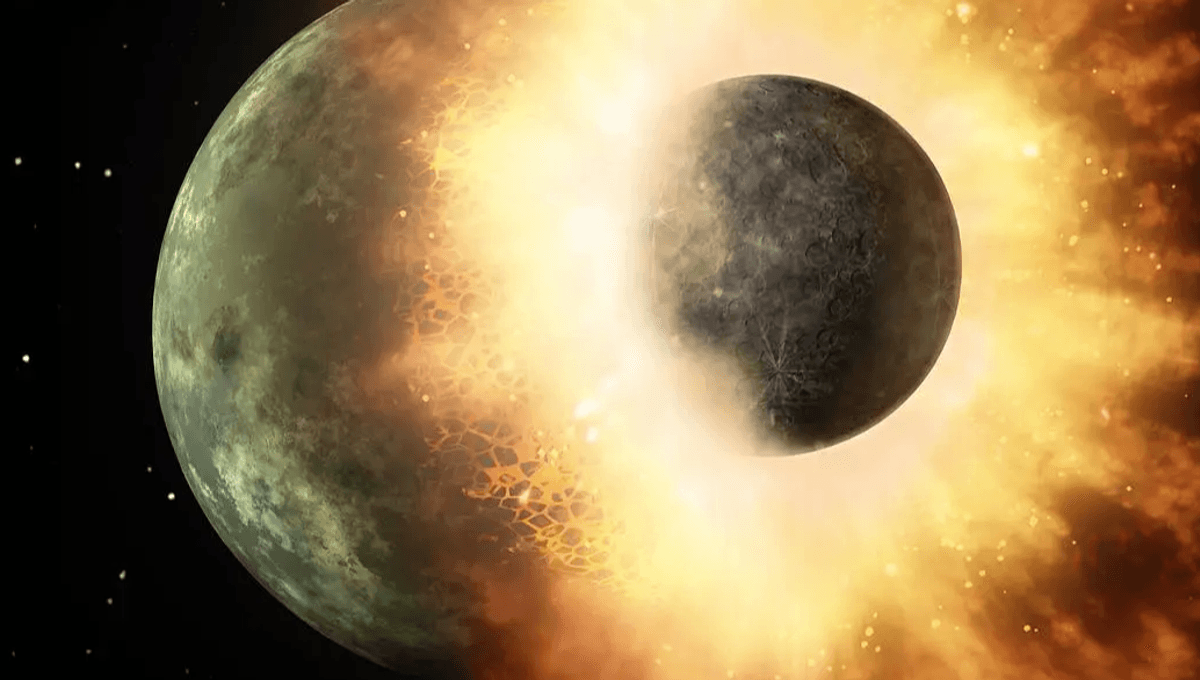
Inside our planet, there are the remains of another world. No, we are not peddling some conspiracy theory like the hollow Earth. We are talking about the remains of Theia, the Mars-sized object that, billions of years ago, hit our planet and led to the formation of the Moon. Its remains were simply incorporated with our planet but not completely. This is the bold idea that has acquired more and more evidence in recent years.

The impact between Earth and Theia may have literally left a big mark on our planet. There are two peculiar structures buried deep in the mantle, surrounding the Earth’s core. They are known as Large Low-Velocity Provinces (LLVPs). These anomalous formations are located beneath the African Tectonic plate and the Pacific tectonic plate. They are believed to have sunk as they are denser than the surrounding mantle material.

Advertisement


Their density depends on their chemical composition. Researchers used seismic waves as a sonogram of the Earth’s interior and found these denser regions. They believe they have more iron than the rest of the mantle and that’s where the connection came from. Dr Qian Yuan from Caltech was listening to a seminar given by Professor Mikhail Zolotov in 2019, when Zolotov explained the Gaia hypothesis and commented that the Moon is rich in iron like, presumably, Theia was.

“Right after Mikhail had said that no one knows where the impactor is now, I had a ‘eureka moment’ and realized that the iron-rich impactor could have transformed into mantle blobs,” Dr Yuan said in a statement.

Detailed simulations showed that the scenario is a sound hypothesis. An impact with Theia would not completely devastate the planet, and much of the energy and material would remain in the upper mantle. There the “Theia blobs” coalesced and eventually sank to the bottom near the mantle-core boundary. The team compares this to lava lamp wax. If the lower mantle had been hotter, the LLVPs would have not existed, as the material would have mixed better.

Advertisement


The team is now investigating what consequence having these structures in the middle of the mantle during the formative years of our planet might have had on Earth’s geology. Our world is quite unique, geologically, compared to the other ones in the Solar System.

“A logical consequence of the idea that the LLVPs are remnants of Theia is that they are very ancient,” Dr Paul Asimow said. “It makes sense, therefore, to investigate next what consequences they had for Earth’s earliest evolution, such as the onset of subduction before conditions were suitable for modern-style plate tectonics, the formation of the first continents, and the origin of the very oldest surviving terrestrial minerals.”

A paper describing the results is published in the journal Nature.

Deborah Bloomfield
Deborah Bloomfield

Related posts:

  1. Egyptian fintech MNT-Halan lands $120M from Apis Partners, DisrupTech and others
  2. Denmark needs more wind, solar to hit emissions target, lobby says
  3. Sully The “Male” Gorilla Surprises Zookeepers By Giving Birth To A Baby Girl
  4. People Are Just Now Learning That Pistachios Can Spontaneously Combust

Source Link: An Ancient Planet May Be Trapped Near The Center Of The Earth

Filed Under: News

Primary Sidebar

  • Rare Core Samples Provide “Once In A Lifetime” Opportunity To Study The Giant Line That Slices Through Scotland
  • The “Special Regions” On Mars Where It Is Forbidden To Explore, For Good Reason
  • Do Animals Fall For Magic Tricks? Watch A Devastated Squirrel Monkey Prove That Yes, They Do
  • Google’s CEO Wants AI Data Centers In Space In 2027. There Is One Massive Problem
  • Live Seven-Arm Octopus Spotted In The Deep Sea – Only The Fourth Time It’s Been Seen In 40 Years
  • Uranus May Not Be So Weird After All – Voyager Just Caught It During An Unusual Gust Of Wind
  • “Exceptional” 5.5-Million-Light-Year-Long Cosmic Structure Appears To Be Rotating, Challenging Current Models Of The Universe
  • How A Mystery Volcano Sparked The Black Death In The 14th Century
  • A Strange New Species Of Bird Has Worrying Similarities To The Doomed Dodo
  • Darkest Fabric Ever Made – Inspired By Birds-Of-Paradise – Creates The Ultimate Little Black Dress
  • This Guy’s Head Was Bitten By A Lion 6,000 Years Ago – But He Survived
  • 12 Former FDA Heads Call Out FDA’s Leaked Memo Claiming COVID-19 Vaccines Killed Children In Bid To Change Policy
  • Hidden Features In Our Galaxy Discovered By Studying The Milky Way From The Inside Out
  • Why Does My Belly Button Smell?
  • 2,500-Year-Old Chronicle Is Oldest Known Record Of A Total Solar Eclipse And Reveals Some Surprises
  • RIP Claude: San Francisco’s Iconic Albino Alligator Dies Aged 30
  • Nitrous Oxide: Inhaling “Laughing Gas” Could Be Surprisingly Effective For Treating Severe Depression
  • JWST Discovers A Milky Way-Like Spiral Galaxy Where It Shouldn’t Exist
  • World’s Largest Dinosaur Tracksite Has At Least 16,600 Footprints And Sets Many World Records
  • Interstellar Comet 3I/ATLAS Will Make Its Closest Approach To Earth This Month, Just 270 Million Kilometers Away
  • Business
  • Health
  • News
  • Science
  • Technology
  • +1 718 874 1545
  • +91 78878 22626
  • [email protected]
Office Address
Prudour Pvt. Ltd. 420 Lexington Avenue Suite 300 New York City, NY 10170.

Powered by Prudour Network

Copyrights © 2025 · Medical Market Report. All Rights Reserved.

Go to mobile version