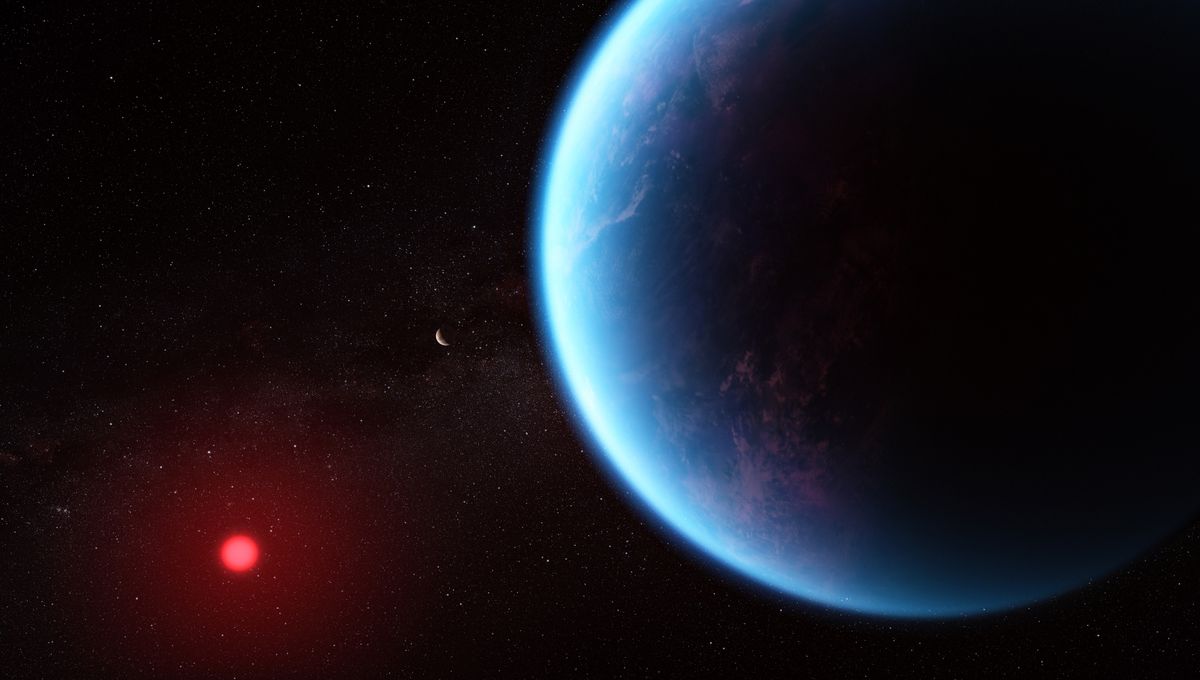
You may have seen exoplanet K2-18b in the news recently, thanks to newly published research that is destined to be discussed for a long while. K2-18b is believed to be a sub-Neptune world with a radius 2.6 times that of Earth, and in orbit around the habitable zone of a red dwarf 124 light-years from us. The big news, however, is that astronomers are claiming that this is the “strongest hints yet” of biological activity beyond the Solar System. So, have we found “life” beyond Earth and how do we even determine that?
Before we get to the details of the matter, it is important to state that unless we see a living, breathing alien waving back at us, it would be extremely difficult to claim the discovery of extraterrestrial life. For example, NASA’s scale for Confidence of Life Detection (CoLD) has seven extremely cautious steps before even getting close to making a claim. The first is detecting a possible signal, followed by ruling out contamination, making sure that the biology is possible, and ruling out a non-biological explanation.
The final three are the discovery of an additional independent signal, ruling out other hypotheses, and finally an independent confirmation. So far, there has only been one object that has gotten onto that scale: the Cheyava Falls rock last year was deemed a detection of a possible signal, so step 1.
This new research on K2-18b builds on many years of work by the University of Cambridge-led team studying this world. They believe it is a “hycean” planet – a portmanteau of hydrogen and ocean – as they have found evidence that suggests it has a hydrogen atmosphere under which a vast water ocean resides. This is not universally agreed, though, as other teams have found no evidence of an ocean at all.
But it’s not the possibility of an ocean, although crucial for life as we know it, that is contentious. Using the JWST, the team detected the presence of certain gases in the planet’s atmosphere: dimethyl sulfide (DMS) and dimethyl disulfide (DMDS). On Earth, these gases are produced by microbes and phytoplankton, so they could be a biosignature.
“Earlier theoretical work had predicted that high levels of sulfur-based gases like DMS and DMDS are possible on Hycean worlds,” lead author Professor Nikku Madhusudhan from Cambridge’s Institute of Astronomy said in a statement. “And now we’ve observed it, in line with what was predicted. Given everything we know about this planet, a Hycean world with an ocean that is teeming with life is the scenario that best fits the data we have.”
However, DMS and DMDS have also been found around cold, dead comets, calling into question the idea that they only have a living source, and thus the usefulness of them as biosignatures. Basically, the uncertainty on this new detection is larger than is expected for a discovery. While Madhusudhan claims that “[t]he signal came through strong and clear,” their paper stressed that this is not the case.
“While DMDS and DMS best explain the current observations, their combined detection significance is ∼3σ, which is at the lower end of the robustness typically required for scientific evidence,” the authors write.
This means their observations have reached a “three-sigma” (3σ) level of statistical significance. The gold standard for a discovery is a 5σ (five sigma) confidence level, which means that there is only 1 chance in 3.5 million that it is a fluke, or in more positive terms, the team has 99.99994 percent certainty of having seen a real signal.
The work is not there yet, but the team argues that follow-up observations with JWST will confirm the presence of DMS and DMDS once and for all. Even if that is the case, that doesn’t mean for certain that life is there.
Consider the saga of phosphine, another possible biosignature, detected in the atmosphere on Venus as a similar example. Follow-up observations continue to suggest its presence, but the source of it remains a mystery. Planetary atmospheres are very complex, and if we struggle to make concrete detections and conclusions about Venus, which is next door, claims of life on K2-18b need to be handled with level-headedness and caution.
The study is published in The Astrophysical Journal Letters.

Source Link: An Exoplanet Discovered With “Hints” Of Biology? This Is What You Need To Know
