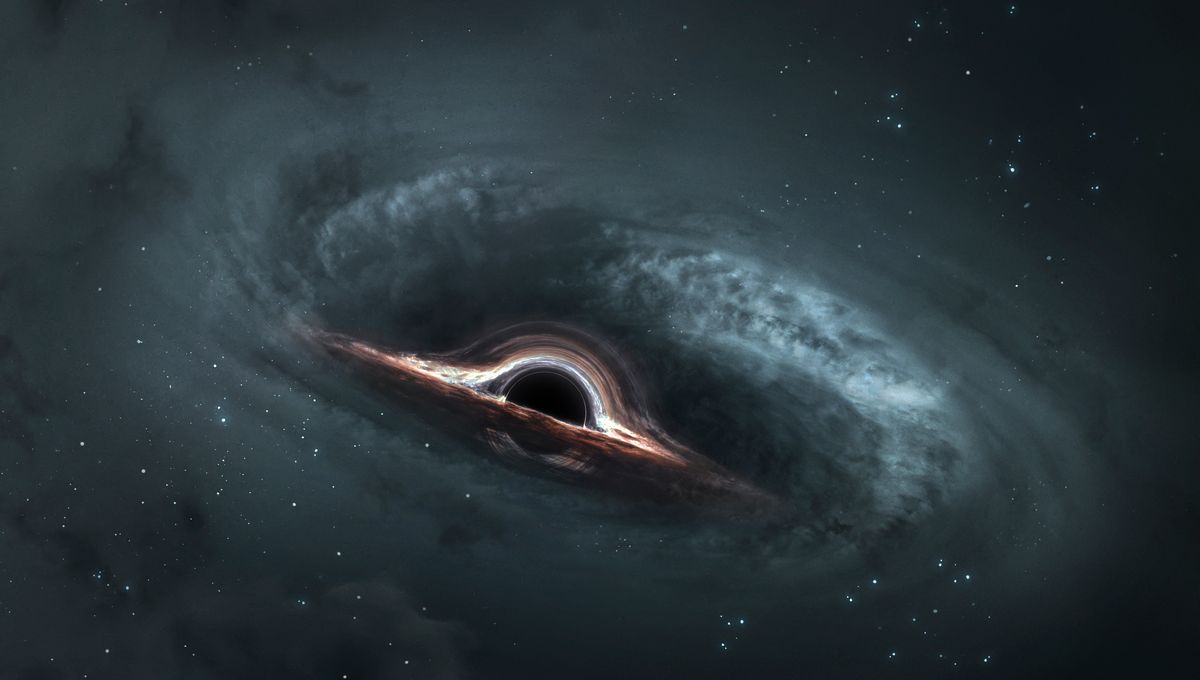
Alas, we do not live in Star Trek; the speed of light, as far as we can tell, is an insurmountable limit. This means that even if we wanted to visit the closest star system, we would have to travel for several years. We currently have no spacecraft that can travel at the speed of light, but proposals have been made for an extremely light spacecraft that could be accelerated using a laser and a solar sail to a fraction of the speed of light. One astrophysicist now asks: Why not send one of them to a black hole?
There have been mission proposals like this to visit exoplanets. Project Starshot is one example. The goal there is to accelerate a nanocraft less than 100 grams to 20 percent of the speed of light, traveling the 4.2 light-years to Proxima Centauri, the closest star to the Sun, in about 25 years. There are major challenges still to be worked out though, from the miniaturization of the light-sail to the laser that can accelerate it.
Physicist Professor Cosimo Bambi of Fudan University in China sees an intriguing opportunity there. If people are working out the tech for such a mission to an exoplanet, why not also consider a different object altogether? The technology might not be ready now, but maybe in a few decades it will be; probes could be sent to different stars and perhaps even a black hole.
“My idea is to try to stimulate the community about such a possibility. I don’t know if it will work or not, of course, but it deserves to be tested,” Professor Bambi told IFLScience. “Sometimes people say: ‘Okay, this is impossible!’ And then after some decades it’s not.”
Examples of this include the discovery of the long theorized gravitational waves and the first image of a black hole, which became revolutionary realities in the last decade. But a nanocraft to a black hole not only has technological challenges to deal with, but there is the important detail that we do not know the target yet.
Statistically, there should be a lot of stellar-sized black holes just peacefully floating around the galaxy, which means that there should be one within 20-25 light-years. The problem is that if they are not feeding, we can’t see them. The two closest, discovered by the Gaia survey, are 1,560 and 3,800 light-years away, respectively, so we won’t be able to visit them.
Maybe a much closer one lurks in the full Gaia data. One might be discovered by the Vera Rubin Observatory or the Square Kilometer Array, or another of the new telescopes (on the ground or in space) coming online in the next few years. Launching a nanocraft at one-third of the speed of light means that we could get to this black hole within 60 to 80 years.
“This is not something we can do tomorrow, this is true. Unfortunately, this seems to be the trend for many experimental observations in particle physics and astrophysics,” Prof Bambi told IFLScience. “The experiment will be the effort of a few generations of scientists. We don’t do this just for us but for future generations.”
A mission to a black hole is not simply worth it because it would be the coolest. It would provide a unique testbed for general relativity and our understanding of gravity. We have tested it with missions in the Solar System, including Juno at Jupiter, but black holes are extreme objects. The predictions of general relativity are very specific, and a mission would be an incredible way to test them.
The study is published in the journal iScience.

Source Link: An Interstellar Mission To Visit A Black Hole Might Only Take 70 Years, Astrophysicist Says
