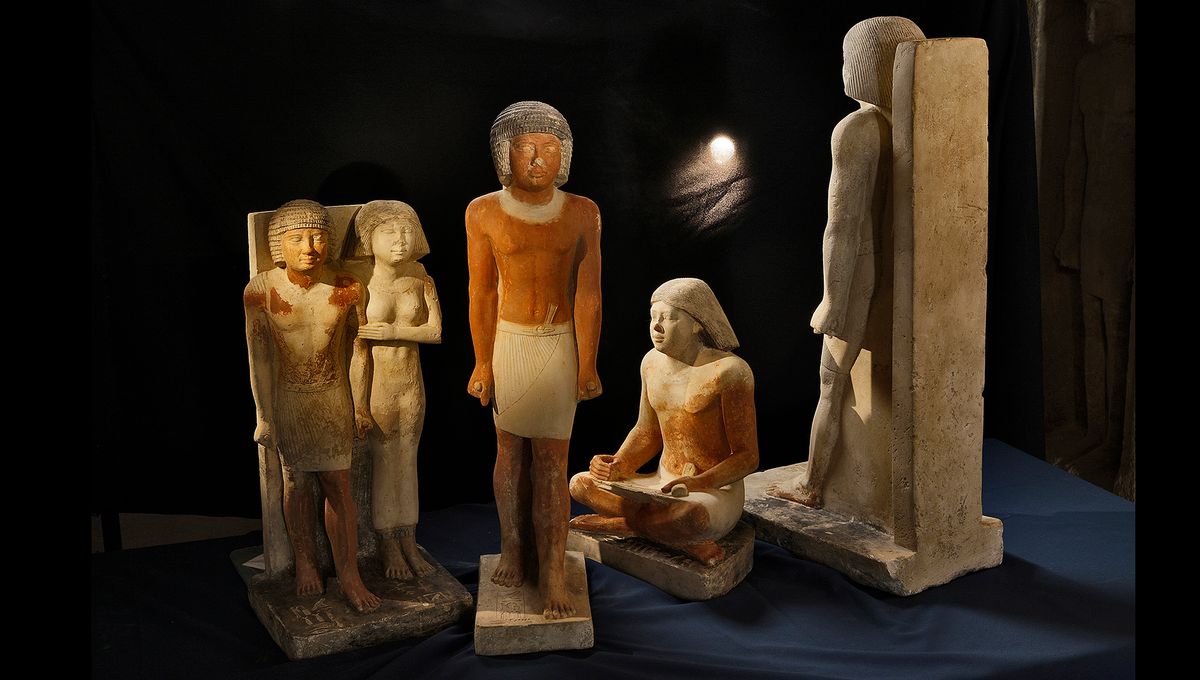
The modern world has plenty of advantages, but nobody would say it comes without any drawbacks. Take computers, for example: it’s awesome having the sum total of human knowledge at your disposal, being connected to the world via wireless signals, and having a machine that you can write essays and calculate sums and play solitaire on – but the carpal tunnel and back problems that result from using such futuristic miracle-machines? Not so great.
Except, as it turns out, those are far from modern inconveniences. According to a recent study, which looked at the skeletal remains of ancient Egyptian scribes buried in Abusir between 2700 and 2180 BCE, sitting and working with the foremost technology of the day like this has been messing with our bodies for eons.
By examining the skeletal remains of 69 adult males – 30 scribes, identified by their tomb style and decoration, plus 39 other ancient laborers – the team were able to isolate some 40 statistically significant differences. Chief among these was an increased degeneration in the neck vertebrae – meaning these ancient scribes probably got the same kind of neck pain as you after a long day at the office.
“In a typical scribe’s working position, the head had to be forward, and the spine flexed, changing the center of gravity of the head and putting stress on the spine,” the researchers write – a position that they note is “characteristic of many modern occupations.” When sitting like this – hunched over, with the head bent forward to look at something horizontally in front of you – the center of gravity of your head is moved, with stressful results: “the load moment for the [neck vertebrae] induced by the weight of the head and neck increases 3.6 times in comparison to the neutral position,” the authors explain.
Also suffering were the right shoulder and clavicle, and the right thumb. Like the neck changes, these are all things that a modern worker might be familiar with: “Stress to the rotator cuff […] usually occurs when the arm is in an elevated position, such as among painters. However, it could also be related to a static sitting position with arms unsupported, such as during typing,” the authors explain.
Of course, not all the changes point to such relatable problems – we are talking about people living 5,000 years ago, after all. This was well before the invention of ergonomic desk chairs, and the scribes’ knees and hips show signs of wear and tear associated with sitting cross-legged or squatting on the right knee.
But perhaps the furthest departed from our modern occupational gripes: the changes to the temporomandibular joint, or TMJ – that is, the hinge where your jaw meets your skull. While the incidence of osteoarthritis in the TMJ generally tops out at about 40 percent in both modern and archaeological samples, among the scribes it was more than twice as prevalent as in the rest of the skeletons – nearly two out of every three scribes showed wear in the TMJ.
What caused such a specific injury? Well, it all comes down to the specific method these ancient scribes used to write: “The tools that scribes used to write were made from rush […] which was cut at a slant and chewed at the end to form a brush-like head,” the authors explain. “When the pen became ragged or clogged with ink, the scribe cut off the end again and chewed the next section.”
The results aren’t definitive. There are no modern populations with whom to compare the scribal cohort, so we can’t really draw causal links between the scribal profession and the skeletal changes noted in the study; moreover, as the authors themselves point out, scribes would live longer, on average, than manual laborers, and therefore had more time for their joints to degenerate simply through old age. But it nevertheless paints a picture of an ancient world that was, at least when it came to office work, more like our own than we might assume.
“They were high-ranking dignitaries who belonged to the ancient Egyptian elite,” Petra Brukner Havelková, an anthropologist in the Department of Anthropology at the National Museum in Prague and lead author of the study, told Live Science. “[But] they suffered the same worries as we do today and were exposed to similar occupational risk factors in their profession as most civil servants today.”
The paper is published in the journal Scientific Reports.

Source Link: Ancient Egyptian Scribes Had The Same Bad Posture As You
