• Email Us: [email protected]
  • Contact Us: +1 718 874 1545
  • Skip to main content
  • Skip to primary sidebar

Medical Market Report

  • Home
  • All Reports
  • About Us
  • Contact Us

Antarctic Scientists Have Just Moved The South Pole – Literally

January 7, 2026 by Deborah Bloomfield

New Year’s celebrations are a little bit different in Antarctica. Under the relentless summer daylight and searing cold, the ragtag crew of souls who have found themselves at the planet’s southernmost point take part in an unusual but important ritual.

The rest of this article is behind a paywall. Please sign in or subscribe to access the full content.

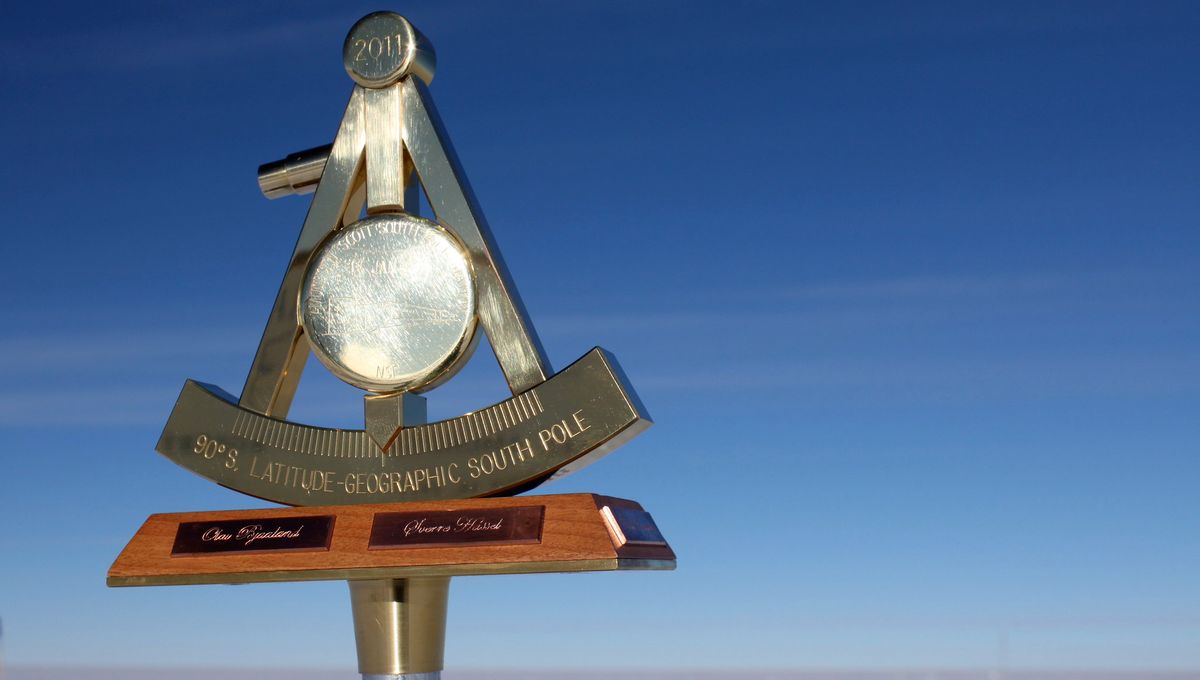
Each year around January 1, the crew of the Amundsen-Scott South Pole Station must move the stick in the ice that designates the geographic South Pole. 

Run by the United States Antarctic Program, the station is located deep within the Antarctic interior at 90°S, the geographic South Pole, sitting on top of an ice sheet at an elevation of approximately 2,835 meters (9,301 feet) above sea level.

The station’s annual pole move isn’t because the magnetic pole of Earth has shifted (although that is another problem polar scientists must battle with). Instead, it’s because ice sheets are dynamic and constantly moving, like a super-thick syrup running off a pancake.

The geographic South Pole is a fixed point where Earth’s rotation axis meets the surface, but it sits atop a slowly drifting sheet of ice. Near the Amundsen-Scott South Pole Station, that ice is slipping toward the Weddell Sea at a significant pace. Over time, this steady motion carries both the station and the surface marker rate of around 10 meters (33 feet) per year across the solid rocky continent far below.

So, each New Year’s Day, scientists carefully survey the area and reset the marker. The old pole is removed and placed into a cabinet while the new pole is unveiled during a small ceremony attended by a huddled crew of researchers, technicians, and support staff stationed at the pole for the summer.


This isn’t an issue on the other side of the planet at the North Pole. Here, there’s no solid land at all. The Geographic North Pole sits in the middle of the Arctic Ocean, covered by floating sea ice that is constantly breaking, reforming, and drifting with winds and currents.

None of this should be confused with the magnetic pole, which wanders independently of both the North and South geographic poles. The magnetic South Pole, for instance, is currently drifting north-northwest around 55 kilometers (34 miles) per year, according to NOAA.

Marking this ever-moving point with a physical stick would be nearly impossible and, to be honest, a fairly fruitless endeavor.

Deborah Bloomfield
Deborah Bloomfield

Related posts:

  1. Thousands of Salvadorans march against President Bukele
  2. Australia’s central bank sees risks in housing market “exuberance”
  3. 72-Foot Fusion Gun Fires Projectiles At 4.3 Miles Per Second Trying To Create Limitless Energy
  4. Interstellar Object 3I/ATLAS May Be A 10-Billion-Year-Old Time Capsule From An Earlier Age Of The Universe

Source Link: Antarctic Scientists Have Just Moved The South Pole – Literally

Filed Under: News

Primary Sidebar

  • World’s Oldest Poison Arrows Were Used By Hunters 60,000 Years Ago
  • The Real Reason You Shouldn’t Eat (Most) Raw Cookie Dough
  • Antarctic Scientists Have Just Moved The South Pole – Literally
  • “What We Have Is A Very Good Candidate”: Has The Ancestor Of Homo Sapiens Finally Been Found In Africa?
  • Europe’s Missing Ceratopsian Dinosaurs Have Been Found And They’re Quite Diverse
  • Why Don’t Snorers Wake Themselves Up?
  • Endangered “Northern Native Cat” Captured On Camera For The First Time In 80 Years At Australian Sanctuary
  • Watch 25 Years Of A Supernova Expanding Into Space Squeezed Into This 40-Second NASA Video
  • “Diet Stacking” Trend Could Be Seriously Bad For Your Health
  • Meet The Psychedelic Earth Tiger, A Funky Addition To “10 Species To Watch” In 2026
  • The Weird Mystery Of The “Einstein Desert” In The Hunt For Rogue Planets
  • NASA Astronaut Charles Duke Left A Touching Photograph And Message On The Moon In 1972
  • How Multilingual Are You? This New Language Calculator Lets You Find Out In A Minute
  • Europa’s Seabed Might Be Too Quiet For Life: “The Energy Just Doesn’t Seem To Be There”
  • Amoebae: The Microscopic Health Threat Lurking In Our Water Supplies. Are We Taking Them Seriously?
  • The Last Dogs In Antarctica Were Kicked Out In April 1994 By An International Treaty
  • Interstellar Comet 3I/ATLAS Snapped By NASA’s Europa Mission: “We’re Still Scratching Our Heads About Some Of The Things We’re Seeing”
  • New Record For Longest-Ever Observation Of One Of The Most Active Solar Regions In 20 Years
  • Large Igneous Provinces: The Volcanic Eruptions That Make Yellowstone Look Like A Hiccup
  • Why Tokyo Is No Longer The World’s Most Populous City, According To The UN
  • Business
  • Health
  • News
  • Science
  • Technology
  • +1 718 874 1545
  • +91 78878 22626
  • [email protected]
Office Address
Prudour Pvt. Ltd. 420 Lexington Avenue Suite 300 New York City, NY 10170.

Powered by Prudour Network

Copyrights © 2026 · Medical Market Report. All Rights Reserved.

Go to mobile version