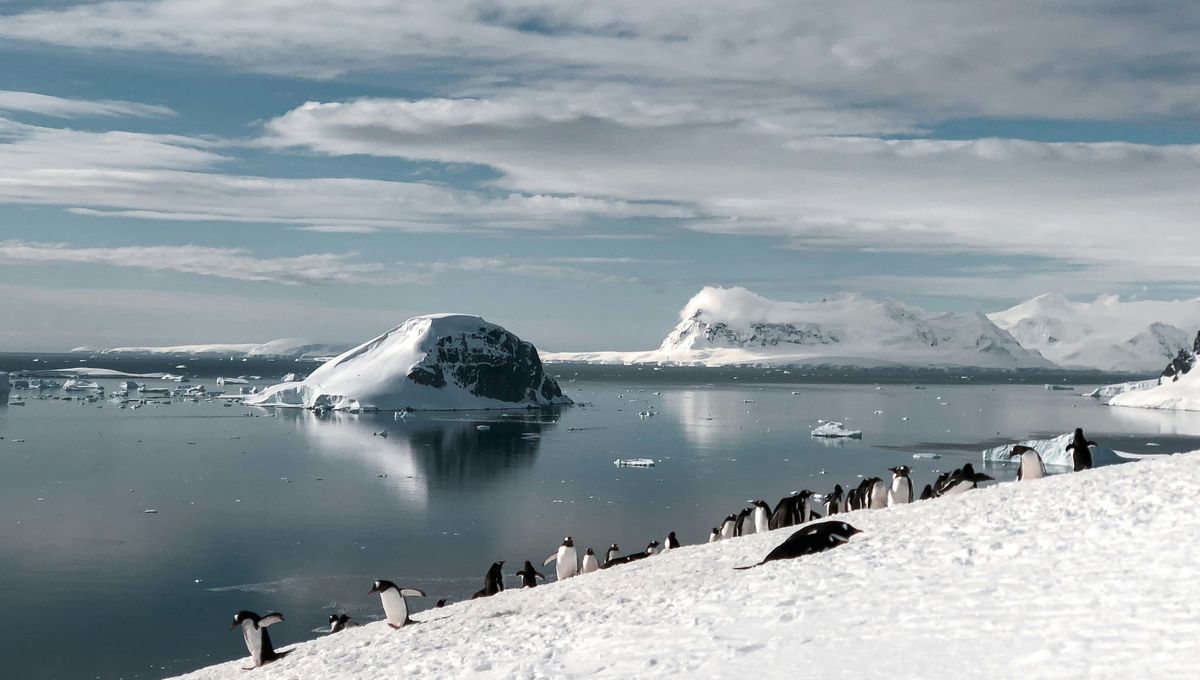
Once viewed as a surprisingly stable bastion, the South Pole is starting to show some worrying signs of change. Antarctic sea ice reached historically low levels last year and climate change is almost certainly to blame.
In 2023, the Antarctic had 2 million square kilometers (772,204 square miles) less ice cover than usual during winter.
Antarctica’s sea ice is influenced by many complex and interweaving factors, involving both natural and human-driven changes to the atmosphere and ocean. This means the situation often defies a simple, straightforward explanation.
However, new research suggests that last year’s record-breaking minimum sea ice extent was very likely driven by a single factor: climate change.
Without the influence of climate change, we’d only expect to see this level of sea ice demise every 2,000 years or so.
“According to the models, the record-breaking minimum sea ice extent would be a one-in-a-2000-year event without climate change. This tells us that the event was very extreme – anything less than one-in-100 is considered exceptionally unlikely,” Rachel Diamond, lead author from the University of Cambridge and the British Antarctic Survey, said in a statement.
“Strong climate change – i.e. the temperature changes we’re already seeing, and those expected if emissions continue to rise rapidly – in the models makes it four times more likely that we see such a big decline in sea ice extent. This suggests that 2023’s extreme low was made more likely by climate change,” added Caroline Holmes, a co-author of the study from the British Antarctic Survey.
Understanding sea ice levels in Antarctica is a tricky business because satellite imagery has only been keeping tabs on the situation for less than five decades. It is evident, however, that ice melt in the Antarctic is a more recent phenomenon compared to the Arctic, which has been progressively melting since the late 1970s.
Between 1978 and 2015, the Antarctic sea ice extent was actually increasing slowly and steadily, before entering a notable decline. In 2017, Antarctic sea ice crashed to a record low, followed by several years of relatively low sea ice extent. More bad news came in 2022 and – most significantly – in 2023 when it reached a new record low.
Scientists are now curious (and concerned) to see how sea ice levels look in the years and decades ahead. The current models indicate that an extreme bout of sea ice loss, such as the decline in 2023, can take at least 20 years to return to normal. If that’s accurate, some worrying times could be ahead for Antarctica and its residents.
“The impacts of Antarctic sea ice staying low for over twenty years would be profound, including on local and global weather and on unique Southern Ocean ecosystems – including whales and penguins,” said Louise Sime, another co-author on the study from the British Antarctic Survey.
The new study was published in the journal Geophysical Research Letters.

Source Link: Antarctica's Recent Ice Loss Was A "One-In-A-2000-Year Event" Without Climate Change
