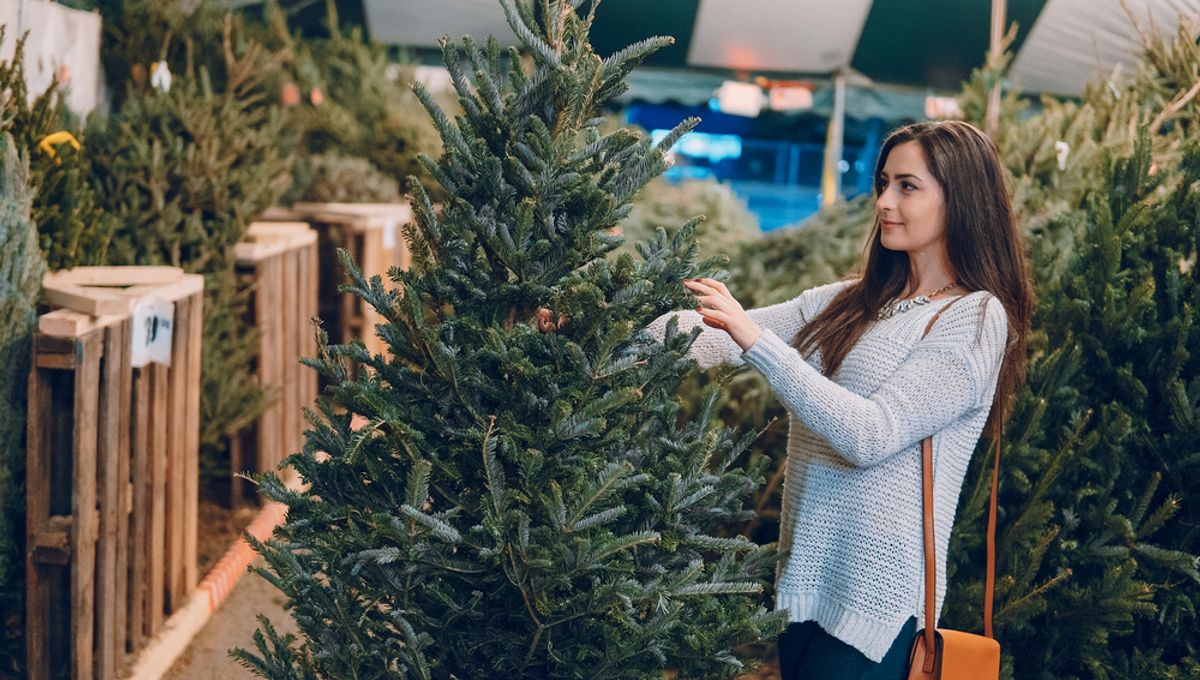
While getting ready to deck the halls and put up the Christmas tree this year, you may have been wondering what’s better for the planet: slashing down a natural tree or buying a synthetic reusable one made out of plastic. It’s a bit of a fiddly question, but real trees are marginally better for the environment than fake ones.
We’ve all heard about how trees can help mitigate climate change by capturing carbon dioxide and storing it in their branches, roots, and needles. Christmas trees are no different, so cutting them down might seem like a bad idea.
However, there’s some evidence that Christmas tree farming could hold some environmental benefits. Christmas trees take over 10 years to grow to a size of 1.8 meters (6 feet). Over these years, trees will serve as an animal playground and “suck up” carbon from the atmosphere. Furthermore, for each Christmas tree harvested, one to three seedlings are planted the following spring, according to the US National Christmas Tree Association.
“That means more trees to fight climate change and to provide more vital benefits for people and nature like clean air and water, wildlife habitat, and healthy soil,” says the Nature Conservancy.
“Science shows that one of the best ways to protect forests is to use them – carefully. When our forests are sustainably managed, they can produce renewable resources like Christmas trees and other wood-made products.”
On the other hand, there are issues in terms of how Christmas trees are cultivated, especially in regard to the heavy use of pesticides and the potential displacement of natural ecosystems to make way for plantations.
If you do opt for a real one, it’s best to pick up your tree from a local source to minimize the carbon emissions associated with shipping.
Disposal is also important when it comes to real trees. If it’s sent to a landfill, its environmental impact will be higher, as the decomposing tree will produce methane, a potent greenhouse gas. Incinerating the tree will release carbon dioxide and other pollutants into the air, although the tree can only return to the atmosphere the carbon which it took out in the first place. The best method of disposal is to shred the tree, turning it into wood chippings or mulch.
But what about artificial trees? Ardent believers in artificial trees argue that they are used many times, year after year. True as that may be, artificial trees hold the massive disadvantage of being made out of plastic.
Fake trees are often made from polyvinyl chloride (PVC). While this material is resilient, it’s one of the most environmentally damaging of all plastics. Due to its high chlorine content, PVC can produce toxic pollution in the form of dioxins, which accumulate in animals’ bodies up the food chain. PVC is also very difficult to recycle and ends up going to landfill where it will stay for decades.
On top of that, the carbon footprint of a plastic tree is actually higher than that of a real one. A fake tree will produce the equivalent of around 40 kilograms (88 pounds) of greenhouse gas emissions – that’s more than double that of a real tree if it ends up in a landfill and more than 10 times that of a real tree that is incinerated.
There’s a high chance that your fake Christmas tree has been on quite the journey before reaching your home, too. Up to 80 percent of artificial trees worldwide are made in China. While being shipped or flown around the world, a huge amount of carbon emissions will be released. If you do currently have an artificial tree, however, the best thing you can do is not dispose of it and continue using it for many years to come.
So there you have it: real trees narrowly edge out their fake counterparts. Just make sure when you bring them indoors, you don’t bring any unwanted hitchhikers, too.
An original version of this article was first published in December 2021.

Source Link: Are Real Or Plastic Christmas Trees More Environmentally Friendly?
