There’s an old “fact” that is regularly passed around the internet, which says that no non-human animal (and in particular the ape) has ever asked a question. This is less clear than the internet posts make out, but there is a reasonable case for the idea that only two animals that we know of have asked humans questions directly.
Since at least 1966, scientists have trained apes to use sign language to communicate with humans. Koko the gorilla is a notable example of this, given the number of words she was able to learn. Back in the 1970s, Stanford animal psychologist Dr Francine “Penny” Patterson had an idea: She would see if she could teach an ape to talk. In 1971, she got her chance when a western lowland gorilla was born at San Francisco Zoo, before being rejected by its mother.
Patterson took the ape under her care for the next 46 years, teaching her “Gorilla Sign Language” (GSL). Patterson reported that she learned over 1,000 signs and understood 2,000 English words. But Koko was not capable of asking questions of her handler, and there is no evidence of other apes asking questions in this way.
“Though [Sarah the chimpanzee] understood the question, she did not herself ask any questions – unlike the child who asks interminable questions, such as What that? Who making noise? When Daddy come home? Me go Granny’s house? Where puppy?” David and Ann Premack, among the first to experiment with teaching apes sign language, explained in the book The Mind of an Ape. “Sarah never delayed the departure of her trainer after her lessons by asking where the trainer was going, when she was returning, or anything else.”
While no ape has been documented asking a direct question, there are claims that two other animals have, and both of them are parrots.
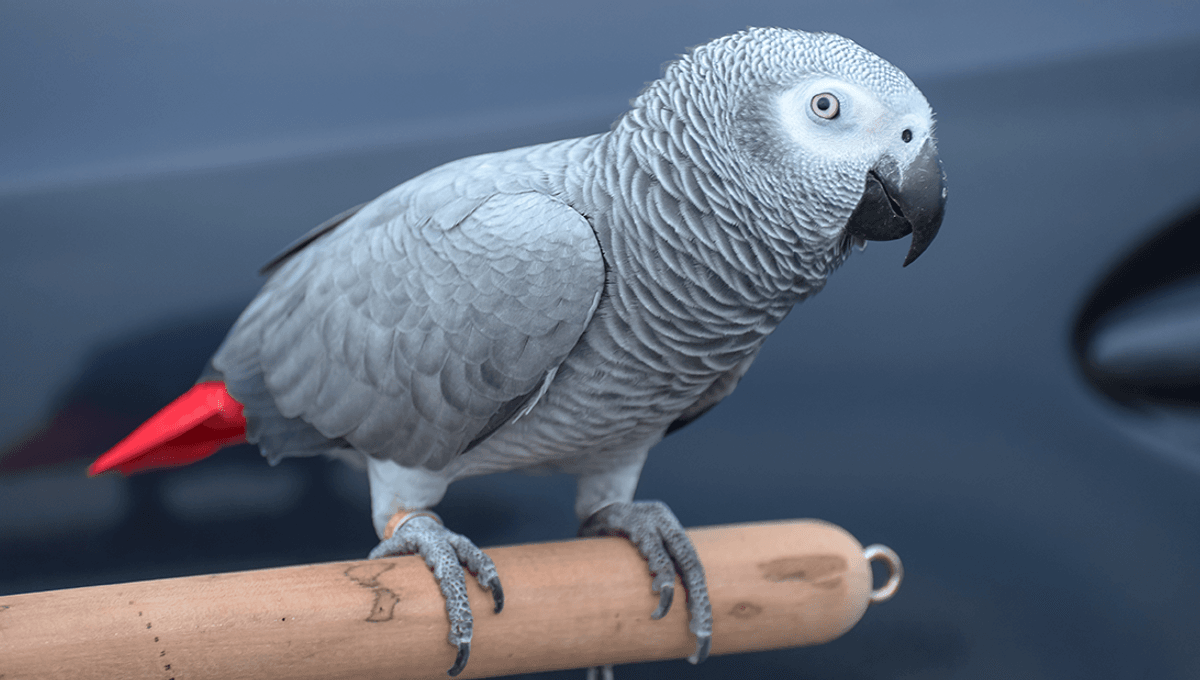
The first to have been documented asking a question was Alex the parrot. Born in 1976 and living to 2007, Alex was an African gray parrot able to use over 100 words, do some basic counting, and answer simple questions, such as which block was larger, or how many blue square blocks there are in a pile.
The parrot was pretty nifty at picking up new words, and even appeared to have a concept of “zero”, something humans can’t do until they are at least toddlers.
But what was really remarkable about Alex, and later another African gray parrot named Apollo, was that he appeared to ask humans questions directly. In one particularly notable example, Alex was looking in a mirror in a washroom in 1980.
Taking a closer look at his reflection, he asked laboratory student Kathy Davidson “What’s that?” indicating himself in the mirror.
“That’s you,” Davidson replied, adding “you’re a parrot”.
Looking again, Alex asked “what color?”, to which Davidson informed him ““Gray. You’re a Gray Parrot, Alex.”
This was how the bird learned the word “gray”, in an interaction that appeared to show plenty of self-awareness. Alex died unexpectedly in 2007, with his last words being “you be good, see you tomorrow. I love you,” the night before, his usual goodbye.
Apollo the parrot, hatched in 2020, has similarly been documented asking questions such as “what’s that called” and “what color”.
While it is apparent that the parrots are the only animals we know of to have been documented asking a direct question, that’s not to say that other animals are incapable of it. Though apes have not been documented doing so directly, their interactions could sometimes be interpreted as questions. For instance, an ape pointing at a banana whilst eyeing its handler could be interpreted as it asking a question.
“If we take at face value that in at least some cases the apes were comfortably using the signs with an understanding of what they meant, then there are plenty of cases of them asking questions,” Cat Hobaiter, professor at the University of St Andrews specializing in ape cognition and communication, told Snopes, adding that there were “plenty of descriptions across multiple enculturated ape studies that include the apes ‘asking questions.'”
Nevertheless, in terms of being direct about it, they have a lot of catching up to do with the “bird-brained” African gray parrot.

Source Link: Are These 2 African Gray Parrots The Only Non-Human Animals To Ever Ask A Question?
