• Email Us: [email protected]
  • Contact Us: +1 718 874 1545
  • Skip to main content
  • Skip to primary sidebar

Medical Market Report

  • Home
  • All Reports
  • About Us
  • Contact Us

Artificial Eclipse, Dancing Dinosaurs, And 50 Years Of “JAWS”

June 20, 2025 by Deborah Bloomfield

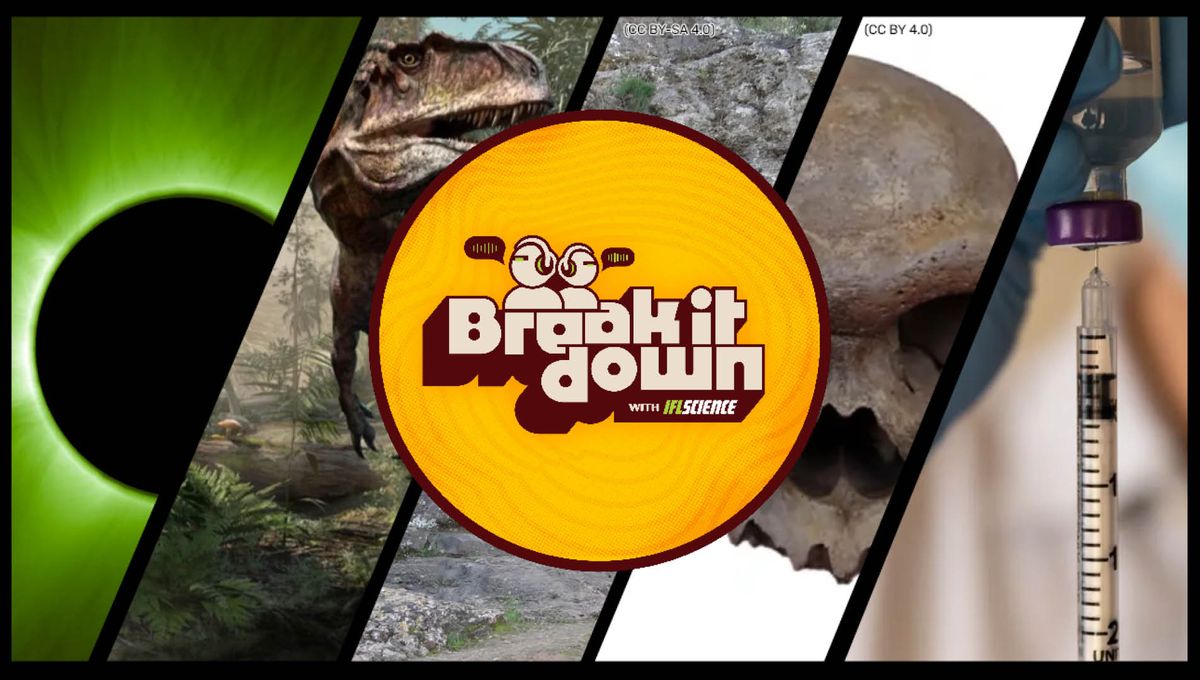
This week on Break It Down: Two spacecraft just created the first ever artificial solar eclipse, thanks to some impressive drone photos we know now dancing dinosaurs might have been leaping around to impress females in Colorado, a child from the world’s oldest burial site appears to be a Neanderthal-Homo sapiens hybrid, for the first time we know what a Denisovan face looks like, a medical breakthrough means we could have a vaccine against HIV (if only anyone could buy it), and 50 years after JAWS was released, we take a look at the lasting impact on shark conservation the blockbuster movie made. Available on all your favorite podcast apps: Apple Podcasts, Spotify, Podbean, Amazon Music, and more.

Break It Down is the audio edition of our This Week In Science newsletter – create an account to get all the biggest science news, and new podcast episodes, delivered straight to your inbox weekly.

So, sit back, relax, and let’s Break It Down…

Links

Artificial solar eclipse

Dancing dinos

Hybrid child

Denisovan skull

HIV vaccine

JAWS 50 Years On

Papahānaumokuākea marine conservation

Ghost Elephant

The Big Questions is back!

Deborah Bloomfield
Deborah Bloomfield

Related posts:

  1. Russia moves Sukhoi Su-30 fighter jets to Belarus to patrol borders, Minsk says
  2. French senators to visit Taiwan amid soaring China tensions
  3. Thought Unicorns Don’t Exist? Turns Out They Live In A Chinese Cave
  4. Colossus: Never-Before-Seen Photos Show The Computer That Helped Win WW2

Source Link: Artificial Eclipse, Dancing Dinosaurs, And 50 Years Of “JAWS”

Filed Under: News

Primary Sidebar

  • World’s Largest Dinosaur Tracksite Has At Least 16,600 Footprints And Sets Many World Records
  • Interstellar Comet 3I/ATLAS Will Make Its Closest Approach To Earth This Month, Just 270 Million Kilometers Away
  • How Does Time Pass On Mars? For The First Time, We Have A Precise Answer
  • Is This How The Voynich Manuscript Was Made? A New Cipher Offers Fascinating Clues
  • An Extremely Rare And Beautiful “Meat-Eating” Plant Has Been Found Miles From Its Known Home
  • Scheerer Phenomenon: Those White Structures You See When You Look At The Sky May Not Be “Floaters”
  • The Science Of Magic At CURIOUS Live: Psychologist Dr Gustav Kuhn On Using Magic To Study The Human Mind
  • Around 5 Percent Of Cancers Are Of “Unknown Primary”. Could A New Blood Test Track Them Down?
  • With Only 5 Years Left In Space, The International Space Station Just Hit A New Milestone
  • 7,000-Year-Old Atacama Mummies May Have Been Created As “Art Therapy”
  • In 1985, A Newborn Underwent Heart Surgery Without Pain Relief Because Doctors Didn’t Think Babies Could Feel Pain
  • Ancient Roman Military Officers Had Pet Monkeys, And The Pet Monkeys Had Pet Piglets
  • Lasting 29 Hours, The World’s Longest Commercial Scheduled Flight Is Set To Take Off This Week
  • What Is Christougenniatikophobia, And What Do I Do About It?
  • Sun’s Ancient Encounter With Two Hot Stars Left A Legacy In The Solar System’s Neighborhood
  • Defiant Stars And Unusual Objects Survive Against The Milky Way’s Supermassive Black Hole
  • A Wobbling Brown Dwarf Might Be A Sign Of The First Discovered “Exomoon” – A Moon Outside The Solar System
  • “Happy Molecule” Precursor Discovered In Extraterrestrial Material For The First Time
  • Why Do Seals Slap Their Belly?
  • Interstellar Comet 3I/ATLAS Appears To Be Experiencing “Cryovolcanism”, And Is Eerily Similar To Objects In The Outer Solar System
  • Business
  • Health
  • News
  • Science
  • Technology
  • +1 718 874 1545
  • +91 78878 22626
  • [email protected]
Office Address
Prudour Pvt. Ltd. 420 Lexington Avenue Suite 300 New York City, NY 10170.

Powered by Prudour Network

Copyrights © 2025 · Medical Market Report. All Rights Reserved.

Go to mobile version