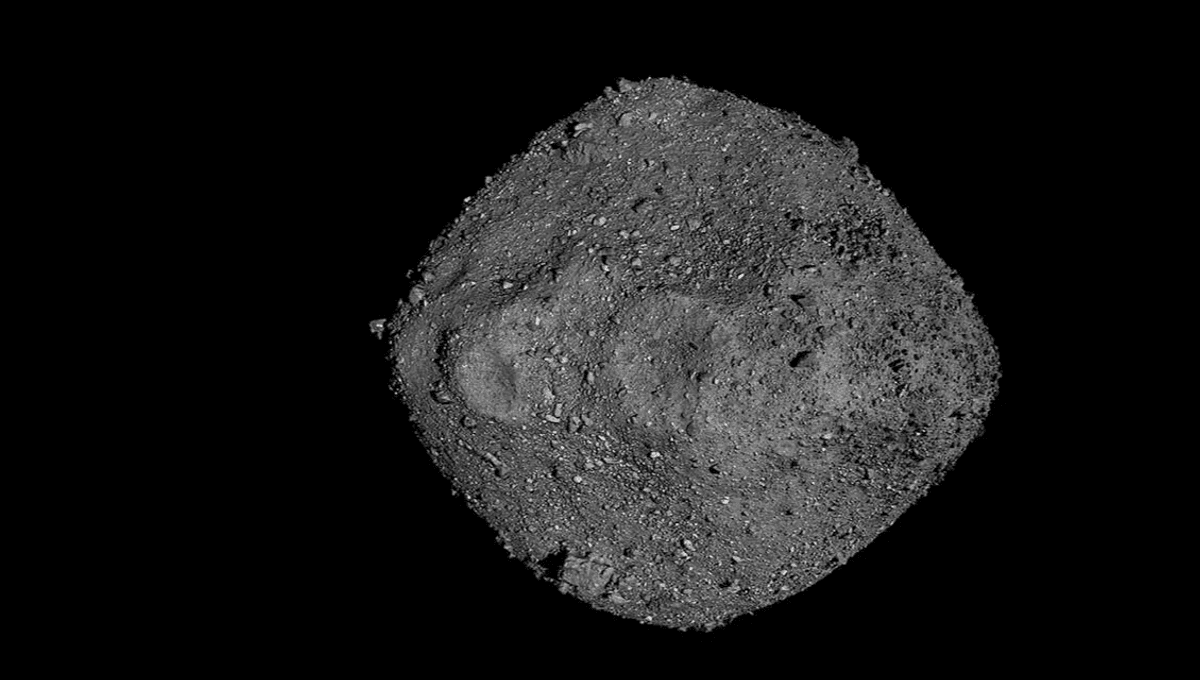
Up until the recent discovery of the asteroid 2024 YR4, which at the time of writing has an estimated 1.6 percent chance of hitting us next decade, the most dangerous space rock to us was asteroid Bennu. Bennu was visited and sampled by NASA’s OSIRIS-REx and data from it is revolutionizing our understanding of the early solar system – but what would happen if this medium-sized asteroid were to defy the odds and hit our planet? It turns out, quite a lot!
ADVERTISEMENT GO AD FREE
Bennu has a diameter of roughly 500 meters (1,640 feet) and has a 1 in 2,700 chance of hitting our planet in September 2182. Bennu is not on the scale of the Chicxulub impactor – which hit the Earth at the end of the Cretaceous and spelled the end of the non-avian dinosaurs and many other species – but it is also not small. Depending on the collision parameters, it could cause regional to large-scale damage.
Scientists have investigated possible scenarios, focusing exclusively on the deposition of dust in the atmosphere. Even without considering the effects of the soot and sulfur if the asteroid hits land, the path through the atmosphere will leave plenty behind to affect our planet.
A collision would deposit large quantities of dust in the stratosphere, more than during the Chicxulub event. Bennu would not be moving as quickly through the atmosphere and would leave more behind. In the worst-case scenario, 400 million tons of dust get injected into the atmosphere, causing an impact winter. Global temperatures could drop by 4°C (7.2°F), the ozone level would fall by a third, and there would be 15 percent less rain and snowfall.
The composition of the dust also matters. In general, there would be a dramatic decrease in photosynthesis, with famine and death across the whole food chain. The team estimated that the terrestrial net primary productivity (NPP) could plummet by up to 36 percent, while marine NPP could drop by up to 25 percent. However, dust rich enough in iron could actually cause diatoms – microalgae – to experience a dramatic bloom in the Pacific Ocean for three years.
“Asteroid impacts have taken place many times in Earth’s history. Our early human ancestors may have experienced some of these planet-shifting events before with potential impacts on human evolution and even our own genetic makeup,” co-corresponding author Lan Dai, from the Center for Climate Physics, Institute for Basic Science in Busan, said in a statement. “This study provides the basis to quantify the possible effects of abrupt events on early human evolution.”
The work is an interesting window into the possibility of medium-sized asteroid collisions and how they might have globe-spanning effects – even if the impact itself affects a smaller locality.
ADVERTISEMENT GO AD FREE
A paper describing the findings is published in the journal Science Advances.

Source Link: Asteroid Bennu Has A Tiny Chance Of Hitting Earth – Which Could Start A Global Winter
