The latest research on asteroid Bennu has revealed its heterogeneous origin and a parent world with flowing water, adding to the evidence that this small and somewhat dangerous rock is extremely complex. Researchers have revealed the presence of a variety of materials in Bennu, some older than the Solar System, as well as new evidence of water modifications.
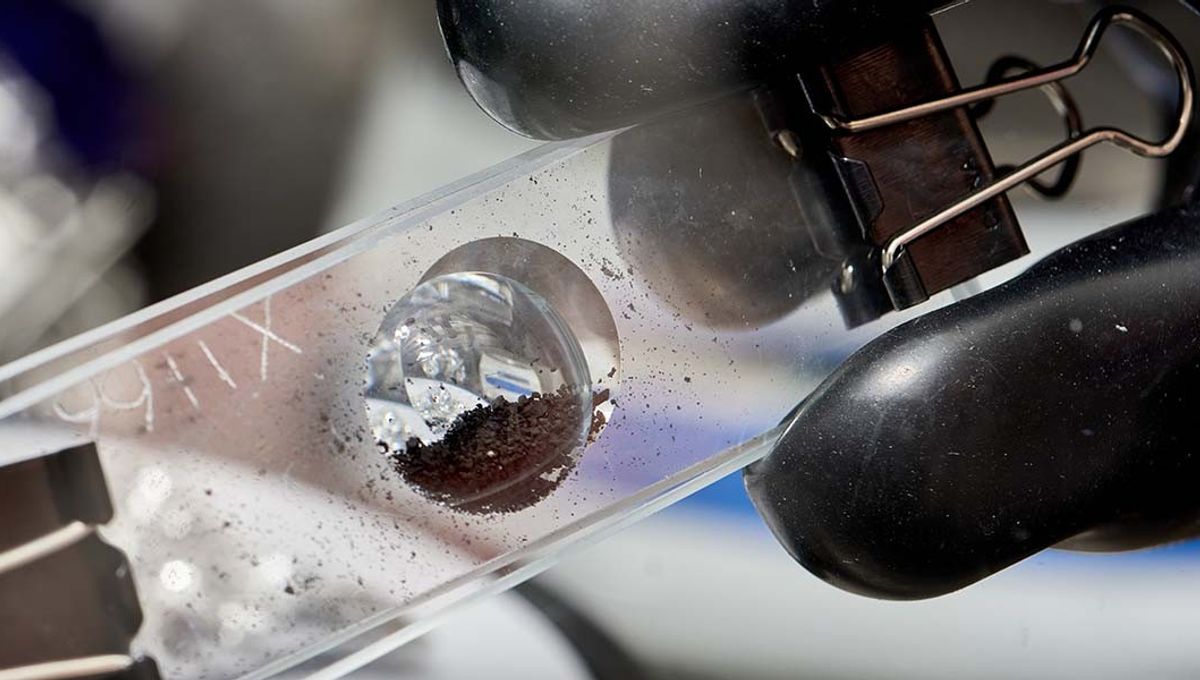
The OSIRIS-REx mission, which delivered over 120 grams (4.2 ounces) of Bennu’s soil to Earth in 2023, is the largest haul of asteroid material ever collected by a space mission. Scientists around the world have been able to look at a portion of the material and work out where it comes from.
Asteroids allow us to study what the building blocks of planets were like. In Bennu, researchers report the presence of material that could have only formed near the Sun, together with some material from different sources. Some must have come from the outer Solar System: too close to our star, those chemical formations would not have been possible. Some of the material even predates the Sun, with stardust from other stars, and organic material from both the interstellar medium and the outer Solar System.
“We were surprised to find higher abundances of this organic matter and minerals from the inner solar system in the Bennu sample compared to asteroid Ryugu and CI chondrites,” Dr Ann Nguyen of the NASA Johnson Space Center, co-lead author of one of two new papers on Bennu, said in a press statement seen by IFLScience.
Ryugu is another asteroid for which we have a sample, collected by the Hayabusa-2 mission. Despite their differences, Ryugu and Bennu also share similarities, and Ryugu, too, had plenty of organic materials, simply not as much of them.
Bennu’s parent body seems to have formed from a really different set of materials from across the Solar System, and it might have formed further away from the Sun, too.
“We’re looking at [a] unique snapshot of the outer solar system at the birth of our Sun,” said Professor Sara Russell, planetary scientist at the Natural History Museum, and co-author on the paper. “Some of these grains have survived billions of years of solar system evolution almost untouched and can tell us more about the environment in which planets were born.”
“Our goal was to unmask where in the solar system and from which starting ingredients Bennu’s parent asteroid formed,” said Jessica Barnes, professor at the University of Arizona and co-lead author of the paper. “We find that the returned samples contain components of diverse origins that survived geological processing within the parent asteroid. Our data suggest that Bennu’s parent asteroid formed in the outer parts of the solar system, possibly beyond the orbit of Saturn.”
A second paper looked at the presence of water alterations. This required an object that had ice in it, and it reached an internal temperature of tens of degrees above zero. Water then flowed around, allowing for certain chemical reactions to take place.
“For a long time, people have argued that the melting ice would have reacted with the minerals near it, and wouldn’t have moved that far,” Dr Ashley King, also from the Natural History Museum, said in a statement. “However, in the Bennu samples, we see that the fluid isn’t staying static over time, but continuously changing as it spreads through the asteroid and reacts with its minerals.”
“While there’s more research to be done to confirm this, the presence of veins in the rock adds further evidence that the fluids would have been moving around.”
The paper discussing the material components of Bennu is published in Nature Astronomy, and the one on the hydrothermal alterations in Nature Geoscience.

Source Link: Asteroid Bennu Is A "Frankenstein's Monster" Of Material From The Inner Solar System, Outer, And Beyond
