• Email Us: [email protected]
  • Contact Us: +1 718 874 1545
  • Skip to main content
  • Skip to primary sidebar

Medical Market Report

  • Home
  • All Reports
  • About Us
  • Contact Us

Asteroid Ryugu Formed Far Away From Earth Before Moving Close To Our Planet

December 16, 2022 by Deborah Bloomfield

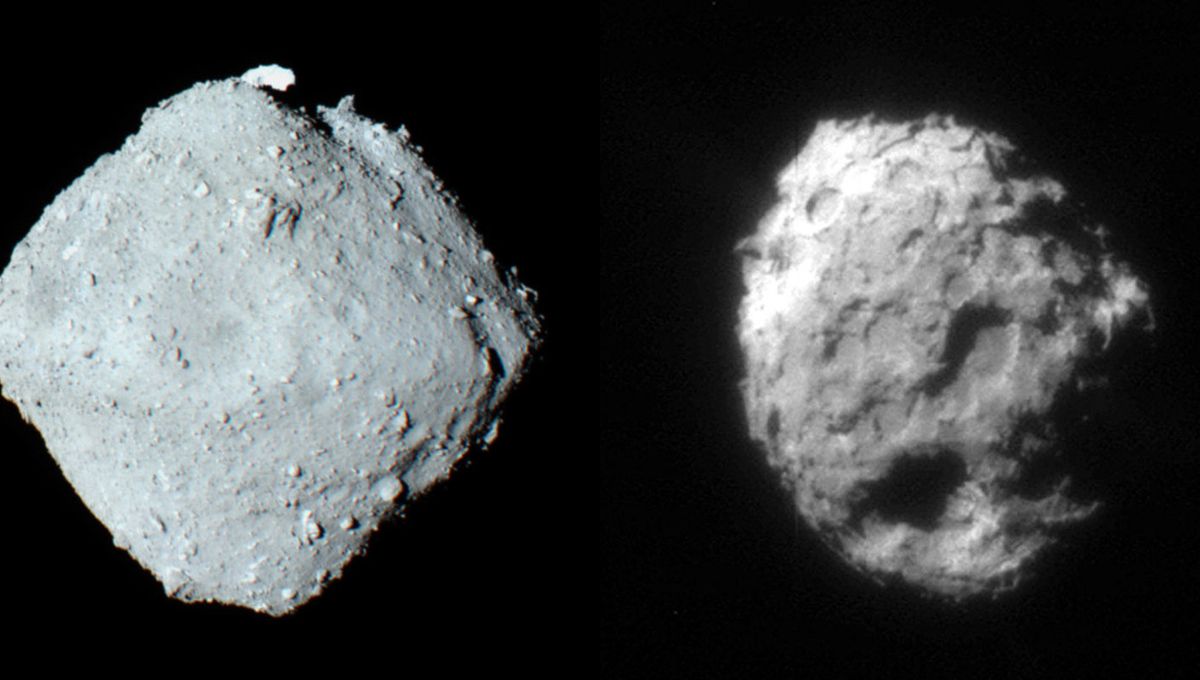
Asteroid Ryugu is one of the most famous Near-Earth Objects. It was visited by the Japanese probe Hayabusa-2 a few years ago and the spacecraft collected samples from its surface and below it. Analysis of this material has revealed incredible insights about Ryugu and the latest research continues this trend. It found an important connection with comet Wild 2 and the outer solar system.

Wild 2 (pronounced vilt two) was visited by NASA’s Stardust mission which collected particles from the comet’s coma – the fuzzy atmosphere that forms when a comet gets closer to the Sun. The comet formed and used to live further out in the solar system but in September 1974, passing very close to Jupiter, it was pulled forward into the inner solar system.

Advertisement

Ryugu’s history seems to be more complicated. The analysis published earlier this year revealed amino acids, the building blocks of proteins, as well as carbonate minerals that are expected to form in water-rich environments at low temperatures. This cannot have been the inner solar system. In particular, Ryugu showed similarity to the Ivuna meteorite. This space rock fell in Tanzania on December 16, 1938, and it is part of the CI group of carbonaceous chondrites. With only nine of them in the world, the CI group is one of the rarest.

Chemical analysis of the isotopic composition of copper and zinc in both Ryugu and Ivuna shows once again remarkable similarities. Isotopes are versions of the same chemical element with different masses due to the presence of extra neutrons in the nucleus. This chemical fingerprint delivers very intriguing insights into the composition and formation history.

Ryugu contains some material though that couldn’t have formed in the outer solar systems. Minerals such as olivine, spinel, and perovskite must have formed at high temperatures. And isotopic signatures of oxygen-16 in these minerals show that some of them are rich in this isotope of oxygen and some are poor. But the ratio is very similar to the CI chondrites and different from other carbonaceous meteorites.

Advertisement

And what’s very interesting is that the ratio is also similar to the comet dust collected from Wild 2, another crucial connection between Ryugu and the outer solar system. These findings suggest that asteroid Ryugu and the CI chondrites formed closer to the region where comets accrete material but that those minerals that formed in the inner solar system were brought outwards before the space bodies brought them back closer to Earth.

The findings are reported in Science Advances.

Deborah Bloomfield
Deborah Bloomfield

Related posts:

  1. French central bank raises growth outlook as economy booms
  2. Golf-Westwood fears he may have played his last Ryder Cup match
  3. Trump’s Final Numbers
  4. Zuul Used Its Weaponized Rear-End For Social Dominance As Well As Clubbing T. Rex

Source Link: Asteroid Ryugu Formed Far Away From Earth Before Moving Close To Our Planet

Filed Under: News

Primary Sidebar

  • Would You Swap Your Festive Feast For Something Plant-Based Or Lab-Grown?
  • Rodents In The US Are Rapidly Evolving Right “Under Your Nose”
  • 39-Year-Old Discovers Raisins Don’t Come From A Raisin Tree, Gets Mercilessly Roasted By Family And The Internet
  • Hundreds Of 19th-Century Black Leather Shoes Have Mysteriously Washed Up On A Beach
  • What’s Behind The “Florida Skunk Ape” Sightings? A Black Bear, Or Something Else?
  • Hubble Telescope’s Bite Of Dracula’s Chivito Reveals Chaos In The Largest Known Planet-Forming Disk
  • All Animals, Plants, And Fungi On Earth Can Be Traced Back To A Common Ancestor: The “Asgardians”
  • The Only Known (Nearly) Complete Green Mummy Just Revealed Why It’s So Green
  • What Happened To The Vasa? Arguably The Least Successful Ship In History
  • Decorating Your Home With Seasonal Plants? They Could Be A Holiday Hazard For Pets
  • The 9th Dedekind Number: Why It Took 32 Years To Find, And Why We May Never See A 10th
  • Alaska Saw More Wildfires In The Last Century Than In The Previous 3,000 Years
  • If Bird Flu Spills Over To Humans,This Is What Would Happen In A Very Short Period
  • This Unusual Plant Might Be One Of Evolution’s “Weirdest Experiments”
  • In 1940, A Dog Investigated A Hole In A Tree And Discovered A Vast Cave Filled With Ancient Human Artwork
  • “Time Is Not Broken”: US Officials Work To Correct Time, After Discovering It Is 4.8 Microseconds Out
  • The Evolutionary Reason Why Rage Bait Affects Us – And How To Deal With It This Holiday Season
  • Whales Living To 200 May Actually Be The Norm – There’s A Sad Reason Why We Don’t Know Yet
  • IFLScience The Big Questions: Can Magic Be Used As A Tool In Science?
  • Sheep And… Rhinos? There’s A Very Cute Reason You See Them Hanging Out Together
  • Business
  • Health
  • News
  • Science
  • Technology
  • +1 718 874 1545
  • +91 78878 22626
  • [email protected]
Office Address
Prudour Pvt. Ltd. 420 Lexington Avenue Suite 300 New York City, NY 10170.

Powered by Prudour Network

Copyrights © 2025 · Medical Market Report. All Rights Reserved.

Go to mobile version