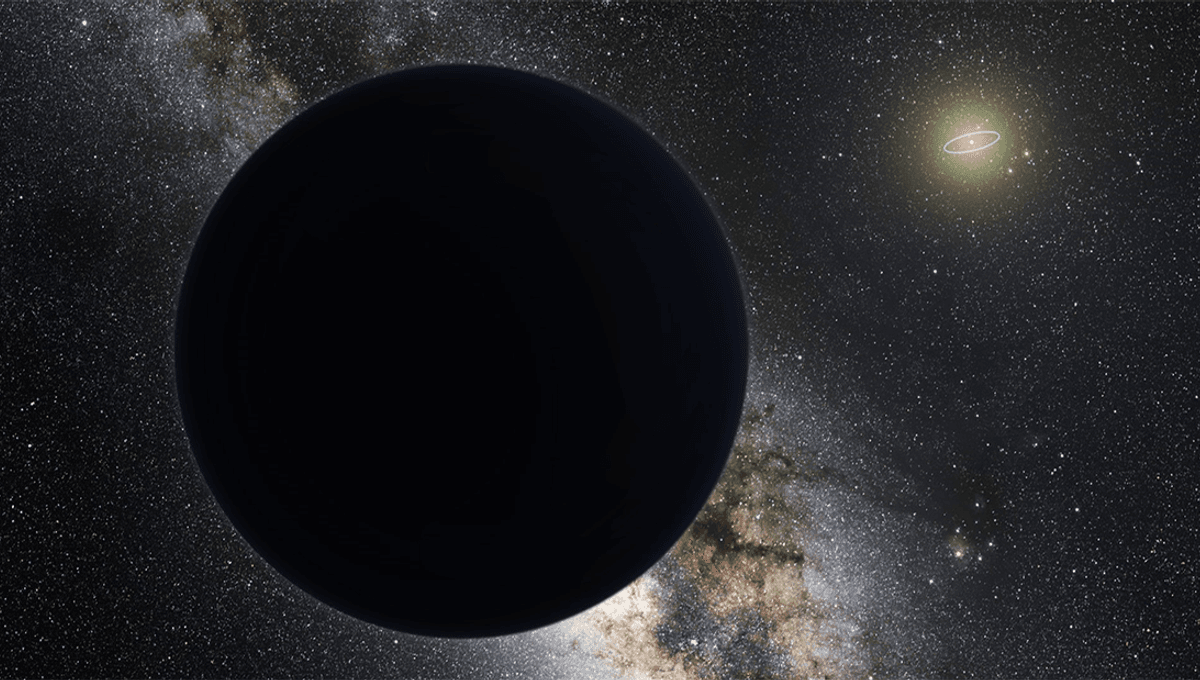
Astronomers have looked back at potential places where the elusive, hypothetical Planet Nine could be hiding, if it exists at all, once again narrowing down where to look.
Looking for planets in orbit around other stars is a relatively easy task, in comparison to hunting for Planet Nine, also known as Planet X. Essentially, when a planet goes past a star we are observing, we see a dip in light. Thousands of exoplanets have been discovered in recent years around other stars using this transit method.
From our perspective, only Venus and Mercury transit our host star, making this method useless for finding planets (and other objects) in our own Solar System, and these two were visible to the naked eye anyway. Saturn, Jupiter, and Mars were also found using the “looking up and seeing a bright object” method.
Uranus was found similarly in 1781 by astronomer William Herschel, after he noticed a bright object had moved compared to other stars in the survey, and took a closer look. But Neptune was discovered by astronomer and mathematician Urbain Le Verrier in 1846 after he noticed there was a difference between the observed orbit of Uranus and the way Newtonian physics predicted its orbit to be. Le Verrier proposed that the difference could be explained by another planet beyond Uranus, and made predictions as to the orbit of this previously unknown body. Looking in that location, German astronomer Johann Gottfried Galle found the planet Neptune.
The reason why people are looking for a mysterious ninth planet at all is because in 2015 two astronomers from Caltech presented evidence that six objects past the orbit of Neptune were bunched together in a way that suggested they were being “herded” by something with a large gravitational pull. Now, the same team has narrowed down where they believe the object – which they say is two to four times the radius of Earth – is. Still, it remains elusive, with suggestions that it could even be just a statistical anomaly and selection bias on behalf of the astronomers from Caltech.
In a new pre-print paper submitted to The Astronomical Journal, the team has used data from the Pan-STARRS1 survey to eliminate 78 percent of the potential places that had been identified by previous research as places to look for the hypothetical planet. While this may sound disappointing – finding a new planet would be great news to all but the most diehard of Pluto fans – it does mean they have narrowed down where to look, if there is a planet to be found.
Areas of particular interest include near the galactic plane, some of which will be covered by the upcoming Vera Rubin Observatory survey. Nevertheless, the team looked at reasons why the planet has not yet been found.
“An obvious possibility, of course, is that Planet Nine does not exist,” the team wrote in their paper. “Such an explanation would require new explanations for multiple phenomena observed in the outer Solar System. Until such explanations are available, we continue to regard Planet Nine as the most likely hypothesis.”
Another option is that Planet Nine is further out and more massive than previously thought, making it more difficult to spot. For now, the team believes that such a planet best explains the orbits of observed objects in the outer Solar System.
“The cluster of the directions of the orbits is the best known, but there is also the large perihelion distances of many objects, the existence of highly inclined and even retrograde objects, and the high abundance of very eccentric orbits which cross inside the orbit of Neptune,” lead author Dr Micheal Brown told Universe Today. “None of these should happen in the Solar System, but all are easily explainable as an effect of Planet Nine.”
The study is available on the pre-print server arXiv.

Source Link: Astronomers Narrow Down Where "Planet Nine" Could Be Hiding
