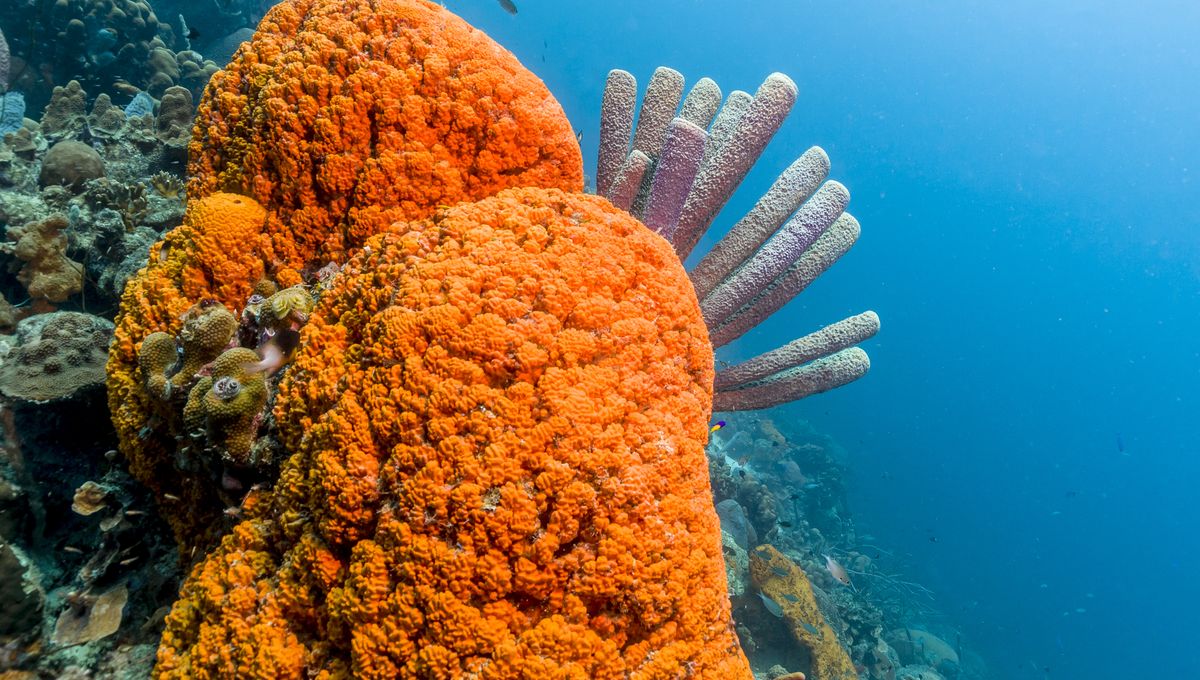
Animal life is a recent addition to Earth, relatively speaking. The planet formed about 4.5 billion years ago, with microbial life likely emerging between 4.3 and 3.7 billion years ago. It was not until several billion years later that animals started to rock up in a humble and vaguely familiar form: sponges.
In a new study, scientists look closely into “chemical fossils” in rocks, indicating that sponges were alive more than 541 million years ago. While older evidence of animal life is out there, their findings suggest ancient sponges emerged much earlier than most multicellular organisms and were possibly one of Earth’s first animals.
The organic compounds in question are special types of steranes, known as 30-carbon (C30) sterols. They are a geologically stable form of sterols, the group of steroids that includes cholesterol, and are found in the cell membranes of complex organisms.
The researchers were able to link these special steranes to a class of sea sponges known as demosponges, strongly suggesting that the “chemical fossils” are traces of early animal life.
“We don’t know exactly what these organisms would have looked like back then, but they absolutely would have lived in the ocean, they would have been soft-bodied, and we presume they didn’t have a silica skeleton,” Roger Summons, study author and the Schlumberger Professor of Geobiology Emeritus in MIT’s Department of Earth, Atmospheric and Planetary Sciences, said in a statement.
Sponges are still around today and, despite appearances, they are animals, not plants or fungi. This is because they are made of multiple types of eukaryotic cells that perform different functions, lack cell walls, and can feed, reproduce, and respond to their environment – key characteristics that separate animals from plants, fungi, bacteria, and other life forms.
They are, however, simple animals, lacking complex organs, tissues, and specialized systems like nervous, digestive, or circulatory systems. They’re essentially a soft, squishy blob of animal cells – but animal cells, nonetheless.
A short time after the sponges first appeared, planet Earth witnessed the unprecedented blossoming of many complex species. Known as the Cambrian explosion, it marks a time when many major animal groups suddenly appeared in the fossil record. Before this, most life consisted of unremarkable blobs and simple structures, but afterward, ecosystems teemed with diverse and complex organisms.
A study in 2009 first suggested that the presence of 30-carbon sterol could be evidence of complex, animal life. However, alternative hypotheses then argued it could possibly be generated by other groups of organisms or by nonliving geological processes.
The latest study strengthens the original case. By analyzing drill cores and rock outcrops from Oman, western India, and Siberia, the team identified sterane signatures that firmly tie the molecules to demosponges.
“You’re not a eukaryote if you don’t have sterols or comparable membrane lipids,” Summons says.
The team went a step further by synthesizing 30-carbon sterol in the lab and showed that it can be created using a distinctive enzyme encoded by the genes of demosponges. All in all, this firmly indicates that the 241-year-old rock does bear evidence of early animal life.
“It’s a combination of what’s in the rock, what’s in the sponge, and what you can make in a chemistry laboratory,” Summons says. “You’ve got three supportive, mutually agreeing lines of evidence, pointing to these sponges being among the earliest animals on Earth.”
The study is published in the journal Proceedings of the National Academy of Sciences.

Source Link: At Least 541 Million Years Old, These Might Be The First Animals To Evolve On Planet Earth
