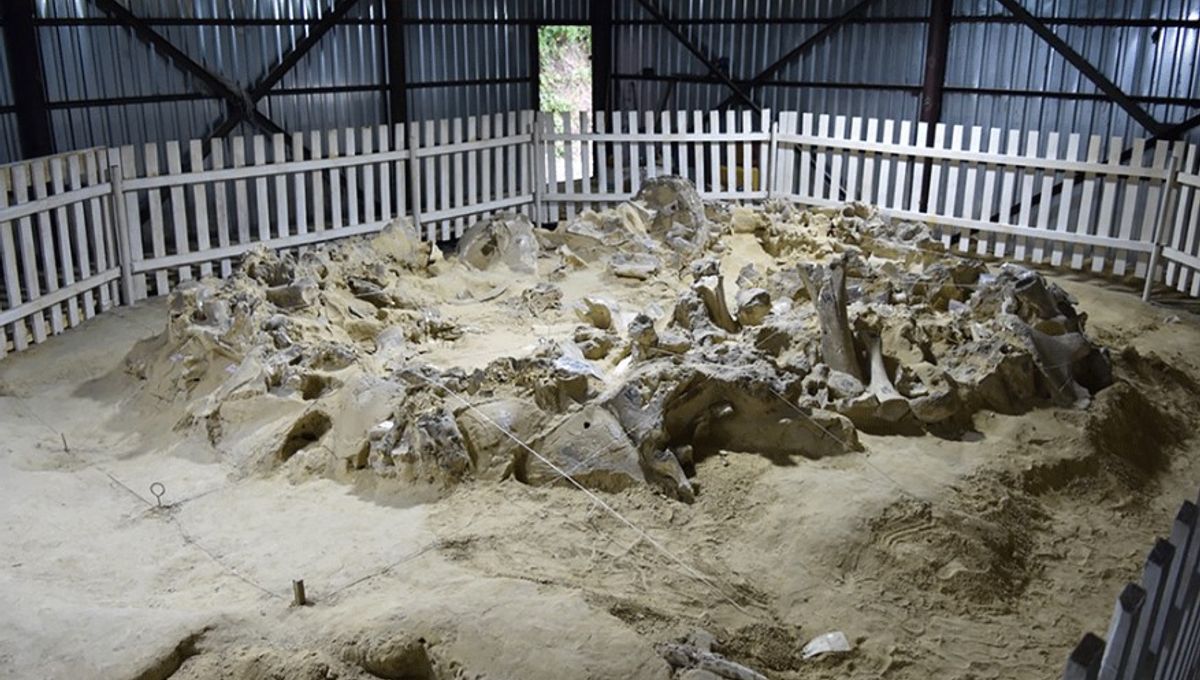
During the Last Glacial Maximum, the materials you chose to build your house out of could make the difference between life and death. And for one group of hunter-gatherers in Ukraine, there really was only one thing for the job – mammoth bones.
The rest of this article is behind a paywall. Please sign in or subscribe to access the full content.
The structures that these prehistoric humans built from the giant mammals’ remains were first excavated in the 1960s at the famous archaeological site of Mezhyrich, in the Cherkasy Oblast region. Here, researchers uncovered four buildings made out of mammoth remains, and while they were initially identified as dwellings, some scholars have suggested that they may actually represent burials, ceremonial sites, bone caches or even religious monuments.
Looking for clues as to the purpose of these osseous structures, scientists have attempted to conduct radiocarbon dating on the mammoth bones. The problem, however, is that these remains are likely to have been scavenged and could therefore be far older than the buildings themselves. As a consequence, the bones have yielded wildly varying ages, ranging from about 19,000 to 12,000 years.
Hoping to provide some clarity, the authors of a new study conducted radiocarbon dating on smaller animal bones that were found in the “cultural layers” associated with the largest structure. In other words, these animals died at the time when the site was in use, and lie in the same sediment layers as the stone tools, hunting weapons and other artifacts that once belonged to the human group that occupied the strange building.
Results suggest that the mammoth bone structure was occupied between 18,248 and 17,764 years ago, placing it slap-bang in the middle of the harshest phase of the Ice Age. What’s more, because the sediment layers containing cultural remains are extremely thin, the study authors suggest that the building was in use for a very short period – possibly for just a few weeks.
It’s unclear how many times the structure was used, and it may have been re-occupied by multiple generations of Ice-Age humans during a period of up to 429 years. On each occasion, these prehistoric communities left behind traces of animal butchery and tool production, strengthening the hypothesis that the mammoth bone structures were indeed residential dwellings.
However, because each occupation was extremely short, the study authors suggest that the buildings may have served as temporary survival shelters rather than long-term abodes.
Exactly which other materials were used to insulate and weather-proof these bone houses is unclear, as are the circumstances that motivated these ancient hunter-gatherers to build and occupy the shelters. However, the new study does at least provide new insights into the survival strategies adopted by prehistoric humans during the bleakest and most challenging period of the Last Ice Age.
The study has been published in the journal Open Research Europe.

Source Link: At The Peak Of The Ice Age, Humans Built Survival Shelters Out Of Mammoth Bones
