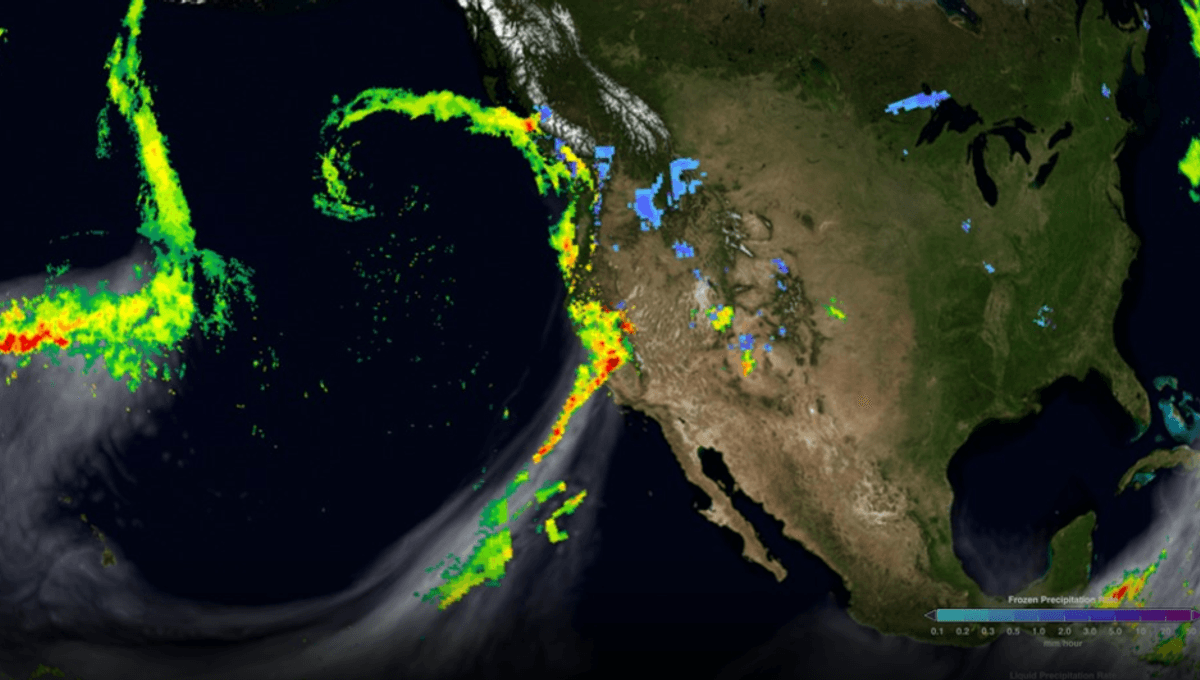
Atmospheric rivers – vast flowing streams of water vapor that flow high up in Earth’s atmosphere – appear to fuel sweaty heatwaves in summer, as well as unseasonable warm weather in the winter, according to a new study.
The phenomenon of atmospheric rivers is closely associated with rainfall because they shift huge amounts of water vapor from the seas to over land where it’s dumped as precipitation. One of the best-known examples is the Pineapple Express, a powerful atmospheric river that often transports moisture from the tropical Pacific near Hawai’i to the West Coast of the United States and Canada, causing downpours of rain.
The impact on moisture and precipitation has been well studied, but scientists at Yale University have now investigated how atmospheric rivers may be associated with heat.
“They’ve been defined up to this point by how much moisture they’re transporting. People knew there was warmth inherent in them, but they cause so much rain that moisture has been the focus,” Serena Scholz, a graduate student at Yale’s Department of Earth and Planetary Sciences and lead study author, said in a statement.
The pair of researchers looked at 40 years of global weather data and compared it to algorithms that track atmospheric rivers. This showed that temperature increases were related to atmospheric rivers on two timescales: hourly spikes of temperature and humid heatwaves that last for at least three days.
“There was no doubt – atmospheric rivers are really impactful for both timescales,” Scholz added.
Atmospheric rivers may influence the heat energy on Earth’s surface in a couple of ways. Firstly, they simply transport the warm air from one region to another. Secondly, the presence of moisture creates a heavy blanket of clouds. Although this blocks out the Sun, it helps to retain heat close to the surface.
The impact of atmospheric rivers on heat is particularly noticeable in winter, a period when atmospheric rivers are most common. In this scenario, their presence tends to be associated with bouts of mild and rainy weather. In the summertime, it has a similar impact that can contribute to extreme heatwaves, characterized by moist air.
“We’re seeing temperature anomalies associated with atmospheric rivers that are 5 to 10 degrees Celsius [9 to 18 degrees Fahrenheit] higher than the climatological mean,” explained Juan Lora, assistant professor of Earth and Planetary Sciences in Yale’s Faculty of Arts and Sciences and co-author of a new study.
“The numbers are astounding,” Lora added.
To be clear, atmospheric rivers are a natural phenomenon that have always been part of Earth’s weather system. In contrast, the recent uptick in global average temperatures plus extreme heatwaves is largely driven by human-induced climate change. While these two forces are distinct, research suggests that warming temperatures from greenhouse gas emissions are making atmospheric rivers larger, more frequent, and more intense.
The study is published in the journal Nature.

Source Link: Atmospheric Rivers Are Influencing Unseasonably Warm Winters And Heatwaves
