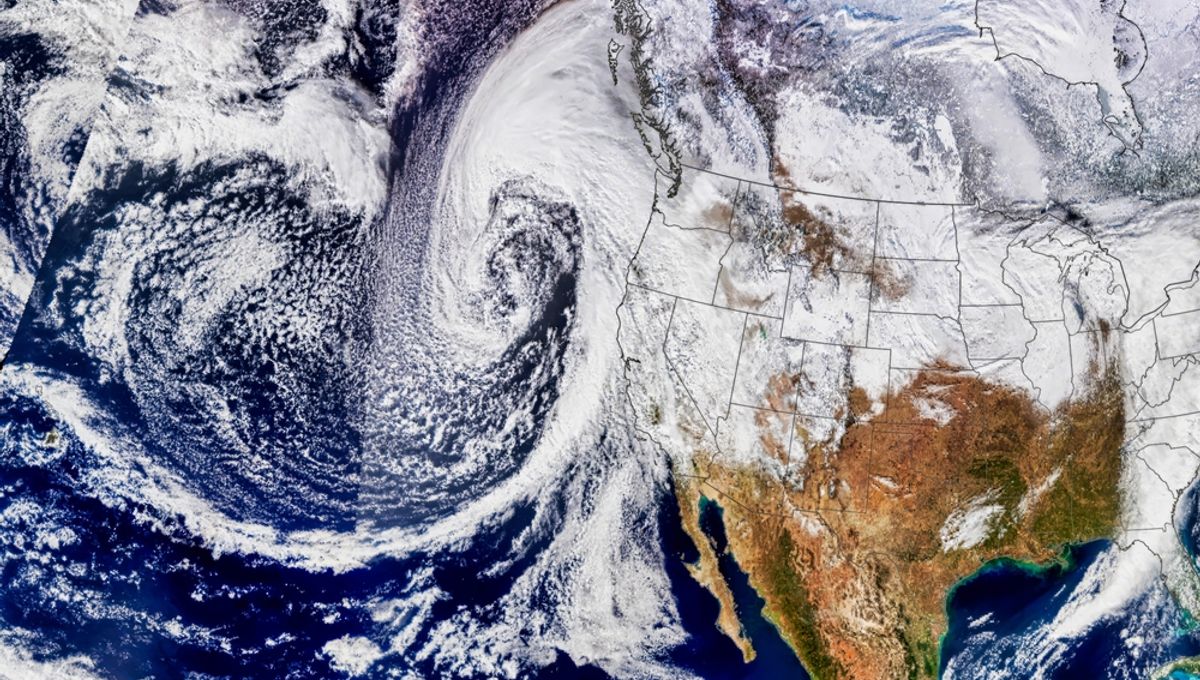
In recent decades, atmospheric rivers that carry water vapor high above Earth’s surface have shifted position, a change that could affect weather patterns and rainfall worldwide.
Scientists at UC Santa Barbara found that atmospheric rivers in both hemispheres have moved approximately 6° to 10° closer to the poles over the past 40 years. This means that the areas affected by atmospheric rivers are farther north in the Northern Hemisphere and farther south in the Southern Hemisphere than they used to be.
The researchers explain that an underlying cause of the shift is cooling in the eastern tropical Pacific over the past four decades, although they note that the chain of events “remains to be fully explored.”
Atmospheric rivers are flowing streams of water vapor in Earth’s atmosphere that have a major impact on levels of rain and snow. They can vary widely in size and intensity, but the average one can convey the same amount of water vapor as the water flow at the mouth of the Mississippi River.
One of the famous is known as the “Pineapple Express“, a strong atmospheric river that delivers moisture from the tropical Pacific around Hawai’i towards the west coast of the US and Canada. When this band of balmy, moist air reaches the West Coast, it can cause significant downpours across California, as well as Oregon, Washington, and British Columbia.
It’s estimated that around 50 percent of the rain and snow on the US West Coast is delivered by atmospheric rivers. However, they aren’t just a North American phenomenon; atmospheric rivers influence the weather and distribute precipitation all over the world.
The recent research indicates that the recent poleward shifts of atmospheric rivers could have a profound effect on the world’s weather systems in the years ahead.
Regions that used to rely on atmospheric rivers for their precipitation could face increased droughts and heatwaves, while regions in higher latitudes are likely to see heavier rainfall, stronger storms, and an increased risk of floods.
For a region like southern California, the northward movement of atmospheric rivers could reduce rainfall even further, leading to more problems with water scarcity, droughts, and wildfires. Meanwhile, regions like the Pacific Northwest might see even wetter weather, unleashing issues like flooding.
However, there are still many unknowns about the wider knock-on effects of the atmospheric rivers moving polewards. For one, it’s likely to bring unforeseen consequences for the world’s oceans.
“Considering the prominent shifts of ARs [atmospheric rivers] over the extratropical ocean, how the ocean responds to these AR-induced changes requires further attention,” the study authors note.
The study was published in the journal Science Advances.
An earlier version of this article was published in 2024.

Source Link: Atmospheric Rivers Have Shifted Toward Earth’s Poles Over The Past 40 Years, Bringing Big Weather Changes
