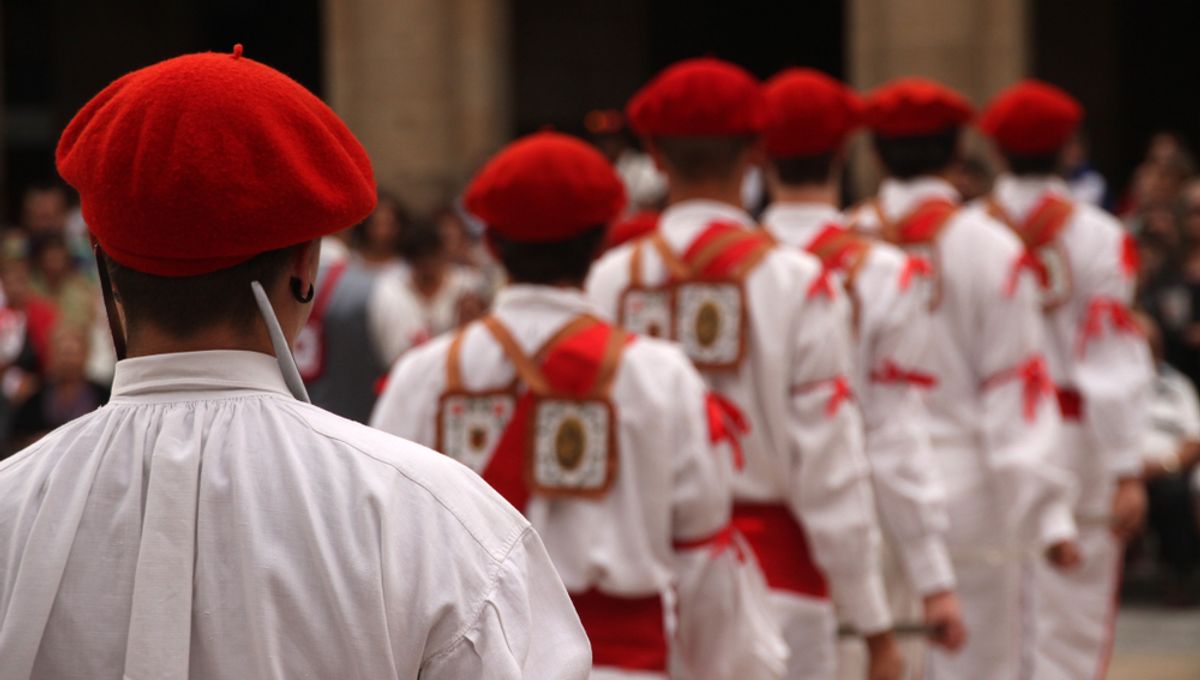
The Basque language is one of the most unique languages still spoken today in Europe. Separated by millennia of evolution, the language is unrelated to any other existing language on the planet, making it a treasure trove for linguists wishing to understand the past.
Also known as Euskara, the language comes from the Basque Country, a region on the western edge of the Pyrenees mountains between the borders of France and Spain.
The exact age of the language is not known, but the oldest written evidence comes from the Hand of Irulegi, a 2,000-year-old hand-shaped bronze charm that’s etched with a Basque word. While it was undoubtedly used as spoken language long, long before this artifact was created, no physical evidence remains.
Out of a population of around 2.1 million in the Basque Country, approximately one-third can speak the language today. However, it’s the mother tongue of just a dwindling few, with the majority of people using Spanish or French in their everyday life. Data suggests that 44 percent of Basque speakers in the Basque Country find it easier to speak in Spanish and that trend is continuing to grow.
Nevertheless, there are active attempts to foster this language to ensure it doesn’t fall into extinction – and for very good reason.
Basque is known as a “language isolate”, meaning it emerged from a completely separate branch of the family tree from every other language currently used on Earth. The overwhelming majority of Europe and significant portions of Asia use Indo-European languages. This includes everything from English and Spanish to Hindu and Russian.
Basque, however, emerged before the time Indo-European languages had conquered much of Europe and somehow managed to survive relatively unchanged. To the average Spanish speaker, it is totally unintelligible.
One theory is that its survival is owed to the mountainous landscape of the Basque region, which made it difficult for outside powers to invade and influence.
The Roman Empire was a significant force that swamped Indo-European languages across the European continent, but Basque prevailed. The language even managed to make it through the reign of 20th-century dictator Francisco Franco, who forbade other languages in a bid to create a strong, unified Spain.
Its survival over the past century is thanks to people setting up secret Basque schools, known as ikastola, hoping to promote the language as an act of resistance against General Franco’s brutal regime. By the 1970s, up to thousands of students had been taught the Basque language via these covert institutions.
Despite ardent Basques striving to keep the language afloat, an increasing number of people are opting to speak Spanish and it’s rare to hear the language on the street. Like many little-spoken tongues, globalization is threatening its existence.
Nevertheless, it seems like resilience and pride are hardcoded into the spirit of the Basque language. If history is anything to go by, it will try its hardest to weather the storm.
“The best scholar in the Basque language, Koldo Mitxelena, used to say, ‘The miracle of Basque is how it has been able to survive’,” Professor Pello Salaburu, director of the Basque Language Institute at the University of the Basque Country in Bilbao, told BBC Travel.

Source Link: Basque: The "Miracle" Of Europe's Most Isolated And Obscure Language
