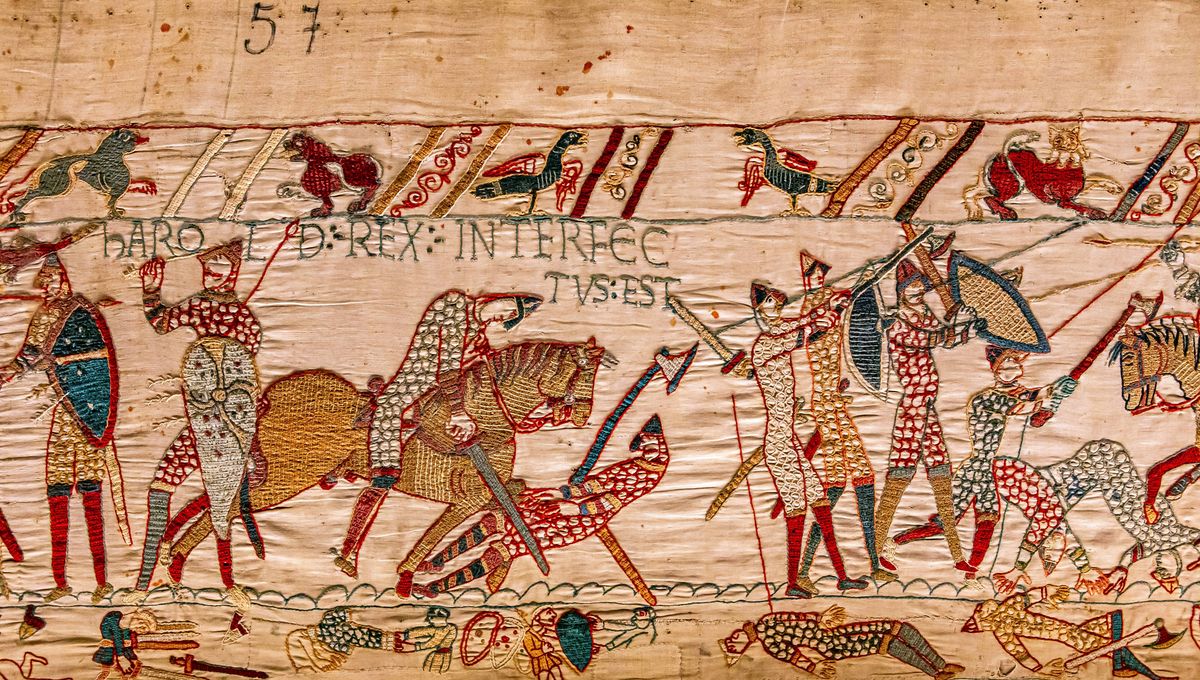
The Bayeux Tapestry, the medieval embroidery depicting the events surrounding the Battle of Hastings in 1066, may have been hung up in the refectory of St Augustine’s Abbey in Canterbury, new research suggests. If this is true, then the famous artifact may have been created as reading material for medieval monks as they ate their meals.
The Tapestry measures about 68 meters (224 feet) in length and weighs around 350 kilograms (772 pounds). It is commonly accepted that the story it depicts is a rather Normandy-friendly version of events that led up to the Norman conquest of England. But despite its historical bias, it remains one of the most detailed visual sources for this period in history.
The narrative itself picks up in 1064, two years before the invasion, and shows Edward the Confessor – the then king of England – instructing his brother-in-law, Harold Godwinson (Harold II), to visit William in Normandy and offer him the succession to the throne. Although other historical sources do not state that Edward promised the throne to William, the Tapestry itself uses this as a launchpad to legitimize his claim.
Following Edward’s death, Harold was chosen as king and took the crown for himself, provoking William to cross the Channel and meet Harold at the Battle of Hastings, where the latter was killed.
The Tapestry is a busy source. It contains around 58 scenes (the ending is missing), 626 characters, 202 horses, various real and imagined animals, examples of Aesop’s fable of the Fox and the Crow, and maybe a few penises.
Despite its fame, the Bayeux Tapestry is not without its mysteries. In particular, no one is sure exactly why it was created and where it was originally displayed. But new research produced by Professor Benjamin Pohl, from the University of Bristol, has offered some new insights that may help address this.
According to Pohl, most scholars now accept that the Tapestry was probably designed at St Augustine’s Abbey in Canterbury, England, during the 1080s. This would mean it was created during the tenure of the first post-Conquest abbot – Scolland – a Norman who had been a monk at the monastery of Mont Saint-Michel, in Normandy.
It is also probable that William’s half-brother Odo, the bishop of Bayeux and later the earl of Kent, was also involved in its creation. However, scholars differ on the nature of his exact role in this story, and there is also disagreement on where the Tapestry was originally displayed before its first appearance in the records of Bayeux Cathedral in 1476, from which it got its name.
“The truth is: we simply do not know where the Bayeux Tapestry was hung – or indeed if it was hung anywhere at all – prior to 1476,” Pohl explains in a statement.
“My article offers a new explanation by arguing that the most suitable place for displaying and engaging with the Bayeux Tapestry would have been in the monastic refectory of St Augustine’s during mealtimes.”
Pohl developed this idea during a seminar with students where they examined the Tapestry and critically reviewed the theories concerning its origins and site of display. Students were encouraged to think up alternative possibilities to those suggested by historians and to consider a range of monastic rooms and buildings that may have been large enough to house the embroidery.
“The more we talked about this, the more I wondered whether a refectory setting could help explain some of the apparent and puzzling contradictions identified in existing scholarship: for example, was the Bayeux Tapestry intended for a religious or a secular audience? Did this audience have to be literate in order to engage fully with the artefact and its narrative? Does it tell an English or a Norman story, or both/neither?” Pohl added.
“Many, and perhaps all, of these conflicts and contradictions can be resolved by embracing the refectory setting proposed in my new article. To be clear: we have no concrete evidence of the Bayeux Tapestry’s presence at St Augustine’s, though this may well be due [to] a combination of circumstances which meant that the abbey’s new refectory designed in the 1080s – perhaps specifically to exhibit the Tapestry – was not completed until the 1120s.”
As a result, the Tapestry may have gone into storage for a generation or more and then forgotten about until it wound up in Bayeux three centuries later.
“There still is no way to prove conclusively the Bayeux Tapestry’s whereabouts prior to 1476, and perhaps there never will be, but the evidence presented here makes the monastic refectory of St Augustine’s a serious contender. Just as today, in the Middle Ages mealtimes were always an important occasion for social gathering, collective reflection, hospitality and entertainment, and the celebration of communal identities. In this context, the Bayeux Tapestry would have found a perfect setting.”
The paper is published in the Historical Review.

Source Link: Bayeux Tapestry May Have Been Mealtime Reading Material For Medieval Monks
