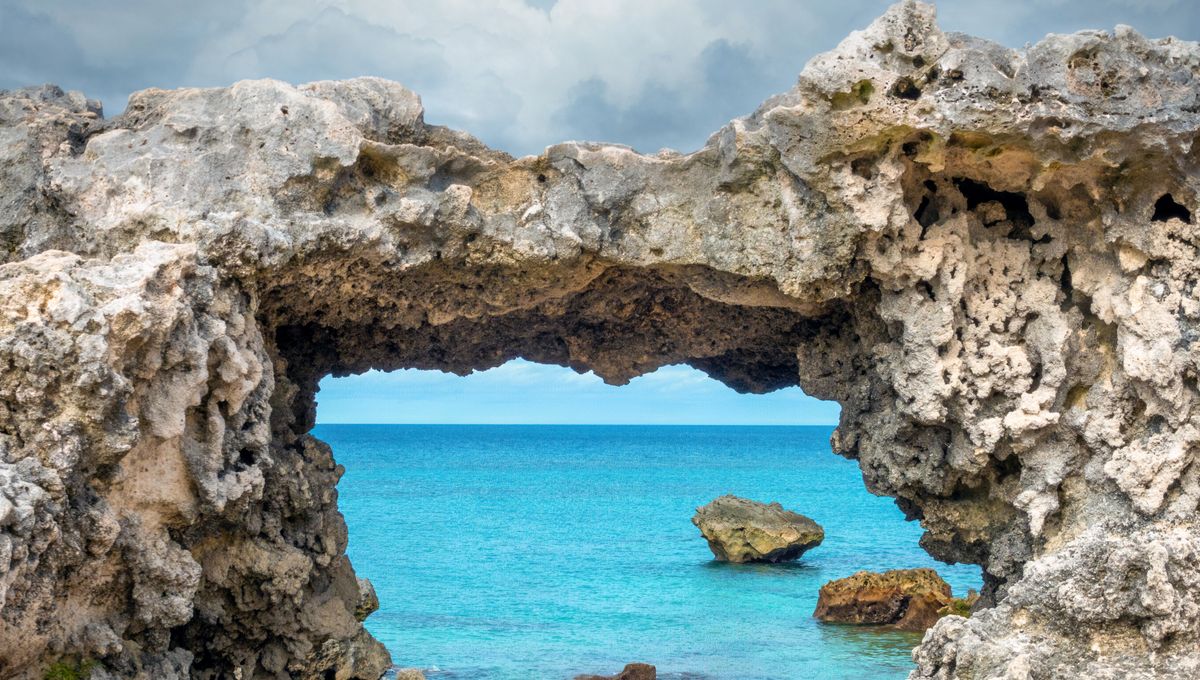
Bermuda is an island remnant of a volcano active 30-35 million years ago. However, it lacks the familiar features of other volcanic islands. Seismic waves reveal a unique structure that two scientists say explains these differences, but the theory of mantle plumes will need to be rewritten to understand how it happens.
When hot plumes rise through the mantle and penetrate oceanic crust, they can produce giant volcanoes in the middle of the ocean, forming islands from their lava. As the migration of tectonic plates shifts the crust compared to the plume, the island stops rising and starts to erode, before a new volcano forms above the hotspot, eventually creating a string of islands.
Bermuda is different. Although composed of 181 islands, Bermuda doesn’t show the same evolution nor any volcanic activity that even geology would call recent. There’s also no sign of a mantle plume that arises from deep within the Earth, such as at familiar chains like Hawaii. However, the passage of waves produced by earthquakes reaching Bermuda offers a clue.
These waves reveal two interfaces, where their speed changes and some waves bounce back, just as light waves do when encountering a boundary between water or glass and air. Such interfaces occur when waves move from one medium into something where they move slowly or quickly, usually signaling a change in density. Dr William Frazer of the Carnegie Institution for Science and Yale’s Professor Jeffrey Park think that in this case, there is a layer that is around 50 kilograms per cubic meter, or about 1.5 percent, less dense than the rest of the upper mantle.
The layer, Frazer and Park report, is around 20 kilometers (12 miles) thick, which is about twice as much as is seen beneath some other islands. They argue that this layer does the job of the usual mantle plume in holding Bermuda up.
Previous attempts to explain Bermuda have proposed that it sits atop a weak thermal plume or is the product of intermittent upwellings from high in the mantle. These have not stacked up well against the evidence we can see.
The authors note that Bermuda “has not significantly subsided since the last major pulse of volcanism,” indicating that whatever is supporting it must be enduring. They used observations of seismic waves from all earthquakes of magnitude at least 5.5 in the Americas and as far east as Central Asia recorded at the Bermuda seismic station.
The data suggests a layer centered beneath Bermuda, whose low density allows it to float within the mantle and put pressure on the crust above, causing it to bend upwards. “Typically, you have the bottom of the oceanic crust and then it would be expected to be the mantle,” Frazer told LiveScience. “But in Bermuda, there is this other layer that is emplaced beneath the crust, within the tectonic plate that Bermuda sits on.”
This would also explain why Bermuda has none of the raised heat flow from the mantle seen at other volcanic islands. The authors suggest the layer stretches 50-100 kilometers (30-60 miles) from Bermuda, with no suggestion that it’s triangle-shaped.
Although a somewhat similar process is thought to support some other islands, such as in French Polynesia, the layers there are probably much thinner, but also less dense.
The work does not explain why such a thick layer of less dense material formed here and, as far as we can tell, nowhere else on Earth. However, the authors offer some possibilities. For example, other studies have indicated Bermuda’s volcanic rocks are unusually high in carbon, possibly because the Atlantic is younger than other oceans; the mantle source might therefore be lighter.
Alternatively, the authors note that elsewhere, forces within the mantle sometimes crack the crust, allowing seawater to react with mantle material, producing chemically distinctive rocks. If the mantle is enriched with the right minerals, that might produce the effects the authors describe.
The study is published in Geophysical Research Letters.

Source Link: Bermuda Sits On A Strange, 20-Kilometer-Thick Structure That's Like No Other In The World
