• Email Us: [email protected]
  • Contact Us: +1 718 874 1545
  • Skip to main content
  • Skip to primary sidebar

Medical Market Report

  • Home
  • All Reports
  • About Us
  • Contact Us

Billion-Year-Old Rocks Could Confirm The Existence Of Dark Matter

November 2, 2024 by Deborah Bloomfield

For all our fancy telescopes and particle accelerators, we still haven’t managed to detect even a smidgen of dark matter. In a dramatic change of course, researchers at Virginia Tech are now taking a staggeringly low-tech approach to the hunt by looking for the elusive stuff in a bunch of old rocks.

While most scientists are pretty convinced that dark matter is indeed a thing, to date we’ve only ever been able to detect it indirectly. For instance, we know that all of the observable mass doesn’t account for the strength of gravity at certain points in the universe, which can only be explained by the presence of some invisible substance lurking all around us.

Advertisement

For decades, physicists have speculated that it may be possible to witness dark matter in action if we can somehow catch it colliding with an atomic nucleus. In such a scenario, a spark of energy is likely to be produced, thus giving us something tangible to work with.

And that’s where the rocks come in. Given that our planet is billions of years old, there’s a high chance that ancient rocks in Earth’s crust have at some point collided with dark matter. Where this has happened, it should be possible to observe nuclei that have been bumped out of place, thus leaving anomalies and imperfections in a mineral’s crystal structure.

Researchers are therefore building a new lab at Virginia Tech’s Robeson Hall where they will use sophisticated imaging techniques to hunt for these miniature trails of destruction left inside old rocks. Explaining the proposed method in a statement, quantum systems expert Vsevolod Ivanov said “we’ll take a crystal that’s been exposed to different particles for millions of years and subtract the distributions that correspond to things we do know.” 

“Whatever is left must be something new, and that could be the dark matter.”

Advertisement

Of course, learning to identify the traces and patterns left behind by other sources of radiation is going to be a major challenge. At present, the team are conducting a series of tests using synthetic lithium fluoride in order to image the particle tracks attributable to cosmic rays, which must be subtracted in order to isolate the echoes of dark matter collisions.

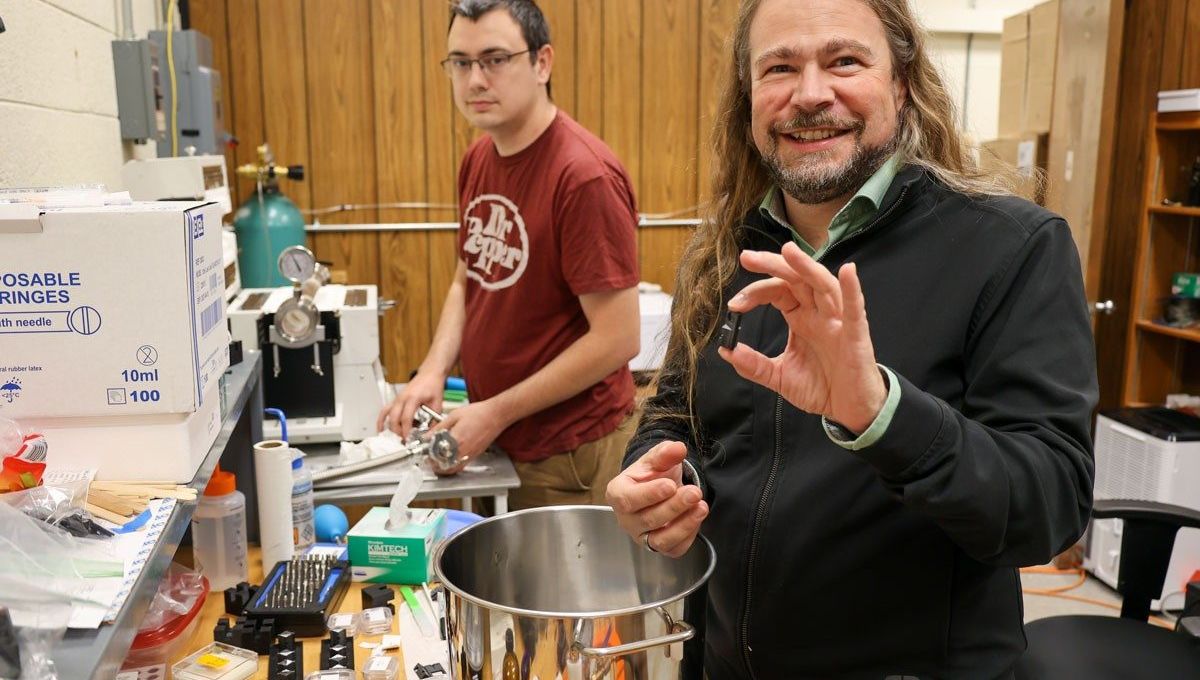
Explaining his motivation for taking on this monumental challenge, project leader Patrick Huber said “it’s crazy. When I first heard about this idea, I was like – this is insane. I want to do it,” 

“Other people in their midlife crisis might take a mistress or get a sports car. I got a lab.”

Deborah Bloomfield
Deborah Bloomfield

Related posts:

  1. Cricket-Manchester test likely to be postponed after India COVID-19 case
  2. EU to attend U.S. trade meeting put in doubt by French anger
  3. Soccer-West Ham win again, Leicester and Napoli falter
  4. Was Jesus A Hallucinogenic Mushroom? One Scholar Certainly Thought So

Source Link: Billion-Year-Old Rocks Could Confirm The Existence Of Dark Matter

Filed Under: News

Primary Sidebar

  • The First Map Of America: Juan De La Cosa’s Strange Map Was Missing Until 1832
  • What’s The Difference Between Buffalo And Bison?
  • 18,000-Year-Old Stalagmite Sheds Light On Why Civilization Started In The Fertile Crescent
  • Enormous Anaconda Fossils Reveal They Got Big 12 Million Years Ago – And Stayed Big
  • Meet The Malaysian Earthtiger Tarantula: Secretive And Stripy With A Leg Span For Days
  • Meet The Thresher Shark, A Goofy Predator That Whips Up Cavitation Bubbles To Stun Prey
  • 18 Asteroids Passed Earth Closer Than The Moon In November – All Of Them Were Discovered That Month
  • 7th Person Cured Of HIV After Stem Cell Donation Offers Hope Of Expanded Treatment Options
  • Humans Weren’t Capable Of “Mass Hunting” Until 50,000 Years Ago – What Changed?
  • ESA Steps Up Earth Monitoring, As NASA And NOAA Missions Face Uncertain Futures
  • Yellowstone’s Wolves And The Controversy Racking Ecologists Right Now
  • A New Universal Principle Behind Fragmentation Predicts Size Of Any Breakup Debris
  • Airbus Just Had To Ground 6,000 Of Its Airplanes – Was A Celestial Threat To Blame?
  • Meet Pumuckel, The World’s Shortest Living Horse (And Probably The Cutest Thing You’ll See This Week)
  • How A 500-Year-Old Inaccurate Bible Is Responsible For The Modern World
  • This Newly Discovered Blood Type Is So Rare, Only 3 People In The World Are Known To Have It
  • The Science Of Magic: Find Out More In Issue 41 Of CURIOUS – Out Now
  • People Sailed To Australia And New Guinea 60,000 years ago
  • How Do Cells Know Their Location And Their Role In The Body?
  • What Are Those Strange Eye “Floaters” You See In Your Vision?
  • Business
  • Health
  • News
  • Science
  • Technology
  • +1 718 874 1545
  • +91 78878 22626
  • [email protected]
Office Address
Prudour Pvt. Ltd. 420 Lexington Avenue Suite 300 New York City, NY 10170.

Powered by Prudour Network

Copyrights © 2025 · Medical Market Report. All Rights Reserved.

Go to mobile version