• Email Us: [email protected]
  • Contact Us: +1 718 874 1545
  • Skip to main content
  • Skip to primary sidebar

Medical Market Report

  • Home
  • All Reports
  • About Us
  • Contact Us

“Black Hole Stars” Might Solve Unexplained JWST Discovery

September 12, 2025 by Deborah Bloomfield

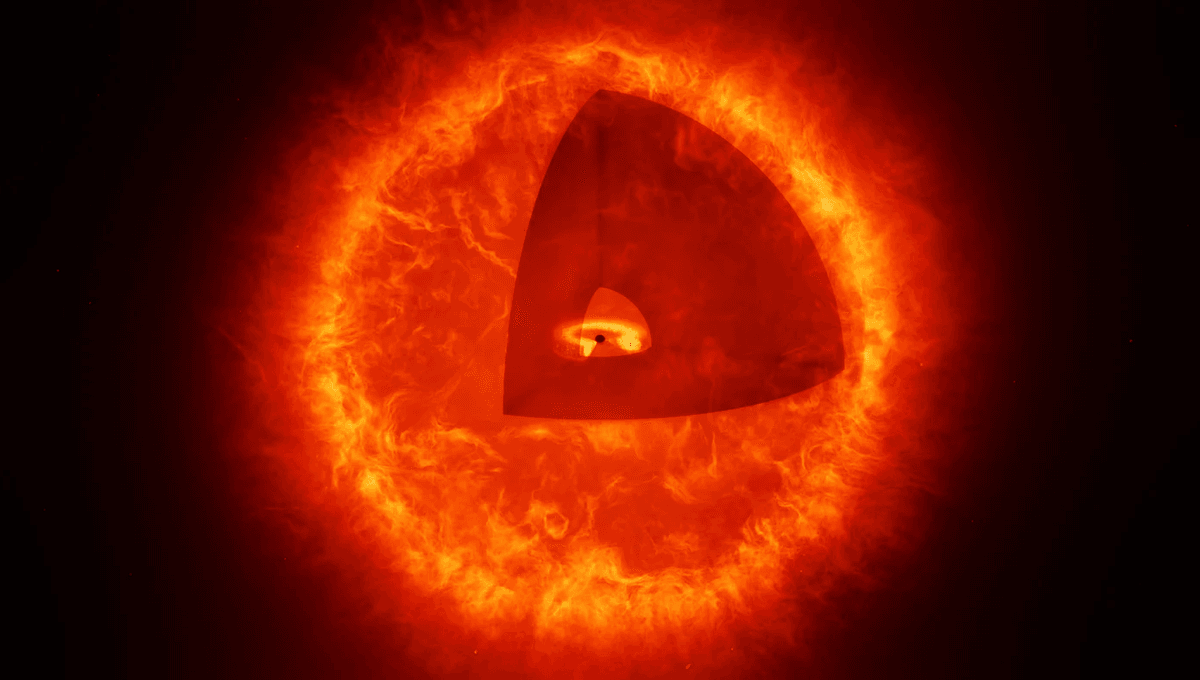
From the early days of JWST’s scientific observations of the distant universe, scientists started noticing a population of curious objects. They are very red, extremely compact, and there are a lot of them. They were nicknamed “Little Red Dots,” and they are so distant that their light had to travel for at least 12 billion years to reach us. Their nature is a mystery, and a new proposal suggests a new object dubbed a “black hole star”.

The rest of this article is behind a paywall. Please sign in or subscribe to access the full content.

The leading explanation is that they are compact young galaxies, with an incredible density of stars and shrouded in dust. That scenario requires a star-formation rate so high that it challenges every model. An alternative would be extremely active supermassive black holes, also shrouded by copious dust. This scenario is also challenging because you would need an enormous black hole to form extremely quickly.

The latter scenario has found some confirmation recently, with the confirmation of the most distant black hole; still, there is one extreme Little Red Dot that defies all explanations. It’s called The Cliff.

The name of the objects comes from a feature in their light spectrum called a Balmer Break, as there is a literal jump in the brightness of their emission due to the electrons in hydrogen being ionized from the second energy level. This is seen in some galaxies that are forming no new stars or in a single very young and very hot star. Surprisingly, The Cliff looks more like a single star than a whole galaxy.

“The extreme properties of The Cliff forced us to go back to the drawing board, and come up with entirely new models,” lead author Dr Anna de Graaff, from the Max Planck Institute for Astronomy, said in a statement.

That’s where the black hole star comes in. That is not really a star, but a supermassive black hole wrapped around a thick layer of violently swirling hydrogen. There is no nuclear fusion, but the hydrogen layer would be shining in a similar way due to the energy happening in the accretion disk surrounding the black hole.

This model could explain what is being seen in The Cliff and also explain how supermassive black holes got so big so quickly. While extremely intriguing, there are many open questions, particularly related to the formation of such an object and its stability.

JWST is planning to study several Little Red Dots, including The Cliff, again next year. These follow-up observations might shed some light on their origin.

The study is published in Astronomy & Astrophysics.

Deborah Bloomfield
Deborah Bloomfield

Related posts:

  1. La Palma volcano spurts again as lava nears the sea
  2. Unlock Adventures Abroad By Learning The Local Language
  3. Turns Out, Tarantulas Hang Out With Lots Of Animal Pals
  4. It Turns Out Bending Ice Produces Electricity, And This Could Finally Explain The Origin Of Lightning

Source Link: “Black Hole Stars” Might Solve Unexplained JWST Discovery

Filed Under: News

Primary Sidebar

  • US Just Killed NASA’s Mars Sample Return Mission – So What Happens Now?
  • Art Sleuths May Have Recovered Traces Of Da Vinci’s DNA From One Of His Drawings
  • Countries With The Most Narcissists Identified By 45,000-Person Study, And The Results Might Surprise You
  • World’s Oldest Poison Arrows Were Used By Hunters 60,000 Years Ago
  • The Real Reason You Shouldn’t Eat (Most) Raw Cookie Dough
  • Antarctic Scientists Have Just Moved The South Pole – Literally
  • “What We Have Is A Very Good Candidate”: Has The Ancestor Of Homo Sapiens Finally Been Found In Africa?
  • Europe’s Missing Ceratopsian Dinosaurs Have Been Found And They’re Quite Diverse
  • Why Don’t Snorers Wake Themselves Up?
  • Endangered “Northern Native Cat” Captured On Camera For The First Time In 80 Years At Australian Sanctuary
  • Watch 25 Years Of A Supernova Expanding Into Space Squeezed Into This 40-Second NASA Video
  • “Diet Stacking” Trend Could Be Seriously Bad For Your Health
  • Meet The Psychedelic Earth Tiger, A Funky Addition To “10 Species To Watch” In 2026
  • The Weird Mystery Of The “Einstein Desert” In The Hunt For Rogue Planets
  • NASA Astronaut Charles Duke Left A Touching Photograph And Message On The Moon In 1972
  • How Multilingual Are You? This New Language Calculator Lets You Find Out In A Minute
  • Europa’s Seabed Might Be Too Quiet For Life: “The Energy Just Doesn’t Seem To Be There”
  • Amoebae: The Microscopic Health Threat Lurking In Our Water Supplies. Are We Taking Them Seriously?
  • The Last Dogs In Antarctica Were Kicked Out In April 1994 By An International Treaty
  • Interstellar Comet 3I/ATLAS Snapped By NASA’s Europa Mission: “We’re Still Scratching Our Heads About Some Of The Things We’re Seeing”
  • Business
  • Health
  • News
  • Science
  • Technology
  • +1 718 874 1545
  • +91 78878 22626
  • [email protected]
Office Address
Prudour Pvt. Ltd. 420 Lexington Avenue Suite 300 New York City, NY 10170.

Powered by Prudour Network

Copyrights © 2026 · Medical Market Report. All Rights Reserved.

Go to mobile version