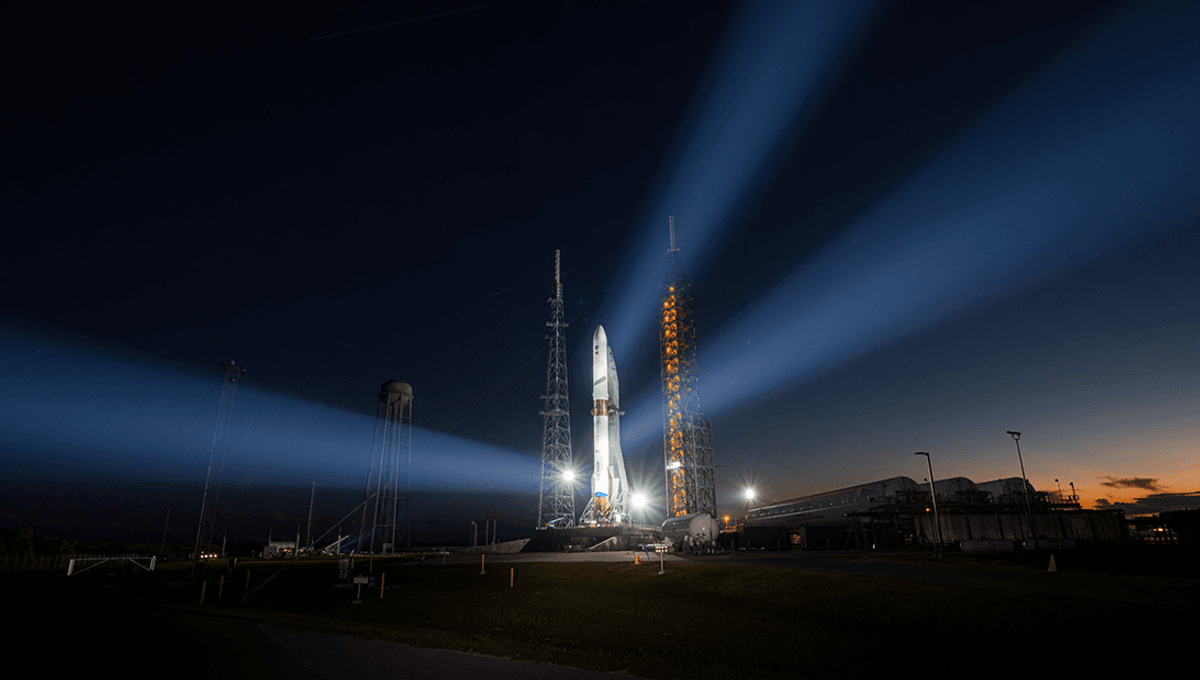
Blue Origin, the private space firm headed by Amazon’s Jeff Bezos, is set to launch its New Glenn rocket on Wednesday, sending two NASA orbiters to Mars.
While traditionally NASA has launched its own spacecraft, satellites, and orbiters into space, since President Ronald Reagan signed the Commercial Space Launch Act of 1984, the space agency has sought and used private space companies to help with the task. SpaceX, led by Elon Musk, has been at the forefront of recent private missions, but Blue Origin has entered the game and will even launch NASA’s VIPER (Volatiles Investigating Polar Exploration Rover) to the lunar south pole in late 2027.
The space firm was set to launch its gigantic New Glenn rocket on Sunday, 9 November, carrying a payload of twin NASA spacecraft, set to study the Red Planet from orbit. The Escape and Plasma Acceleration and Dynamics Explorers (ESCAPADE) project is made up of two probes that will simultaneously study Mars from different locations above it.
“ESCAPADE will analyze how Mars’ magnetic field guides particle flows around the planet, how energy and momentum are transported from the solar wind through the magnetosphere, and what processes control the flow of energy and matter into and out of the Martian atmosphere,” NASA explains, adding that “the observations will reveal the planet’s real-time response to space weather and how the Martian magnetosphere changes over time”.
But unfortunately, on Sunday, good old-fashioned Earth weather put a stop to the launch.
“Today’s NG-2 launch is scrubbed due to weather, specifically the cumulus cloud rule,” Blue Origin explained on X. “We’re reviewing opportunities for our next launch attempt based on forecasted weather.”
Spaceships are robust objects, designed to make their way through our atmosphere at speeds that can burn meteorites to nothing before they hit the ground. So why are launches canceled due to a little light cloud cover? It is not some new Blue Origin rule, as NASA also has some very specific guidance about launching through clouds, including cumulus clouds.
“Do not launch through cumulus type clouds with tops higher than the 41 degree F. temperature level. Launch may occur through clouds with tops as cold as 23 degrees F. if the cloud is not producing precipitation, there is a field mill within 2 nautical miles of the cloud, and this field mill and all field mills within 5 nautical miles of the flight path read between -100 volts per meter and +500 volts per meter for the past 15 minutes,” NASA explains of their launch weather rules, which also disallow launching through anvil clouds, and thick clouds generally.
“Do not launch through or within 5 nautical miles of the nearest edge of cumulus type clouds with tops higher than the 14 degree F level,” they add. “Do not launch through or within 10 nautical miles of the nearest edge of cumulus clouds with tops higher than the -4 degrees F. level.”
The very simple reason is lighting. In short, you do not want your rocket to be struck by it if you are a fan of not exploding. Though a lightning strike is not guaranteed to damage a spacecraft, when you are working with enough fuel to launch a spaceship out of Earth’s gravitational embrace, it’s best to stay on the safe side. Hopefully, NASA’s Mars probes will not be kept from their onward journey for too long.
“Our next launch attempt is no earlier than Wednesday, November 12, due to forecasted weather and sea state conditions,” Blue Origin said in an X update. “We worked with the FAA and range to select a launch window from 2:50 PM – 4:17 PM EST / 19:50 – 21:17 UTC. The live webcast starts at T-20 minutes.”
New Glenn is a partially reusable rocket and this launch will be only its second, after its inaugural launch in January this year. Blue Origin will attempt a vertical landing for its booster, something that SpaceX has achieved in between many explosions.
“New Glenn lifts off from Launch Complex 36. Following separation, the first stage autonomously descends toward Jacklyn, a landing platform located several hundred miles downrange in the Atlantic,” the Blue Origin explains. “Meanwhile, the two BE-3U engines ignite, propelling New Glenn’s second stage into space. The fairing separates and the twin ESCAPADE spacecraft are deployed to begin their journey to Mars. After completion of the mission profile, the second stage will be safed and inerted, which is compliant with NASA’s Orbital Debris Mitigation Standard Practices.”
The launch will be viewable live on the Blue Origin website.

Source Link: Blue Origin Mars Mission Scrubbed Due To "Cumulus Cloud Rule". Why Can't Rockets Fly Through Clouds?
