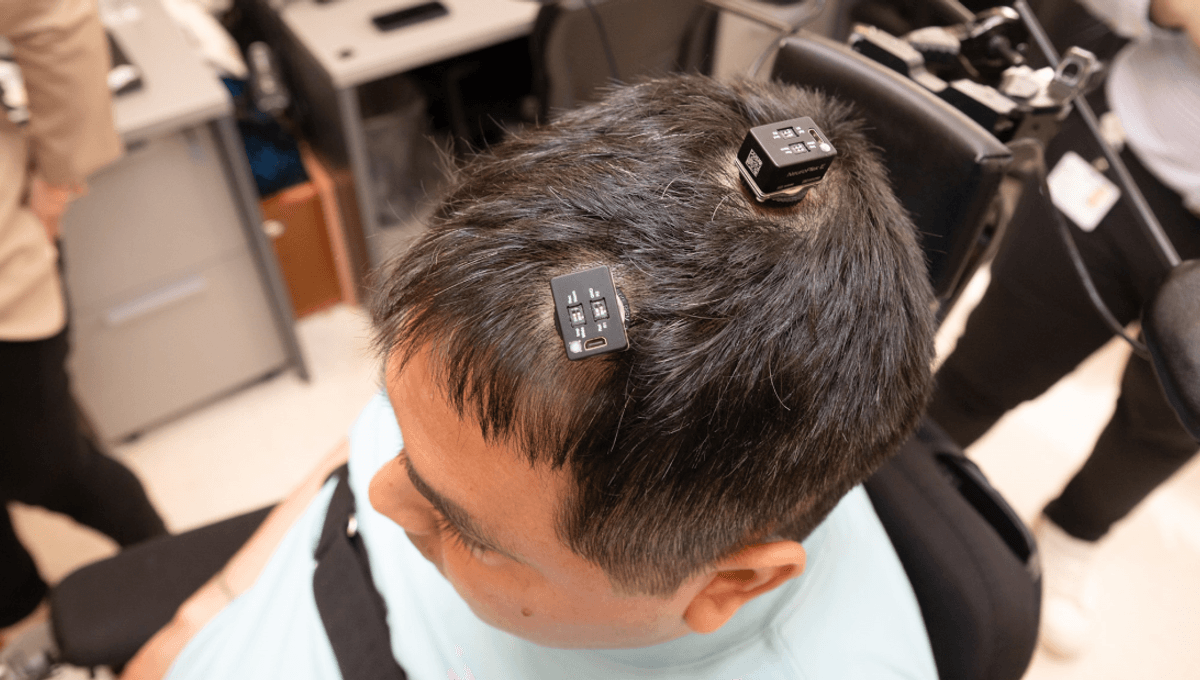
A man with quadriplegia has had partial movement and sensation restored to his hands and wrists following a first-of-its-kind clinical trial that implanted microchips into his brain. The brain implant forms an electronic bridge that uses artificial intelligence (AI) algorithms to translate thoughts into actions, reconnecting the pathway between his brain and body that was severed by injury.
“This is the first time the brain, body and spinal cord have been linked together electronically in a paralyzed human to restore lasting movement and sensation,” said Chad Bouton, professor in the Institute of Bioelectronic Medicine at the Feinstein Institutes, vice president of advanced engineering at Northwell Health, developer of the technology, and principal investigator of the clinical trial, in a statement.
“When the study participant thinks about moving his arm or hand, we ‘supercharge’ his spinal cord and stimulate his brain and muscles to help rebuild connections, provide sensory feedback, and promote recovery. This type of thought-driven therapy is a game-changer. Our goal is to use this technology one day to give people living with paralysis the ability to live fuller, more independent lives.”
Keith Thomas has had quadriplegia since a diving accident in July 2020 that injured the C4 and C5 vertebrae of his spine. Injuries this high up can cause quadriplegia and tetraplegia, patterns of paralysis that affect the hands, arms, torso and legs, bladder and bowel function, and respiratory function. It results in loss of movement and sensation in all four limbs – but now a novel type of brain implant has been able to restore the feeling and control of Thomas’s hands and wrists for the first time since his accident.
“There was a time that I didn’t know if I was even going to live, or if I wanted to, frankly. And now, I can feel the touch of someone holding my hand. It’s overwhelming,” Thomas said. “The only thing I want to do is to help others. That’s always been the thing I’m best at. If this can help someone even more than it’s helped me somewhere down the line, it’s all worth it.”
Installing the implant required a 15-hour open-brain surgery that was successfully completed on March 9, 2023. The double neural bypass effectively acts as an electronic bridge, reconnecting his brain, spinal cord, and body so that information can flow freely.
The implant is made up of five tiny microchips that go directly into the brain, forming a critical portion of a double neural bypass that uses AI to translate thoughts into actions. Its achieved lasting gains for Thomas, who can now move and feel his hands and wrists again without needing to be connected to computers.
In bypassing the injuries of the nervous system, it’s hoped the implant can encourage new neural pathways that can help the body overcome physical injury and even disease using a bioelectric medicine that doesn’t come with the side effects of certain pharmaceuticals.
“Millions of people live with paralysis and loss of feeling, with limited options available to improve their condition,” said Dr Kevin Tracey, president and CEO of the Feinstein Institutes and Karches Family Distinguished Chair in Medical Research. “Prof. Bouton and his team are committed to advancing new bioelectronic technologies and open new clinical paths to restore movement and sensation.”

Source Link: Brain Implant Partially Restores Feeling And Movement In Quadriplegic Man's Hands
