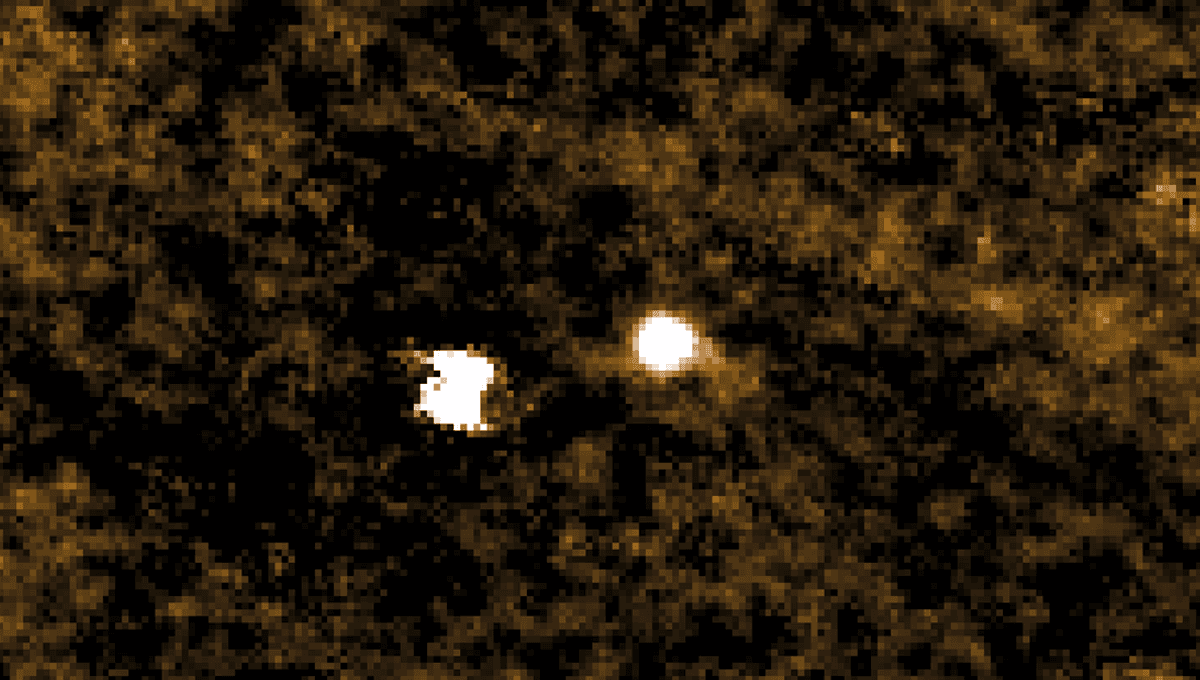
During comet 3I/ATLAS’s closest approach to Earth, the Breakthrough Listen project attempted to search the interstellar visitor for signs of technosignatures, or signs of alien beings sending communications. Meanwhile, another team has taken a look at the non-gravitational acceleration of the object – or the acceleration of the comet that is not due to gravitational interactions alone – attempting to pin down its size.
Let’s start with the briefest of recaps, for anyone who is not aware of the third interstellar visitor humanity has found so far. On July 1, 2025, the Asteroid Terrestrial-impact Last Alert System detected an object moving through our Solar System on an escape trajectory. It was soon determined to be an interstellar object, originating from a different part of the galaxy than our own Solar System comets.
Since then, scientists have attempted to learn more about the object, quickly determined to be a comet due to its classic cometary behavior. Nevertheless, it is an interesting one, being from a different part of the galaxy from our own, and could potentially tell us about the different stellar environment from which it originated. We’re talking about an object older than our Solar System, that may not have had another close encounter for at least 10 million years.
Though the comet has been the subject of much speculation regarding the unlikely hypothesis that it could be an alien spacecraft or probe, the object is thought by astronomers (including Harvard astrophysicist Avi Loeb) to most likely be a natural one. Nevertheless, while it made its closest approach to Earth – still a comfortable 270 million kilometers (168 million miles) away – the Breakthrough Listen project used the opportunity to search the comet for signs of technosignatures, just in case.
“Unlike 1I/‘Oumuamua, 3I/ATLAS exhibits mostly typical cometary characteristics, including a coma and an unelongated nucleus. There is currently no evidence to suggest that ISOs are anything other than natural astrophysical objects. However, given the small number of such objects known (only three to date), and the plausibility of interstellar probes as a technosignature, thorough study is warranted,” the team explains in their new paper, which has not yet been peer reviewed.
“Putative nonanthropogenic interstellar probes are likely to communicate via narrowband radio signals for transmission efficiency and for the low extinction of such signals across interstellar space; all of humanity’s spacecraft, including the now-interstellar craft Voyager 1 and Voyager 2, communicate via such signals.”
While the team knew that communication would be unlikely – there is nothing yet to suggest 3I/ATLAS is anything other than a comet – fans of the “alien probe” hypothesis will be pleased to know that scientists gave it a check anyway, using a radio telescope that is certainly up to the task.
“On December 19, 2025, 3I/ATLAS reached its closest distance to Earth, at 1.7 AU (167 million miles). To obtain optimum sensitivity, we observed 3I/ATLAS with the largest steerable single-dish radio telescope in the world, the 100-meter Green Bank Telescope, less than 24 hours before the closest approach of 3I/ATLAS, on December 18, 2025,” the Search for Extraterrestrial Intelligence (SETI) Institute explained in a statement. “We used four receivers (L, S, C, and X) spanning frequencies of 1 – 12 GHz. At closest approach, the GBT is sensitive to transmitters with an EIRP of approximately 0.1 W, more sensitive than all previous observations.”
Looking at 3I/ATLAS, the team found nine “events” worthy of inspection, but given that the headline of this article isn’t “astronomers found potential alien signatures on interstellar object 3I/ATLAS,” you are probably aware which way this is going.
“Overdensities in frequency correspond to known bands of high radio-frequency interference (RFI) contamination. We visually inspect the nine events and, due to their appearance in the off-target scans and/or congruence to known contaminants, rule out all of them as RFI,” the team writes.
“Similar technosignature searches have recently been undertaken by S. Z. Sheikh et al. (2025) and D. J. Pisano et al. (2025) over different frequency ranges and with different sensitivities,” they added. “Like those searches, we find no credible detections of narrowband radio technosignatures originating from 3I/ATLAS.”
The object is not emitting narrowband signals, as far as our telescopes can tell. For those who would like to take a look at the data, the project has made it available to the public.
Meanwhile, in another preprint paper that is also yet to be peer-reviewed, a different team has attempted to pin down the size of 3I/ATLAS by looking at its non-gravitational acceleration. Though this may sound to non-astronomers like signs of thrust being applied technologically, this is not the case.
“As comets approach the Sun, higher temperatures cause sublimation of volatile ices, which depart the nucleus in the gas phase, carrying dust and ice grains along. Asymmetries in the outgassing impart non-gravitational accelerations (NGAs) on the nucleus via conservation of momentum,” the new paper explains.
“Measurements of NGAs may therefore be combined with estimates of the mass loss rate to constrain the mass of the nucleus. Importantly the acceleration is never measured at a single moment, but inferred from its cumulative effect on the astrometry, whereas mass loss rates are estimated at well-defined points in time.”
Using data from Earth’s telescopes as well as spacecraft far from Earth (the comet was observed from Mars orbiters, and spacecraft on their way to Jupiter), the team found that the size of 3I/ATLAS’s nucleus, or the solid central core of the comet, is consistent with Solar System comets.
“We assess how much mass loss is required to produce plausible non-gravitational acceleration solutions and compare with estimates of the mass loss. We find that they are consistent when the nucleus of 3I/ATLAS is around 1 km in diameter. For a recent solution with a time lag in the acceleration from Eubanks et al, we find diameters between 820 meters and 1050 meters, assuming an outgassing asymmetry factor ζ = 0.5 and a density of the comet nucleus ρ = 0.5 g cm−3,” the team writes in their paper.
“Substantial extrapolation is required in general to compare non-gravitational accelerations to mass loss rates, so reliable estimates of the mass loss rate at other stages of the comet’s trajectory will substantially reduce the systematic uncertainty in this estimate.”
The technosignature search paper is posted to preprint server arXiv. The non-gravitational acceleration paper is also posted to arXiv.

Source Link: Breakthrough Listen Searched Interstellar Object 3I/ATLAS For Technosignatures During Its Closest Approach To Earth
