• Email Us: [email protected]
  • Contact Us: +1 718 874 1545
  • Skip to main content
  • Skip to primary sidebar

Medical Market Report

  • Home
  • All Reports
  • About Us
  • Contact Us

Bumblebees On A Quest Can Share Their Knowledge With Pals

March 7, 2024 by Deborah Bloomfield

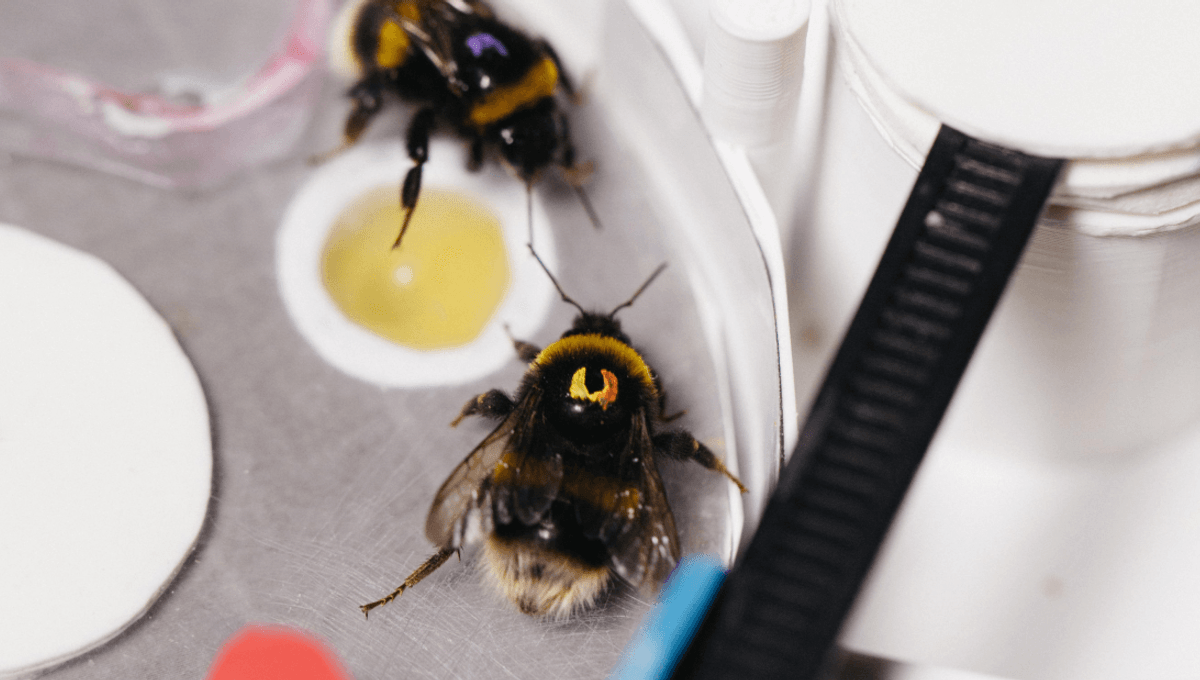
The cumulative acquisition of knowledge through culture was once thought to be unique to humans – but now, new research has shown that it’s a trait that may extend to invertebrates. Sending a bunch of bumblebees on a quest to learn how to reach a reward in a puzzle box has shown that they too can train one another, demonstrating an unprecedented degree of social learning in a non-human species.

The task at hand was a complicated one, chosen specifically because it was something that a bee would never come up with on its own. That meant it had to first be trained how to complete the task by a human, and so bee school was in session.

Advertisement

The bee had to learn how to push a tab out of the way so that it could use a second tab to expose a patch of delicious sucrose reward. It sounds simple to us, but getting a bee to do it is impressive because the first step – moving that pesky tab out of the way – doesn’t result in a reward, which is typically what it takes to get an animal to do something.

Untrained bees weren’t able to solve the puzzle, but those that were trained picked it up after two days. Then, the student became the master as the 15 trained demonstrator bees were paired up with observer bees, who had received no training and hadn’t flown around the puzzle box before.  

Of those 15 observers, five successfully completed the box challenge, receiving their sugary prize with the shifting of a few tabs. Footage shows the first successful attempt, followed by rapturous applause and calls of “well done, bee!”. 

Advertisement

IFLScience doesn’t have a dedicated research site, but if it did, we’d sure like it to be like bee lab. 

The capacity to inherit knowledge and pass it down through a community over time is referred to as culture, something that has not been demonstrated in invertebrates before. This new research therefore raises a lot of interesting questions – as, if bees are capable of spreading knowledge, it’s possible they’re capable of the transmission of culture.

“We used to think that humans were the only species where someone might head out on a quest [and] learn something so complicated that when they bring it back to their village, the others don’t believe it could have come from anywhere but the gods, and [then] pass that on to other generations,” said postdoctoral researcher Alice Bridges.

“It now seems at least plausible that a similar quest is going on in social insects, and that changes everything,” concluded Professor of Sensory and Behavioural Ecology Lars Chittka.

Advertisement

The study is published in the journal Nature.

Deborah Bloomfield
Deborah Bloomfield

Related posts:

  1. Soccer – FIFA backs down on threat to fine Premier clubs who play South American players
  2. U.S. House passes abortion rights bill, outlook poor in Senate
  3. UBS clients raise $650 million for biggest yet biotech impact fund
  4. We’ve Breached Six Of The Nine “Planetary Boundaries” For Sustaining Human Civilization

Source Link: Bumblebees On A Quest Can Share Their Knowledge With Pals

Filed Under: News

Primary Sidebar

  • Why Carl Sagan Was Way Ahead Of His Time And The Legacy He Left Behind
  • Why Were Pompeii Victims All Wearing Thick Woolly Cloaks In August?
  • We May Finally Know What Causes These Bizarre Bright Blue Cosmic Flashes
  • What’s The Biggest Rock In The World?
  • There Is A Very Simple Test To See If You Have Aphantasia
  • Bringing Extinct Animals To Life: Is Artificial Intelligence Helping Or Harming Palaeoart?
  • This Brilliant Map Has 3D Models Of Nearly Every Single Building In The World – All 2.75 Billion Of Them
  • These Hognose Snakes Have The Most Dramatic Defense Technique You’ve Ever Seen
  • Titan, Saturn’s Biggest Moon, Might Not Have A Secret Ocean After All
  • The World’s Oldest Individual Animal Was Born In 1499 CE. In 2006, Humans Accidentally Killed It.
  • What Is Glaze Ice? The Strange (And Deadly) Frozen Phenomenon That Locks Plants Inside Icicles
  • Has Anyone Ever Actually Been Swallowed By A Whale?
  • First-Known Instance Of Bees Laying Eggs In Fossilized Tooth Sockets Discovered In 20,000-Year-Old Bones
  • Polar Bear Mom Adopts Cub – Only The 13th Known Case Of Adoption In 45 Years Of Study At Hudson Bay
  • The Longest-Running Evolution Experiment Has Been Going For 80,000 Generations
  • From Shrink Rays And Simulated Universes To Medical Mishaps And More: The Stories That Made The Vault In 2025
  • Fastest Cretaceous Theropod Yet Discovered In 120-Million-Year-Old Dinosaur Trackway
  • What’s The Moon Made Of?
  • First Hubble View Of The Crab Nebula In 24 Years Is A Thing Of Beauty… With Mysterious “Knots”
  • “Orbital House Of Cards”: One Solar Storm And 2.8 Days Could End In Disaster For Earth And Its Satellites
  • Business
  • Health
  • News
  • Science
  • Technology
  • +1 718 874 1545
  • +91 78878 22626
  • [email protected]
Office Address
Prudour Pvt. Ltd. 420 Lexington Avenue Suite 300 New York City, NY 10170.

Powered by Prudour Network

Copyrights © 2025 · Medical Market Report. All Rights Reserved.

Go to mobile version