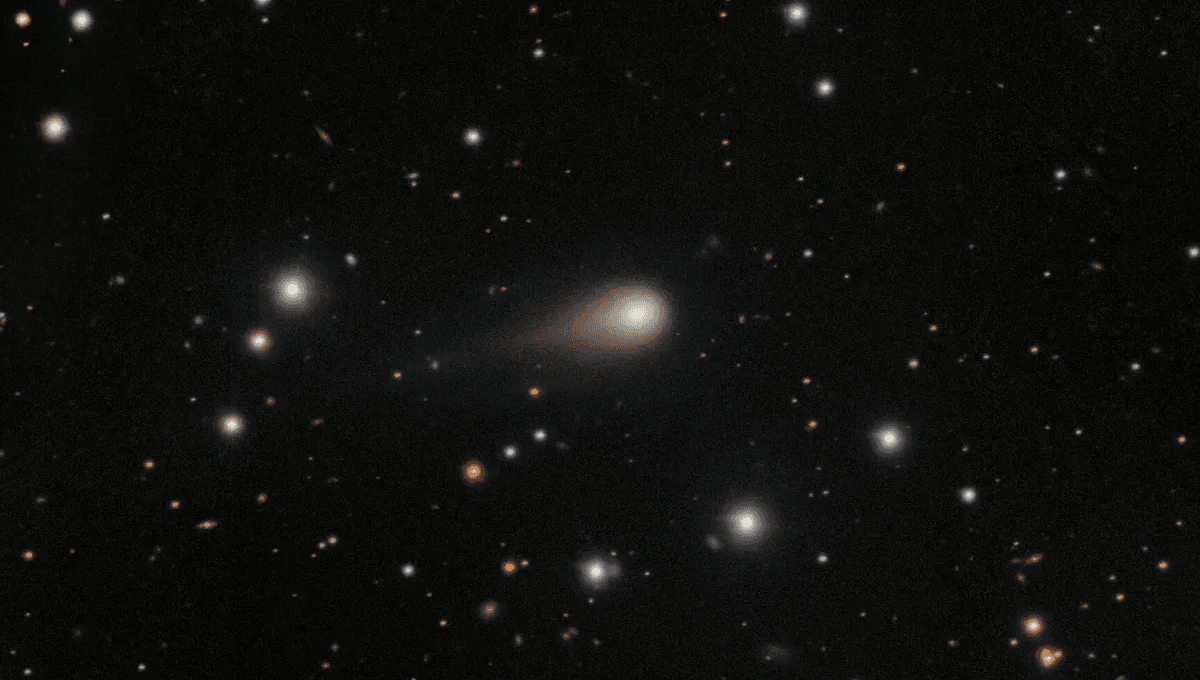
Our third known interstellar visitor, comet 3I/ATLAS, will reach its closest point to Earth today, December 19. It will still be pretty far away, at 270 million kilometers (168 million miles) away, but despite being almost twice the Earth-Sun distance, it’s the closest it will ever get to Earth as it continues its journey through the Solar System, which makes today a good time to put in the effort to see this incredible object.
The rest of this article is behind a paywall. Please sign in or subscribe to access the full content.
The comet had its closest passage to the Sun in late October, reaching its peak brightness around then, and then it was on the other side of the Sun from the Earth’s point of view until November. Now, as our planet is moving closer to it, with all eyes on the ground and in the skies on it, the comet is setting off for its journey out of the Solar System.
At no point was the comet ever going to give a spectacle like Hale-Bopp, the Great Comet of 1997, but it is bright enough to be seen at home with a telescope. At the current magnitude of 11.2, it’s a little fuzzy dot, there in the sky, just a little too faint for most binoculars.
So, when, where, and how to find it?
How to find Comet 3I/ATLAS in the sky
Finding Comet 3I/ATLAS in the sky is not difficult. It rises after midnight and is visible throughout the night, getting quite high above the horizon. The comet can be found very near the star Rho Leonis in the constellation of Leo the Lion, right on the ecliptic line. It will be not too far from Regulus, also known as Alpha Leonis, the brightest star in the constellation and one that you can’t miss. If you look with a telescope at Regulus, you’ll discover underneath what looks like a second star, not visible to the naked eye.
There is also another reason that today and the next few days are ideal for this observation. There is a new Moon! Our natural satellite is on the sunny side of the Earth, with no moonlight to drown out the comet and make the observations more difficult.
If you are unsure about the location of Leo, do not worry. You can use a stargazing app (such as SkySafari, Stellarium, or Sky Tonight) or websites such as SkyLive to work out where you should be pointing your telescope.
See The Interstellar Comet Online
If clouds or something else is stopping you from seeing the comet, worry not: there are other options. Many major observatories and spacecraft will be following and snapping images of the comet. You can also follow along with our friends at The Virtual Telescope Project, who are planning a livestream this weekend, starting on December 20 at 4 am UTC (Dec 19 at 11 pm EST).
If the weather improves where you are next week, the comet will still be visible. It is getting fainter and fainter as it continues to move away from the Sun and, from tomorrow, away from us. Act now if you want to catch it!

Source Link: Can I See Comet 3I/ATLAS From Earth During Its Closest Approach Today? Yes, Here’s How
