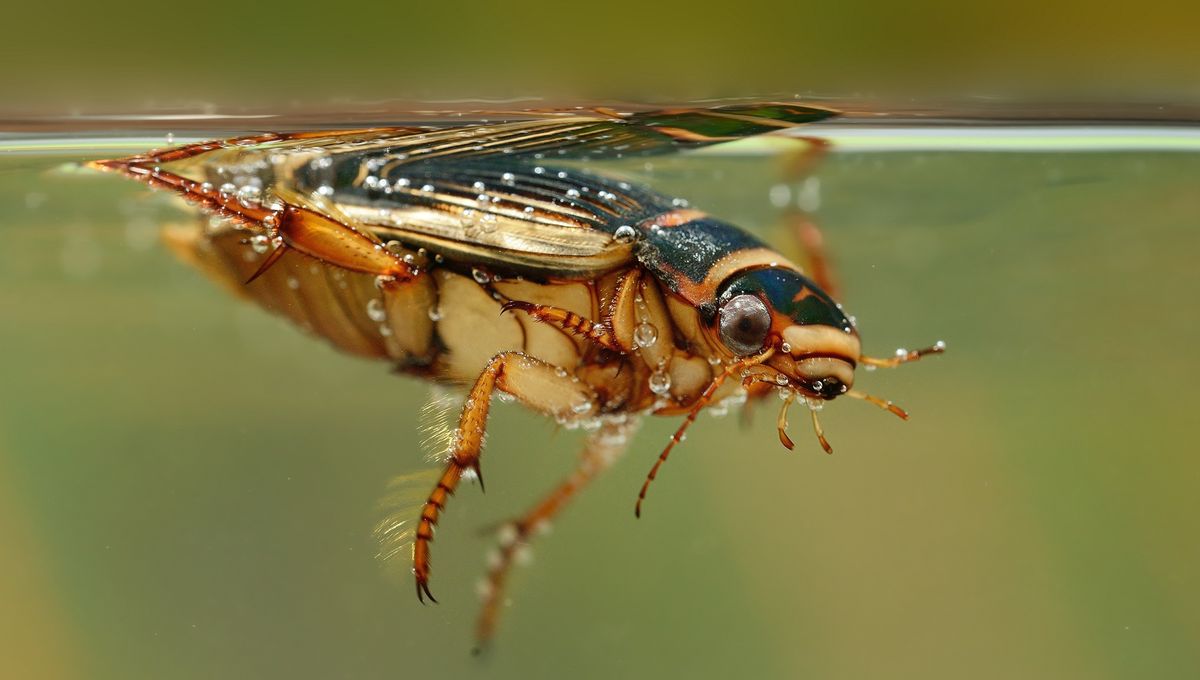
If you’ve ever witnessed a spider climb out of your bathtub drain or chucked a particularly creepy crawly down the toilet in a moment of panic, you may have wondered if insects are capable of surviving these watery ordeals.
The answer is that – thankfully for some, unfortunately for others – many insects are pretty great at staying alive even after long periods completely submerged. While all insects are different, and some are better at withstanding submersion than others, species like bumblebees have been observed proverbially holding their breath for up to a week!
A study published in April 2024, which was inspired by an experimental oversight that almost drowned a bumblebee queen population, found that 81 percent of the common eastern bumble bee (Bombus impatiens) sample were able to survive unscathed after being entirely submerged in water for seven full days.
While the study has its ethical criticisms, what was being replicated happens naturally to these insects, which is why they’ve adapted to withstand it so well. Bumblebee species typically nest in the ground in earthy burrows that are especially susceptible to flooding.
The queen honeybee’s special adaptation means she can remain in her burrow to overwinter even when the risk of heavy rainfall is high. This remarkable ability has been observed in a number of species that inhabit areas that experience seasonal flooding, as well as being an adaptational advantage for any burrowing species that has to withstand low oxygen levels while underground.
A 2006 paper observing the migration behaviors of insects in European river floodplains found that 70 percent of plant and leafhopper species overwintered in the floodplain and withstood submersion. However, the majority of spiders and ground beetles in the area chose to migrate away from the floodplains, as did the larval forms of many species, indicating their submersion abilities are less robust.
So, what makes these insects so skilled at withstanding submersion and staying put in low-oxygen burrows? It all comes down to how insects breathe.
How do insects breathe?
Mammals, birds, and reptiles all respire through a combined respiratory and circulatory system, whereby oxygen is inhaled into the lungs and moves into the blood, which then delivers the oxygen to the tissues and muscles throughout the body.
Insects, on the other hand, don’t have any lungs; in fact, their respiratory and circulatory systems are entirely separate. Instead of inhaling oxygen through the mouth or nostrils, insects breathe through openings called spiracles found in the thorax and abdomen. A network of tracheae throughout the insect’s body then transports and exchanges oxygen and carbon dioxide.
However, similarly to humans, more active insects, like those able to fly, need to breathe in more oxygen than species that live more sedentary lives. They also, like humans, release carbon dioxide as a waste product.
These respiratory differences make insects highly efficient at using the oxygen they take in. In proportion to their bodies, insects can breathe in far more oxygen than humans, and can also perform discontinuous gas exchange by opening and closing their spiracles.
Discontinuous gas exchange is a cycle of opening, closing, and “fluttering” spiracle phases that allows insects to essentially recycle the oxygen in the tracheae, effectively eliminating the need to take in fresh oxygen for extended periods of time.
This is the key mechanism behind their ability to survive in low-oxygen environments and to emerge unscathed after being completely submerged in water.
While this peculiar respiratory mechanism has its advantages, it’s also thought the be one of the reasons insects’ size is dependent on the availability of oxygen in the environment. The bigger the insect, the longer the internal tracheae, so larger insects need a more oxygen-rich environment to be able to take in enough of it to reach the very end of the blind-ended tracheae.
So, will a spider survive an impromptu journey around the U-bend? Maybe, but probably best to gently place it outside instead.

Source Link: Can Insects Drown – And How Do They Breathe Anyway?
